Meteors, supermoons, a comet: a guide to the southern sky in 2024

hero media
What exciting events will we see in the southern sky in 2024? Meteor showers, Saturn covered by the Moon, close approaches of bright planets to each other, supermoons – and, if we’re lucky, a comet visible to the naked eye.

Even if you live in a city surrounded by light pollution, these are all worth looking out for. Here are some of the highlights.

May – the Eta Aquarid meteors

The first of the two main Southern Hemisphere meteor showers during the year is the Eta Aquariid or Eta Aquarid shower. It’s named after a star in the constellation of Aquarius, the Water Carrier, as the meteors appear to originate from there.

Meteors are small particles hitting Earth’s atmosphere and creating a streak of light as they burn up. A meteor shower occurs when many particles hit, all coming from the same direction.

They are generally due to Earth passing through a stream of dust left behind by a comet. For the Eta Aquariids, the comet is the famous Halley’s Comet, which was first recorded more than 2,000 years ago.

In 2024, there will be a good opportunity to see them in the early mornings of Monday 6 and Tuesday 7 May, as the Moon will not be brightening the sky.

December – the Geminid meteors

The second of the two main meteor showers is the Geminid shower . This originates in the direction of the constellation of Gemini, the Twins.

Unusually, they are associated not with a comet but with a rocky asteroid named Phaeton. In 2024, they are likely to be best seen early on the morning of Saturday 14 December.

The peak time to view is during the short interval between the setting of the Moon and the start of dawn.

March, June and August – the planets

Celestial objects approaching one another in the sky can provide a nice view. On the evening of Friday 22 March, the brightest planet Venus is less than the width of the Moon away from the ringed planet Saturn. Look low down in the east.

For people in the eastern part of Australia, the Moon covers the planet Saturn low in the eastern sky on the night of Thursday 27 June. The event can be seen by eye, but binoculars or a small telescope would help.

It is safe to take images or video. From Sydney, Saturn disappears at the bright edge of the Moon at 10:55pm and reappears at its dark edge at 11:41pm. The times for Brisbane, Canberra and Melbourne are similar.
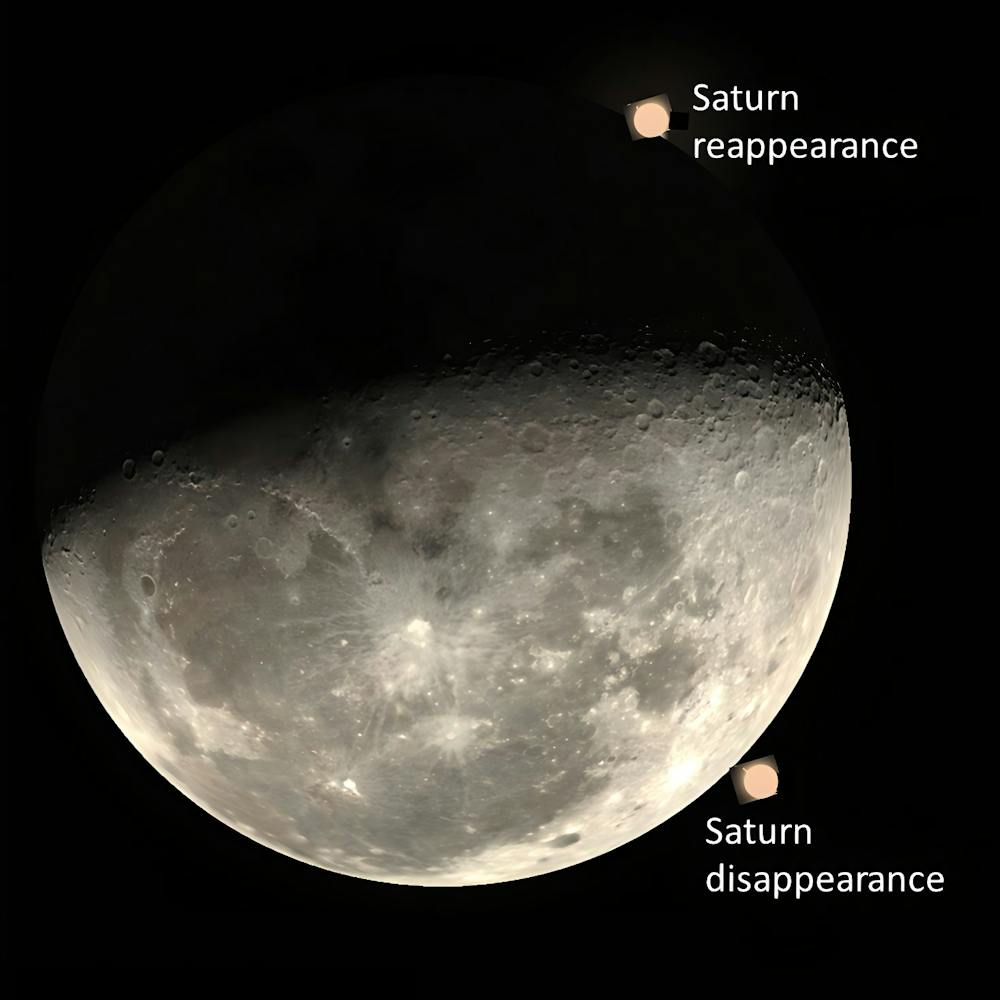
Diagram showing Saturn disappearing behind the Moon and later reappearing.

The occultation or covering of Saturn on Thursday 27 June 2024. (Image: Nick Lomb / Stellarium)

Another close approach is in the early morning of Thursday 15 August, when the red planet Mars is less than a Moon-width from the giant planet Jupiter.

September and October – supermoons

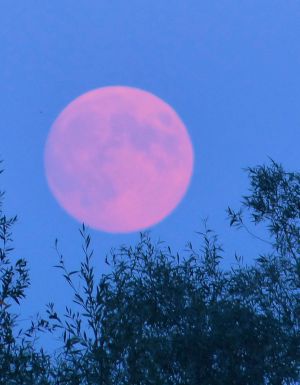
There will be two supermoons during 2024. The Moon has a path that sometimes takes it further from Earth and sometimes closer.

Recently, a time when the full Moon coincides with the Moon at its closest point to Earth has become known as a supermoon. At this time the Moon is slightly larger in the sky than usual.

It’s best to look at moonrise, as an illusion in our brains makes the Moon appear larger when it’s near the horizon. The supermoons in 2024 are on Wednesday 18 September and Thursday 17 October.

October – Comet C/2023 A3 (Tsuchinshan-ATLAS)

Comets visible to the naked eye are rare and exciting events. A comet with the impressive name of Comet C/2023 A3 (Tsuchinshan-ATLAS) , discovered in January 2023, is approaching the Sun and Earth, and may become bright enough to be easily seen. As yet, it is unknown whether this will happen – comets are notoriously fickle.

At a distance of 71 million kilometres, the comet will be closest to Earth on Sunday 13 October. However, for the next six days a bright Moon will make sighting it unlikely.

By Saturday 19 October, the Moon will have moved out of the way. That evening and the following few evenings will give us the best chance to see it. Look low in the west.

January and May – constellations

Not only these highlighted events can be seen in the sky. There are star pictures or constellations that still stand out in the sky of bright cities.

Orion, the Hunter , is a favourite Southern Hemisphere summer constellation, high in the northern sky on January evenings. It consists of four bright stars in a rectangle with a line of three stars, representing Orion’s belt, in the middle.
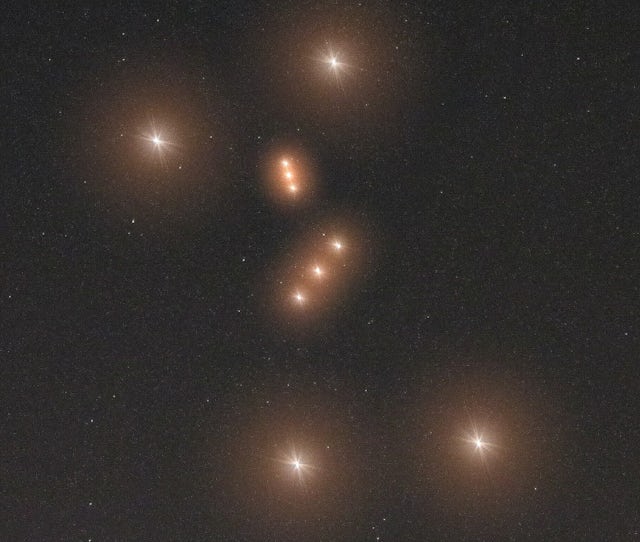
A photo of the constellation Orion.

The constellation Orion is named for a hunter from Greek myth. (Image: Nick Lomb)

According to Greek legend, Orion was a great hunter who vowed to kill all animals. To stop him carrying out his threat, one of the gods sent a scorpion to kill him. This ancient story with Scorpius, the Scorpion chasing Orion takes place above our heads each night.
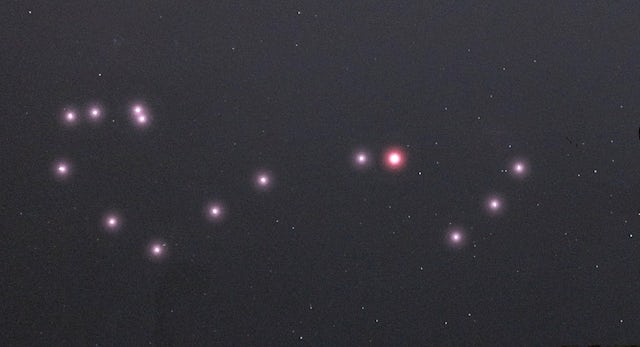
A photo of the constellation Scorpius.

The constellation Scorpius is named for its resemblance to a scorpion. (Image: Nick Lomb)

Scorpius is another spectacular constellation with a curved line of bright stars, with a red star forming the creature’s heart. In January, people who are up at around 3 am can see Scorpius rising in the east, while its quarry Orion is sinking in the west. Alternatively, if you don’t like early mornings you can see the same scene on May evenings after dusk.

The information in this article is from the 2024 Australasian Sky Guide . The guide contains monthly star maps and has much more information to assist with viewing and enjoying the night sky from Australia and New Zealand.The Conversation

This article is republished from The Conversation , the world’s leading publisher of research-based news and analysis. It was written by: Nick Lomb University of Southern Queensland .
Nick Lomb
I have had a variety of research directions over my career. During my PhD project on short period variable stars, I developed the theory of least squares frequency analysis for unequally spaced data. This is now a standard method of numerical analysis, called the Lomb or Lomb-Scargle Periodogram, that is used in astronomy and other fields. Later at Sydney Observatory, the focus was on astrometry, that is, the positions and motions of stars and solar system objects. This work culminated in the publication of a star catalogue, of which I was co-author. Then, when the Observatory came under the auspices of the Museum of Applied Arts and Sciences, I became the Museum’s Curator of Astronomy. As such, I planned exhibitions and collected and looked after instruments and other items relating to astronomy. I was also involved with the media and with public education and outreach. On leaving the Observatory and the Museum, my research emphasis became the history of Australian astronomy, with my latest book, with Toner Stevenson, 'Eclipse Chasers', to be released in March 2023. As well, I continue to prepare the annual Australasian Sky Guide for Powerhouse Publishing and maintain my interest in combatting light pollution.
See all articles
hero media

8 experiences that prove The Bellarine is the ultimate multi-gen getaway

No matter your age and no matter your interests, Victoria’s coastal Bellarine region makes for a memorable getaway for the whole family.

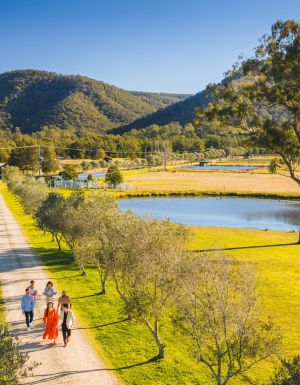
Curving into Port Phillip Bay and extending south from Geelong, The Bellarine is a gorgeous coast-meets-country destination. It’s a captivating mix of beachside towns, rolling farms and vineyards, effortlessly cool eating and drinking spots and coastal vistas that seem to stretch beyond the horizon.

Among its many highlights is a plethora of family-friendly activities to suit all ages and all interests. Here’s your guide to the ultimate Bellarine getaway guaranteed to keep every generation happy.

1. Tuckerberry Hill Farm

Tuckerberry Hill Farm
Pick your own fruit at Tuckerberry Hill Farm.

There may be no better way to spend an early morning than by foraging and feasting on your own bounty of berries. At Tuckerberry Hill Farm , you can pick blueberries, strawberries and stone fruit from November through March. Take them home or enjoy on the farm’s sun-dappled grounds.

Tuckerberry also has a regular market selling farm-fresh produce, plus an inviting on-site cafe doing light lunches, drinks, home-baked treats and condiments – many of which incorporate the farm’s own harvest.

2. The Oxley Estate

The Oxley Estate
Wake up to the neighbours.

A memorable holiday starts with a memorable place to stay, and The Oxley Estate delivers. Situated in the relaxed coastal town of Portarlington, the sprawling site offers thoughtfully styled rooms and activities that’ll keep both parents and kids entertained.

Wander the fragrant rose gardens, olive grove and fruit-laden orchards. Meet the resident alpacas, donkeys, goats, sheep, chickens and ducks. Challenge your crew to a round of giant chess or mini golf. Or cool off in the shimmering saltwater pool after a busy day of exploring.

Different room types cater to different groups, with the largest able to comfortably sleep eight.

3. Oneday Estate

Oneday Estate
Taste small batch wines at Oneday Estate.

Oneday Estate is a must-visit. The winery lets you try small-batch, estate-grown shiraz, pinot noir and riesling. It’s also a vibrant and character-filled Sunday lunch spot.

The on-site eatery and bar hosts weekly Sunday Sessions accompanied by tunes from local musicians, a buzzy atmosphere and flavour-packed food and drink. Order a round of delicious woodfired pizzas with toppings to suit all tastes, alongside a glass of Oneday’s signature wine.

The restaurant is also a sight to behold, an eclectic stone-and-timber hall crafted from recycled materials and 100-year-old relics repurposed from the surrounding region.

4. BIG4 Ingenia Holidays Queenscliff Beacon

BIG4 Ingenia Holidays Queenscliff Beacon
Kids will love BIG4 Ingenia Holidays Queenscliff Beacon.

BIG4 holiday parks are renowned for their all-ages appeal, and BIG4 Ingenia Holidays Queenscliff Beacon in the coastal enclave of Queenscliff is no different. The pool and gym are a given, but there’s also a playground, pickleball and basketball courts, a jumbo-sized jump pad, an interactive games arena and an indoor games room equipped with toys, activities and entertainment.

The diverse range of accommodation spans compact studios designed for three guests, all the way up to expansive beach houses accommodating up to 10, providing comfort and flexibility to suit every size of family.

5. Bellarine Railway

Bellarine Railway
Take a journey aboard the Bellarine Railway.

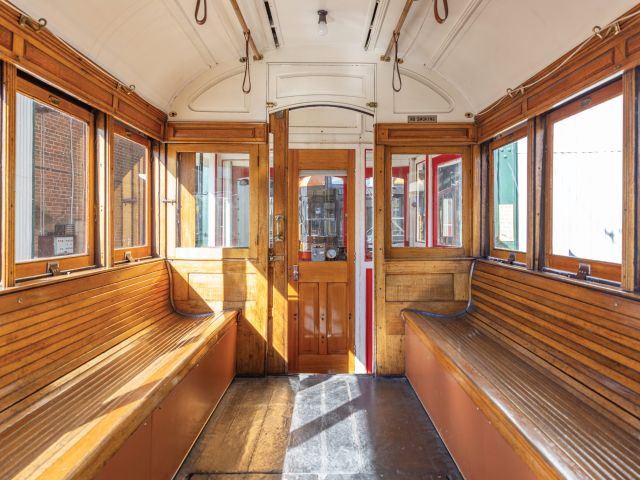
If your entourage includes any locomotive enthusiasts, book a journey aboard the Bellarine Railway . The more than 100-year-old steam train transports you to a bygone era and takes you through the rolling farmland and windswept coastal landscapes that make The Bellarine so beautiful.

The Swan Bay Express is an easy 45-minute ride perfect for younger passengers (and even allows dogs on board), or you could opt for a themed trip. There are seasonal events like the Polar Express (a festive favourite in the lead-up to Christmas), along with the Blues Train (a high-energy experience of live music and dancing) and the Q Train (a roving fine-dining feast celebrating regional produce).

6. The Dunes

waiter holding desserts at The Dunes, the bellarine
Save room for dessert. (Image: Visit Vic)

The Dunes offers the perfect balance of polished and playful, a breezy beachside bar and restaurant that appeals to adults and kids alike.

Feast on moreish snacks, share plates and mains from the Italian-inspired menu, or a selection of San Marzano-topped pizzas fresh from the wood-fired oven. Pair your meal with a classic cocktail, an ice-cold beer or a glass from the generous drinks menu, which brims with local drops. Little ones are well catered for with a line-up of kid-approved meals for breakfast and lunch.

If you’re simply swinging by en route to the family-friendly beach, grab a bite at The Dunes’ beachside kiosk before strolling down for a paddle or surf.

7. Sea All Dolphin Swims

dolphins playing in The Bellarine
Spot the locals with Sea All Dolphin Swims. (Image: Visit Vic)

The sparkling waters around The Bellarine are home to dolphins, fur seals, little penguins, humpback and southern right whales, plus a flurry of seabirds. Sea All Dolphin Swims lets you see some of these magnificent animals up close aboard one of their small-group vessels.

Head out on a sightseeing tour and spot local wildlife darting around the boat, or dive right in with a swim adventure tour. You’ll be swimming alongside dolphins and seals in their natural habitat – a bucket-list experience you won’t forget fast.

Swimming and snorkelling gear is provided, and guides are trained to ensure a gentle, eco-friendly encounter for both swimmers and sea creatures.

 8. Jack Rabbit

aerial of jack rabbit winery and vineyard
Everyone has a menu to enjoy at Jack Rabbit. (Image: Visit Vic)

Jack Rabbit is a one-stop dining destination, with a casual cafe and refined restaurant in one place.

If your mood leans laid-back, the House of Jack Rabbit is a lovely spot for brunch, lunch or dinner. The cafe serves a produce-driven all-day menu filled with seasonal mains, generous sharing platters and a playful kids menu to suit even the pickiest of eaters.

If you’re after something more elevated, Jack Rabbit Restaurant does plates that change with the seasons and incorporate plenty of local produce. Even younger guests are well catered to, with a considered yet familiar kids’ menu that’s just as vibrant as the grown-up one.

To start planning your trip or for more inspiration, head to visitgeelongbellarine.com.au