Along the hallways of Australia’s cherished heritage hotels can be traced the birth of a nation. From political movements to bloody murders, they’ve witnessed the turmoil of the centuries. Author Barry Stone guides AT through his pick of the most significant and fascinating properties in the country.
On Christmas Eve in 1882, an impromptu game of cricket was organised between the touring English Cricket team and a local side in the grounds of Rupertswood, a 50-room Italianate mansion in Sunbury, 30 minutes drive north of Melbourne.
It’s generally conceded that the local side, composed in the main by Rupertswood staff, lost the game, although no official scoresheets have ever been found. At dinner that night Rupertswood’s owner, Lady Janet Clark, marked the occasion by presenting English captain Ivo Bligh with a tiny urn that contained, it is said, the charred remains of a set of bails.
After the death of Lady Clark’s husband William in 1927, Bligh handed the long-forgotten urn over to London’s Marylebone Cricket Club, and the legend of The Ashes, Australia’s sporting Holy Grail, was born.
And it all began in the grounds of an historic Australian hotel. What drama. What pathos! How many contemporary hotels, regardless of their reputation or star rating, must wish they had ownership of a story like that.
Rupertswood remains one of this country’s premier examples of Victorian architecture on a grand scale. A boutique hotel complete with butlers, doormen and the sort of attention to detail and historical self-awareness you’d find in only the very best English country estates.
Of course not every heritage hotel can lay claim to a slice of Aussie history on that scale. But history comes in all shapes and sizes.
Social building blocks
One private residence that has achieved fame and glory within Australia’s historic accommodation community is southeast Queensland’s elegant, almost entirely intact Wiss House (1900, www.wisshouse.com.au), a characteristic example of a late Federation dwelling with a profusion of gables, balustrades, decorative eave brackets and use of period elements such as pressed metal, hoop pine and extensive cedar joinery.
It’s not often a State Heritage Minister issues a stop work order at 7pm on a Sunday. But that’s exactly what Queensland’s Molly Robson did on April 11, 1993, to prevent the Wiss House from being moved by its then owner who wanted to relocate it to a more affluent location in the hope of increasing its value. Fifty angry Kalbar residents watched aghast that night as workers began dismantling the roof, fence and side windows. The Wiss House became a test case as talkback radio shows across the nation debated the merits of its likely relocation. Should such an important and celebrated property be removed from its environment? How far does an owner’s rights extend over a building that helped define the very town in which it is set?
The EPA and National Trust soon became involved, compromises were made, and to this day the Wiss House stands exactly where its original owners intended for it to be.
The hotel as a political platform
Many of Australia’s historic hotels were, and often still are, the social heart and political focal point of their communities. At George Hotel on Lydiard Street North in Ballarat , a tradition emerged whereby patrons would air their political beliefs from the hotel’s unique three-storey balcony verandah. Aspiring policy-makers would regale the assembled crowds below in hopes of using the impressive balcony as a kind of wrought-iron springboard into Victorian parliament.
Politics and hotels have often gone hand in hand. Two Canberra hotels, the Hotel Kurrajong and the Hyatt Canberra (1925, formerly the Hotel Canberra , share a friendly rivalry that began in the ’30s. Labor MPs adopted the Kurrajong as a watering hole and the opposition United Party (today’s Liberal Party) frequented the Hotel Canberra. The Kurrajong played host to four Prime Ministers, including Ben Chifley, who used it as a residence in preference to the Lodge. Built in the garden pavilion style reminiscent of the low-slung rooflines and generous overhangs of Frank Lloyd-Wright, the Kurrajong now houses the award-winning Australian International Hotel School and continues to operate as the capital’s finest boutique hotel, superbly located in a suburban setting within walking distance of Parliament House – and still holding pride of place as one of Canberra’s architectural treasures.
One murder for every 104 years of hospitality is actually doing pretty well.
The Hotel Canberra housed the Commonwealth Solar Observatory until it was relocated to nearby Mt Stromlo in 1924 (only to be destroyed by bushfires in 2003), and during the Great Depression Prime Minister Scullen governed the nation from one of the hotel’s suites. By the 1950s the Hotel Canberra had become the centre of the capital’s social life, and as the Hyatt Canberra it remains one of the city’s most prestigious addresses.
Need tips, more detail or itinerary ideas tailored to you? Ask AT.
AI Prompt
Hauntings and sightings
Historic hotels have stories both famous and infamous. And, like people, they accumulate a little “emotional baggage" as time goes by. Take, for example, the Hydro Majestic (1904) in the Blue Mountains.
In 1912 a young female sought to flee a troublesome male suitor, boarded a commuter train at Sydney’s Central Station and fled west to the Blue Mountains village of Medlow Bath to find sanctuary, or so she thought, in the hotel’s labyrinth of corridors and alcoves. Unfortunately for the lady, her less than-chivalrous admirer, devastated by her apparent rejection, pursued her to her room where he strangled her with her favourite silk scarf. (As gruesome as that story may be, looking at it objectively, one murder for every 104 years of hospitality is actually doing pretty well.)
Also meeting a premature end while holidaying at the Hydro Majestic in January of 1920 was Australia’s first Prime Minister, Sir Edmund Barton, who passed away of heart failure while taking a bath in a second-floor suite. Then there are the Hydro’s more, well, “permanent" occupants. Take a tour of this venerable, eclectic hotel and you’re bound to hear the story of its two resident ghosts, a little girl in a blue frock with a white lace collar who likes to run through walls, and the boy who’s often seen by staff sitting in the dining room’s chandeliers long after the last diners have returned to their rooms.
Ghosts are a big deal in the world of the historic hotel, and nowhere will you find electro-magnetic gauges going off the scale more than at Sydney’s old Quarantine Station at North Head overlooking Sydney Harbour (www.qstation.com.au). Opening as a boutique hotel after a $17m refurbishment in April 2008, it’s Australia’s most haunted site. Employees have quit after seeing legs running across hillsides, feet in the old shower block and doors weighing hundreds of kilos slamming for no reason.
Hotels in many forms
Beautifully restored suburban and rural residences represent an alternative to traditional hotels, and one of the finest is Buxton Manor , a heritage-listed Arts & Crafts masterpiece in North Adelaide. With more than 1800 heritage buildings, North Adelaide is the nation’s largest historic precinct, a stunning showcase of every architectural style from colonial to art deco that rivals even the great US historic districts such as Savannah and Key West.
Owned and operated by Rodney and Regina Twiss, Buxton Manor is one of Australia’s painfully few examples of the Arts & Craft architectural style that flourished in the US and Europe from the late 1890s to the1920s. The movement was a return to the pride and precise joinery work of the master craftsman, a response to the era of industrialisation, mass production and subsequent profusion of Victorian architecture. At Buxton Manor you don’t just get a room, you get a house that the movement’s founder, William Morris, would have been proud to call his own.
Stagecoach Inns that survived the gold rush era intact are a rarity in Australia, though a fine example can be found on the NSW south coast just minutes from Pambula Beach overlooking the Pambula River. Constructed from handmade bricks and classified by the National Trust, the Roan Horse Inn (1845) is one of the oldest buildings in the state and has been delighting travellers for more than 160 years. With one exception. On April 5, 1872, the Bega Gazette reported that a Mr Baker, a guest at the inn, sued the hotel’s licensee for ten pounds for refusing to serve him breakfast. The case was heard in the Pambula Police Court before C H Baddeley, JP, who ruled in favour of the plaintiff. The current owners, Brian and Sharon Cole, swear that was the last recorded instance of anyone complaining about the service at this delightful French provincial-style inn.
If these hoteliers could talk
It doesn’t take a lot of prompting to get the proprietor of these properties to assume the mantle of archaeological historian and chat long into the evening about heart-stopping discoveries made during restoration. John Grimley is the owner of the boutique hotel Woodbridge On The Derwent (1825) which sprawls along the southern bank of the picturesque Derwent River at New Norfolk, a 40-minute drive west of Hobart. Grab a glass of port and ask him about the convict lockup they excavated. Then get ready for a long night.
Unearthed below the east foundations, the tiny cell had a floor of handmade bricks hidden beneath 20cm of water and silt and bisected by a French Drain that would have doubled as a latrine. Original iron bars are still embedded into the bricks and mortar on one of its internal walls, upon which were shackles until as recently as the 1950s. They haven’t found any bones. Yet.
Wherever you travel in Australia there’s heritage accommodation waiting to educate and tantalise the sophisticated palate. Mittagong in the foothills of the NSW Southern Highlands saw the first lawn tennis court in Australia laid out in the grounds of the beautiful Fitzroy Inn (1836), which has been serving the needs of travellers for more than 170 years.
Beneath the ageing floorboards of this superbly restored Georgian masterpiece can be found the finest example of a colonial-era kitchen still remaining in Australia, complete with its own water well cut through the shale floor by convict masons. There’s also a convict cell down the hall, replete with iron shackles and hand-turned iron bars used to incarcerate criminals overnight on the long trip to Berrima Gaol.
A nation built by convicts (also sheep) You’d be forgiven for thinking that, if not for our convict heritage, the ranks of historic properties in Australia would be considerably thinner. Norfolk Bay Convict Station on Tasmania’s Tasman Peninsula was Australia’s first railway station, albeit on a small scale, built to ferry goods in tiny rail cars to nearby Port Arthur. Its location on the shores of tranquil Norfolk Bay meant supply ships no longer had to make the dangerous crossing across Storm Bay to the infamous penal colony. It began life as an accommodation house in 1877 after the closure of Port Arthur. Containing five beautifully appointed rooms with stunning views across Norfolk Bay, this languid reminder of our colonial past has a wraparound verandah, oversized rooms with wood fires, and all the tranquillity you can handle.
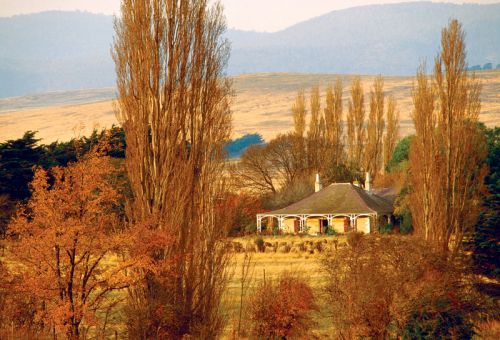
Old pioneering homesteads are increasingly making use of workers’ cottages and outbuildings to cater to visitors interested in our pioneering heritage. Sheep and cattle stations like Somercotes and Woolmers Estate on Tasmania’s “Heritage Highway" between Hobart and Launceston, offer priceless glimpses into our nation’s past in restored cottages that guarantee privacy and seclusion. They’ve also accumulated a wealth of antique farm equipment from tractors and hand-held ploughs to scythes and blacksmithing tools that wouldn’t be out of place in the finest museums.
Somercotes is the perfect base for exploring the surrounding historic communities of Ross, Richmond and Oatlands, the town with the highest number of pre-1837 buildings to be found anywhere in Australia. Woolmers Estate, one of the country’s finest examples of a 19th-century pastoral settlement, is in Longford, a short drive south of Launceston. Originally the generational home of the Archer family from 1817 to 1994, it has been open to the public since 1995. Accommodation is in seven superbly restored worker’s cottages that, along with blacksmith’s shops, a pump house, a bakehouse and various family dwellings, combine to impart to its guests a child-like sense of nostalgia and a welcome sense of community. The estate’s formal rose garden has one of the southern hemisphere’s largest and most complete collections of historic roses. Poltalloch Station, meanwhile, is within easy reach of SA’s Coorong wetlands, a 140km expanse of estuaries, saline lagoons and freshwater lakes. Along with their superb locales, pastoral stations like these also provide a social and economic look back in time at the growth of Australia when the nation rode to prosperity on the sheep’s back.
Historic hotels and guesthouses, be they turn-of-the-century Federation homes, grand country estates, restored commercial buildings or convict-era inns, will transport you back to a simpler, less complicated era. Your patronage assists their maintenance and preservation, their rooms are as individual as you are, and the history is free.
Weekly travel news, experiences
insider tips, offers, and more.
More worth a mention
+ Penghana B&B, Queenstown, TAS // Delightful Queen Anne-style B&B, formerly a mine manager’s residence with a stunning blackwood staircase and four impeccable rooms in a National Trust Mansion.
+ Balquhain House, Blackheath, NSW // The 1885 Heritage-listed property, former residence of the powerful Fairfax family. For years after its sale to a private bidder Lady Fairfax insisted on regular visits for afternoon tea. (You can no longer stay here)
+ Koendidda Country House, Barnawartha, VIC // Glorious, late 1850s, double-storied, triple-bricked Victorian mansion 15min from Wodonga, graced by cast-iron gates that open to visitors like a page from a storybook as you approach down long, tree-lined driveway.

Australian Traveller
View profile and articles