Recruited from the Middle East and India for their hardiness, camels were the backbone of support behind some of this country’s most ambitious infrastructure projects, writes Jessica Zavolokin.
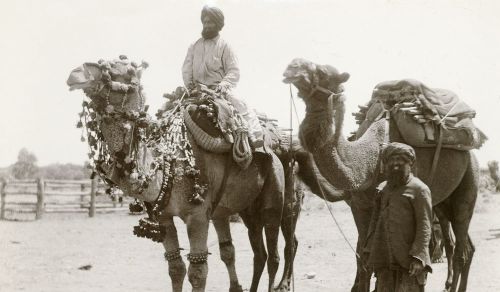
It’s the New Year’s Eve of 1865 in Port Augusta, South Australia, and a crowd of people gather to witness the spectacle of 124 camels being hoisted from a ship onto a new continent and 31 peculiar, sandal-clad men setting foot on unfamiliar territory.
These foreigners would go on to be a pillar for the Australian economy, ultimately supporting the outback for 50 years, playing a pivotal and much understated role in Australian history.
Nineteenth-century Australia was a magnet for explorers, settlers and prospectors who were eager to map the vast and inhospitable continent, but it had become clear that horses, the traditional means of transport, weren’t suitable for such tough conditions. The solution was the so-called Afghan Cameleers (a misnomer because they weren’t all from Afghanistan).
They would assist exploration parties – such as the Burke and Wills expedition of 1860 and Madigan’s Simpson Desert Crossing in 1939 – hauling supplies and resources where horses and oxen couldn’t.
Madigan initially described the camels as “queer, stupid and unapproachable", but acknowledged their capabilities in the soaring heat when food and water dried up. He said the camel “kneels, uncomplaining and unconcerned, a tower of strength and comfort… good for another 200 miles".
There were some 800 cameleers in Australia by the 1890s; not only did these men and their steeds assist with exploration, they played a momentous role in our country’s infrastructure.
Most significantly, they were an integral part in the construction of the Overland Telegraph between Adelaide and Darwin and later The Ghan railway between Adelaide and Alice Springs, carrying building and railway resources, food, furniture, water, mail and medicine.
Graham Dadlah, a train driver on The Ghan for more than 35 years, honours his ancestral legacy: “My great grandfather was one of the first cameleers to come out in the late 1800s to Australia; he was brought out here to work the camel trains and deliver transport for the telegraph line through to Alice Springs."
More than 150 years on, he feels great pride taking passengers through the heart of the country. “It’s a unique job and I feel honoured to be a driver of this legendary train."
The Northern Territory is made for road trips, and this one hits all the highlights.
Craggy mountain ranges, inviting waterholes, ochre soil: the landscape of the Northern Territory is asking to be explored by road and foot. There are many iconic road trips to choose from here, but none so all-encompassing than the roughly 3000 kilometres of sealed road that make up Explorer’s Way.
Spend 14 days (or more, to really make the most of it) driving this route from Adelaide, hitting the NT near the small settlement of Kulgera before later finishing in Darwin. Along the way, you’ll find nearly all the territory’s most iconic sights.
Discover some of the top highlights that make Explorer’s Way one of Australia’s most incredible road trips.
1. Alice Springs
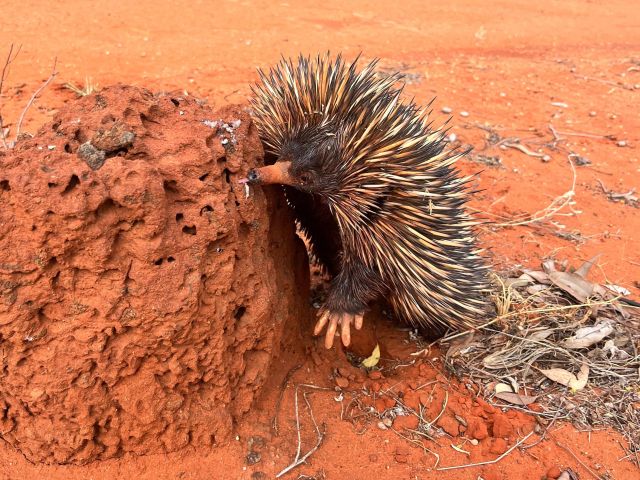
See the locals at Alice Springs Desert Park. (Credit: Tourism & Events NT)
Recently hitting the big screen again with the story of The Kanagroo Sanctuary , there’s a lot to surprise you in Alice Springs.
Three distinct desert habitats – desert rivers, sand country and woodland – are recreated over 1300 hectares at Alice Springs Desert Park . Time your visit for a presentation or a free bird show.
Later, turn your attention to the skies above, taking a dive into local astronomy at Earth Sanctuary . You’ll find a range of experiences, from a 90-minute toe-dip into the stars through to an overnight adventure.
Alice Springs packs a surprising punch with its tasty dining options, including pub grub and unique brews at Alice Springs Brewing Co , tapas and pizza at Epilogue Lounge and tasty cafe fare at the quirky Page 27 .
2. Tjoritja/West MacDonnell National Park
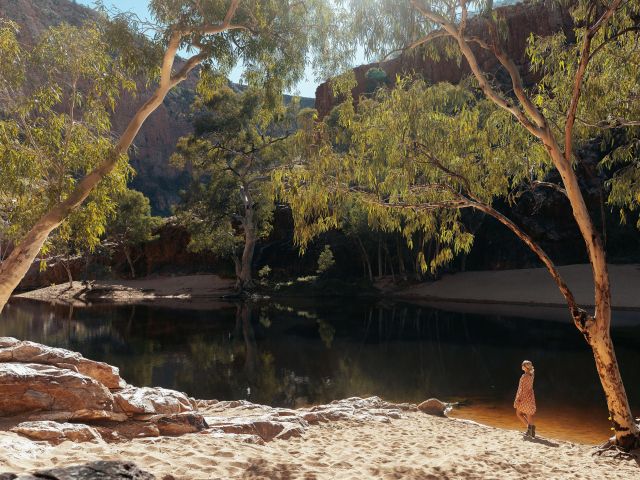
Dive into Ormiston Gorge. (Credit: Tourism & Events NT/ Dom and Jesso)
Beginning 15 minutes from Alice Springs and stretching across 161 kilometres, Tjoritja/West MacDonnell National Park is packed with striking ancient landscapes and inviting water holes.
Visit Standley Chasm – traditionally known as Angkerle Atwatye, meaning ‘Gap of Water’ – to take in its bold red and orange hues, and to observe the diverse bird species, lizards and wallabies that call it home.
Cool off in one of several picturesque natural swimming holes, like Ellery Creek Big Hole and Ormiston Gorge.
3. Uluru & Kata Tjuta
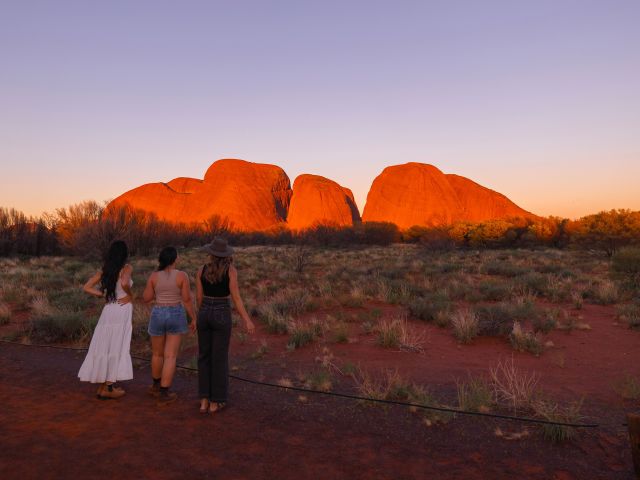
Explore Kata Tjuta. (Credit: Tourism & Events NT)
Visiting the Cultural Heart of Australia is something everybody should experience. There are so many side trips in the Red Centre you could easily spend a week here, but to get the most out of a short time, park the car then get out on foot.
Take the 10-kilometre Base Walk around the entirety of Uluru or join a free, ranger-guided Mala Walk along part of the base, learning about Tjukurpa (creation stories) and geology as you go.
For a change of pace, wait until nightfall and wander through the iconic Field of Light display by celebrated artist Bruce Munro, or see the Wintjiri Wiru lightshow that shares the ancient Mala story using drones, lasers and projections.
4. Tennant Creek
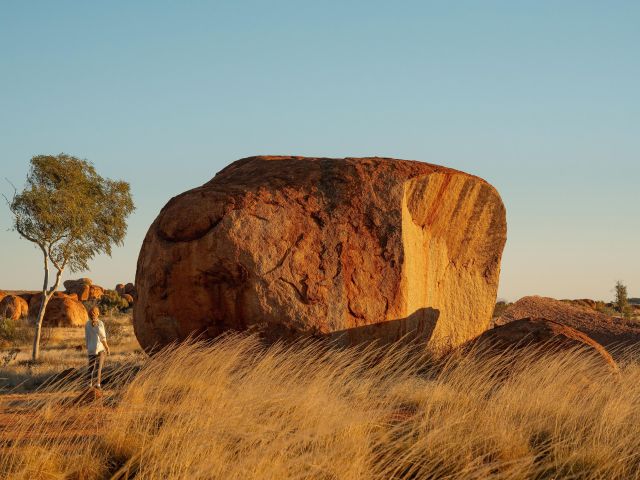
See the ancient granite boulders of Karlu Karlu (Devils Marbles). (Credit: Tourism & Events NT/ Dom And Jesso)
Tennant Creek was Australia’s third-largest gold mining town in the 1930s, and visitors can discover that history at Battery Hill Mining Centre – and even try their own hand at gold fossicking.
For a completely different side of history, pop into Nyinkka Nyunyu Art & Culture Centre , which preserves and shares Warumungu culture through art, performance, a museum and more.
Just outside town, find the ancient granite boulders of Karlu Karlu (Devils Marbles). A site integral to important stories held by the Warumungu, Kaytetye, Warlpiri and Alyawarra peoples, the boulders appear to almost have dropped out of the sky and seemingly continue to defy gravity.
5. Mataranka
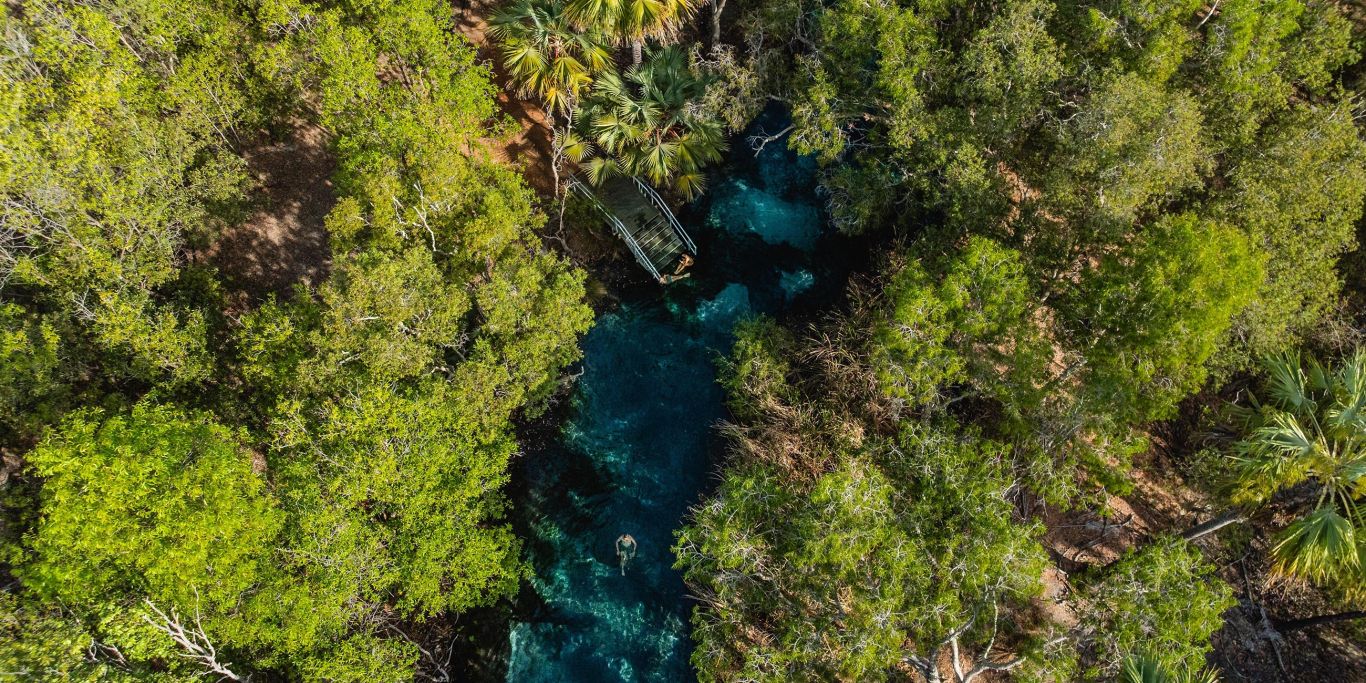
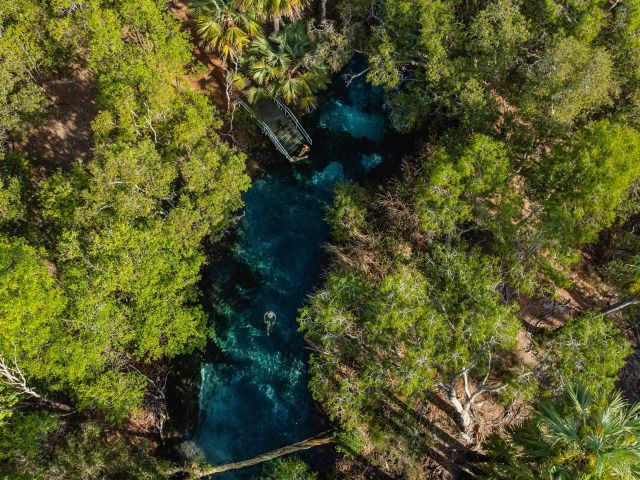
Dive into Bitter Springs. (Credit: Tourism & Events NT/ Ben Savage)
A town made famous by the novel We of the Never Never by Jeannie Gunn (and a movie of the same name), Mataranka is also known for its sandy-bottomed thermal pool, Bitter Springs , within Elsey National Park. Follow a 500-metre loop track around these spring-fed pools that stay a toasty 34°C year-round, before choosing your favourite spot to dive into. Enjoy the local birdlife while you relax.
Elsewhere in the park, find historical sites, several scenic walks and Roper River, which is perfect for boating and fishing.
6. Nitmiluk National Park
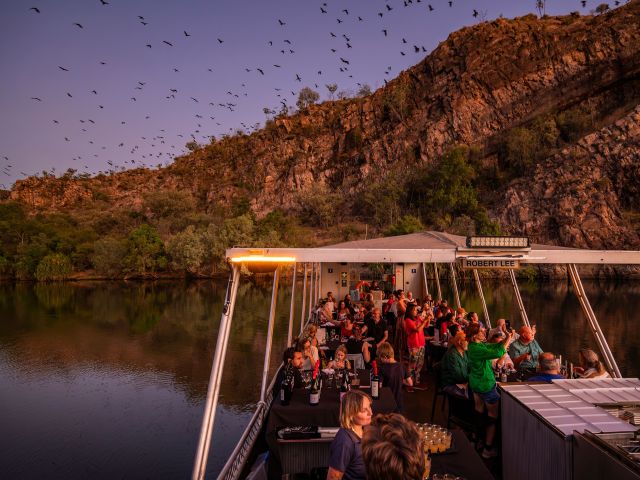
Join a sunset cruise with Nabilil Dreaming. (Credit: Tourism & Events NT/ Lachlan Gardiner)
Nitmiluk National Park is sandstone country, with 13 stunning gorges and plenty of waterfalls waiting to be explored.
One of the most beautiful spots can be found along the 62-kilometre Jatbula Trail, a five-to-six day bushwalk that follows an ancient Jawoyn songline from Nitmiluk Gorge to Leliyn (Edith Falls). Numbers are restricted and book out quickly, so be sure to plan well ahead. Not up for the hike? Drive right up to the falls and enjoy a dip without the challenge.
Elsewhere, explore Nitmiluk (Katherine) Gorge. Paddle a kayak through the river running through the canyon, or save your energy on a Nabilil Dreaming Sunset Dinner Cruise , discovering the stories and ways of the Jawoyn people while enjoying a candlelit dinner as the cliffs around you shift colour and glow with the changing daylight.
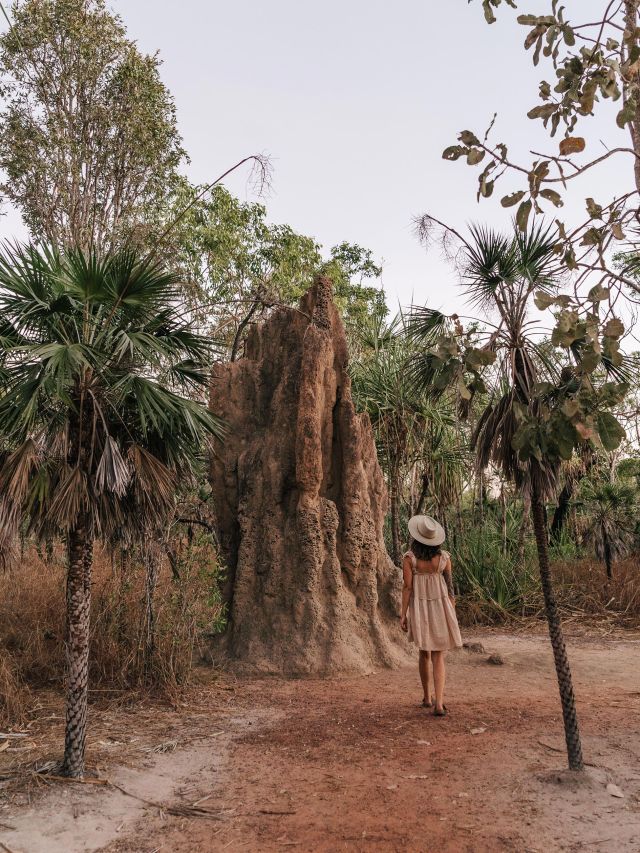
Be awed by giant cathedral termite mounds. (Credit: Tourism & Events NT/ As We Wander)
Just over an hour’s drive from Darwin lies the beautiful Litchfield National Park. It’s famous for stunning waterfalls and swimming holes, including Buley Rockhole, Wangi Falls, Florence Falls and Tjaynera Falls.
Here you’ll also find hundreds of giant – and magnetic – cathedral termite mounds that are truly a sight to see. Ageing up to 100 years old, you won’t find mounds like these outside the northern parts of Australia. Stroll along the accessible boardwalk to see them up close.
8. Darwin
Darwin art is streets ahead. (Credit: Tourism & Events NT/ Mark Fitzpatrick)
This list wouldn’t be complete without the territory’s capital city: Darwin. Situate yourself upon arrival with a stroll through the main streets, admiring the many art murals by local, interstate and international artists. They’re all remnants of the annual Darwin Street Art Festival , one of Australia’s longest running street art festivals.
Stop to recharge along Darwin’s Waterfront Precinct , an area of delectable restaurants, public swimming pools and free events. And, of course, it would be wrong to leave the city without enjoying a bowl of laksa at Mindil Beach Sunset Market as the sun goes down.