Your rights in a flight delay: the plane facts

hero media
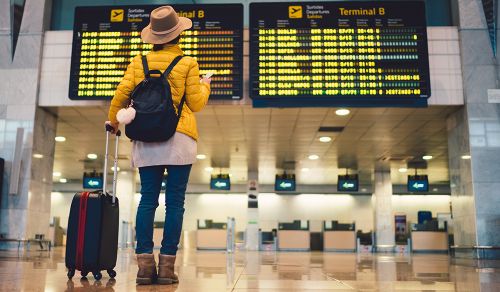
Australian Traveller’s Steve Madgwick talks to Julia Lines from passenger rights group Airline Customer Advocate to get the low-down about your rights when your plane/flight is delayed or cancelled (in Australia).

Am I entitled to monetary compensation for flight delays?

You are not entitled to mandatory compensation when a flight is delayed because the airline’s agreement is limited to flying you from airport A to airport B, rather than flying you from A to B at the times specified in your itinerary.

What about the right to be put up in a hotel room and meals overnight?

Airlines do not guarantee flight times. If your flight is delayed for a long period and you decide to book a flight on another airline carrier, the airline may not be required to refund this additional cost. Airlines are also not required to compensate you if your flight is delayed or provide you with a bottle of water or a meal (or voucher) while you wait at the airport.

Time to complain?

If the airline can’t resolve your issue on the spot, then it should be escalated to the airline’s customer care team so that the complaint can be acknowledged and responded to. All of the airlines that participate in the ACA scheme include information in their customer service charters about accessing their complaint management processes and response times.

Get it in writing!

If the airline says it will reimburse your expenses, make sure it is in writing to avoid disappointment.


Each airline has its own policies about how it will manage delayed passengers. Always check with staff about whether the airline will pay for meals, phone calls, transfers or accommodation if the delay is overnight.

Group of people standing in queue to board airplane.

Need tips, more detail or itinerary ideas tailored to you? Ask AT.

AI Prompt

What’s the first step during a delay?

Contact the airline to find out how late the flight will be, but be aware that it can be difficult for the airline to predict the length of the delay. Also, staff cannot provide information until they are cleared to do so. Ensure the airline has your best contact number and email address so that information on the flight disruption will reach you.

Flight cancelled, what next?

If the flight is delayed as a result of an event beyond an airline’s control, it will attempt to rebook you on its next available flight. If the proposed rebooking is not acceptable, the airline may agree to refund the applicable flight and you should check to see if this is an option. A refund is only available if it is provided for in the airline’s conditions of carriage, or under laws administered by consumer protection bodies. Read Scott Welsch blog about Flight Compensation for more information.

When does a flight delay become a flight cancellation?

I am not aware of a reasonable or an unreasonable time that has to expire before a flight will be cancelled. The airline will usually always intend to operate the flight until it decides to cancel the service.

Connections: how tight is too tight?

Allow at least 3-4 hours for connecting flights. It may sound excessively long however, the extra 30 minutes can save you from a holiday disaster particularly if it is an international flight connection with a different airline. Read and understand the airline’s Conditions of Carriage prior to booking and consider the questions: “What if my flight is delayed?" or “Do I need an earlier flight"?


(The Department of Infrastructure and Transport publishes a monthly report “Airline On Time Performance" that provides information about flight delays and punctuality of the domestic and regional airlines.)

Weekly travel news, experiences
insider tips, offers, and more.

Travel insurance to the rescue?

Given flight delays are a reality of airline travel, travel insurance is highly recommended. Depending on the provider, you can be covered for costs arising from delays and cancellations. Check with the insurer to understand what out-of-pocket expenses the airline or the travel insurer will reimburse, or won’t, as the case may be.


MORE


Can you beat jet lag? Yes…

The new truth about frequent flyer programs

This luxe trawler tour is redefining Victoria’s seafood experience

    Chloe Cann Chloe Cann
    Victoria’s ‘mussel capital’ is the source of exceptional shellfish used by top chefs far and wide. Step aboard a beautifully refurbished trawler to see how these plump and juicy bivalves are sustainably cultivated.

    A curtain is slowly winched from the placid, teal waters just off Portarlington , like a floating garland beside our boat. The ropes heave with blue mussels, the star attraction of our tour. But as we reach to pluck our own, it’s quickly clear they’re not alone; a mass of weird and wonderful creatures has colonised the ropes, turning them into a living tapestry. ‘Fairy’ oysters, jelly-like sea squirts, and tiny, wriggling skeleton shrimp all inhabit this underwater ecosystem.

    We prize our bivalve bounty from the ropes, and minutes later the mussels arrive split on a platter. The plump orange morsels are served raw, ready to be spritzed with wedges of lemon and a lick of chilli as we gaze out over the bay. They’re briny, tender and faintly sweet. “This wasn’t originally part of the tour,” explains Connie Trathen, who doubles as the boat’s cook, deckhand and guide. “But a chef [who came onboard] wanted to taste the mussels raw first, and it’s now become one of the key features.”

    A humble trawler turned Hamptons-style dreamboat

    inspecting bivalve bounty from the ropes
    Inspecting the bounty. (Image: Visit Victoria/Hannyn Shiggins)

    It’s a crisp, calm winter’s day, and the sun is pouring down upon Valerie, a restored Huon pine workhorse that was first launched in January 1980. In a previous life she trawled the turbulent Bass Strait. These days she takes jaunts into Port Phillip Bay under the helm of Lance Wiffen, a fourth-generation Bellarine farmer, and the owner of Portarlington Mussel Tours . While Lance has been involved in the fishing industry for 30-plus years, the company’s tour boat only debuted in 2023.

    holding Portarlington mussels
    See how these plump and juicy bivalves are sustainably cultivated.

    It took more than three years to transform the former shark trawler into a dreamy, Hamptons-esque vessel, with little expense spared. Think muted green suede banquettes, white-washed walls, Breton-striped bench cushions, hardwood tables, bouquets of homegrown dahlias, and woollen blankets sourced from Waverley Mills, Australia’s oldest working textile mill. It’s intimate, too, welcoming 12 guests at most. And yet there’s nothing pretentious about the experience – just warm, down-to-earth Aussie hospitality.

    As we cruise out, we crack open a bottle of local bubbles and nibble on the most beautifully curated cheese platter, adorned with seashells and grey saltbush picked from the water’s edge that very morning. Australasian gannets soar overhead, and I’m told it’s not uncommon for guests to spot the odd seal, pod of dolphins, or even the occasional little penguin.

    The sustainable secret behind Victoria’s best mussels

    blue mussels off Portarlington
    Blue mussels sourced just off Portarlington.

    Connie and Lance both extol the virtues of mussels. They’re delicious. A lean source of protein and packed with omega-3 fatty acids, vitamin B12, iron, selenium, and zinc. They’re cooked in a flash (Connie steams our fresh harvest with cider and onion jam). And they’re also widely regarded as one of the most sustainable foods in the world.

    Portarlington mussels with lemon and chilli
    Mussels served with lemon and chilli.

    “Aquaculture is [often] seen as destructive, so a lot of our guests are really surprised about how environmentally friendly and sustainable our industry is,” Lance says. “[Our mussels] would filter 1.4 billion litres of water a day,” he adds, explaining how mussels remove excess nitrogen and phosphorus from the water. “And through biomineralisation, we lock carbon into mussel shells.”

    a hand holding a Portarlington mussel
    Mussels are a sustainable food.

    Despite their glowing list of accolades, these molluscs have long been seen as the oysters’ poorer cousins. “It was a really slow start,” explains Lance, who says that in the early days of his career, “you could not sell mussels in Victoria”.

    But word has slowly caught on. Chefs as globally acclaimed as Attica’s Ben Shewry and even René Redzepi of Noma, Denmark, have travelled to these very waters just to try the shellfish at the source, sharing only the highest praise, and using Lance’s mussels in their restaurants.

    guests sampling Portarlington mussels onboard
    Sampling the goods onboard. (Image: Visit Victoria/Hannyn Shiggins)

    According to Lance there’s one obvious reason why the cool depths of Portarlington outshine other locations for mussel farming. “The water quality is second to none,” he says, noting how other regions are frequently rocked by harvest closures due to poor water quality. “We grow, without a doubt, some of the best shellfish in the world.” And with Lance’s bold claims backed up by some of the industry’s greatest names, perhaps it won’t be much longer until more Aussies uncover the appeal of Portarlington’s mussels.