A must-read guide to the Three Sisters Walk

hero media
No trip to the Blue Mountains is complete without taking in the jaw-dropping vistas along the Three Sisters Walk.

Rising from the valley floor of the World Heritage Listed Blue Mountains National Park, the Three Sisters are breathtaking, ancient and folded deeply into the lore of the local Gundungurra and Darung People.

The best way to admire the sandstone maidens is by following the approachable Three Sisters Walk, which is helpfully dispersed with lookouts offering different vantage points. While the short, bush-hemmed trail is open to everyone, read on for a few things to know before you go.

What to expect of the Three Sisters Walk

Duration: 25–45 minutes
Distance: 0.8 kilometres return
Difficulty: Easy

Perhaps the best-known icon of the Blue Mountains, the Three Sisters spoils visitors with their monolithic sandstone splendour as they rise nearly one kilometre above sea level. Offering up the best vantage points to take in the sisters’ bush-enclosed beauty, this walk also lays out vistas across the soft-blue haze of the Jamison Valley and leads walkers under eucalypt canopies where bird songs melodically soundtrack the trail.
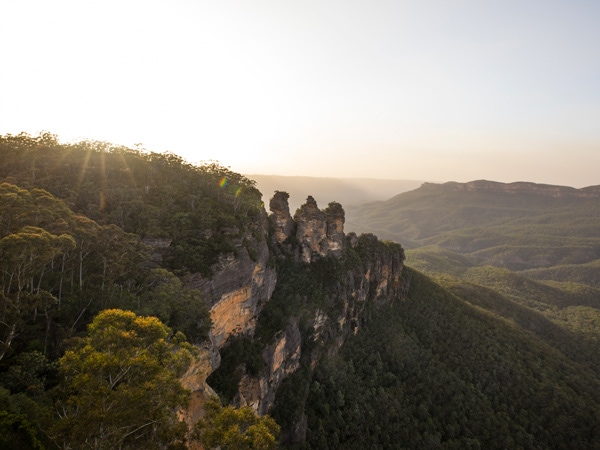
views of the Three Sisters and the Jamison Valley, Blue Mountains National Park
Admire the monolithic sandstone splendour of the Three Sisters. (Image: Destination NSW)

Keep an eye out for the superb lyrebird and vibrant rosellas, as well as spotted tail quolls and the Blue Mountains water skink. Along the way, take your time to absorb the views from Oreades Lookout, Lady Game Lookout and, if you’re eager, take a detour to Spooners Lookout. Pets are not allowed and smoking is prohibited.
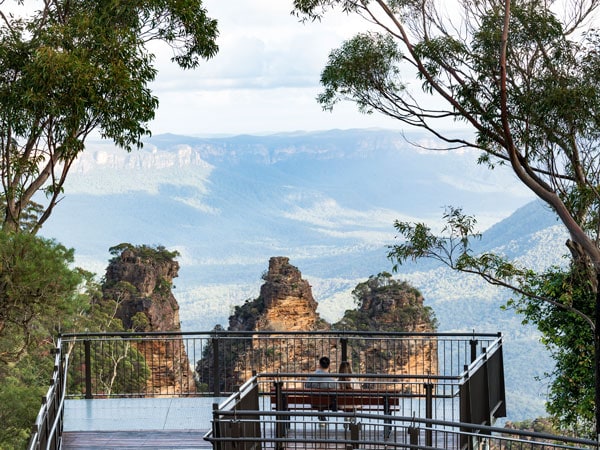
scenic views across the Jamison Valley from Echo Point Lookout in the Blue Mountains
Absorb the views from Echo Point Lookout. (Image: Time Out)

How accessible is the Three Sisters Walk?

This is a family-friendly walk and fairly achievable for smallish children or those that can be carried. For those with limited mobility, seating and rest spots are dispersed frequently along the track.

Prams and wheelchair access with assistance is easy from Echo Point to Oreades Lookout with smooth terrain and no significant slopes. However, beyond this point it’s not recommended as there are some stairs. There is no wheelchair access from Lady Game Lookout to Honeymoon Bridge.
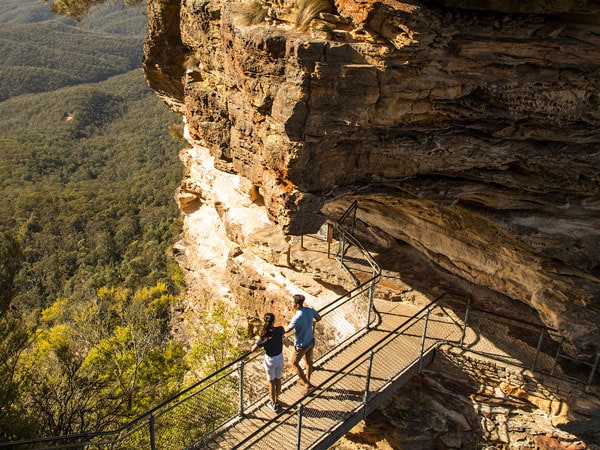
a couple enjoying views from Honeymoon Bridge overlooking the Jamison Valley along the Three Sisters Walking Trail
Honeymoon Bridge is a scenic spot to stop along the trail. (Image: Destination NSW)

Highlights of the Three Sisters Walk

Dramatic valley views and serene bushland make it a popular entry-level trail. In fact, the Three Sisters Walk is often considered to be up there with the best of Blue Mountains hikes.

From here, you can embark on spin-off walks that are longer and some more challenging, such as the Prince Henry Cliff Walk, Dardanelles Pass Loop Track and the Grand Cliff Top Walk. However, if you only have time for one, the Three Sisters Walk is a fantastic option.
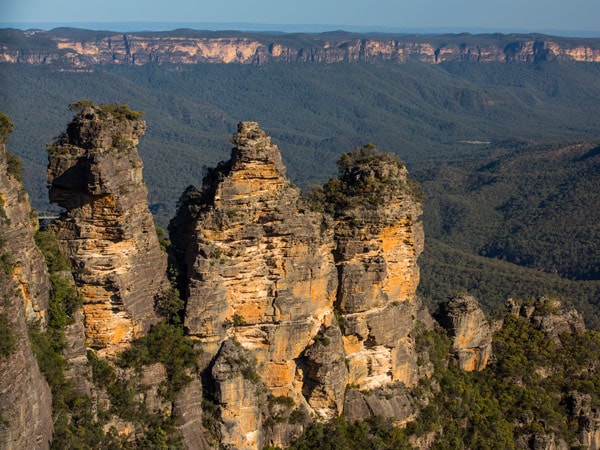
the Three Sisters and the Jamison Valley, Blue Mountains National Park
Three Sisters is an iconic landmark in the Blue Mountains National Park. (Image: Destination NSW)

Need tips, more detail or itinerary ideas tailored to you? Ask AT.

AI Prompt

Echo Point

Starting at the Echo Point Visitor Centre, make your way to Echo Point Lookout, where you’ll be treated to panoramic views of the Three Sisters and Jamison Valley. Also, spot the Ruined Castle and Mt Solitary.
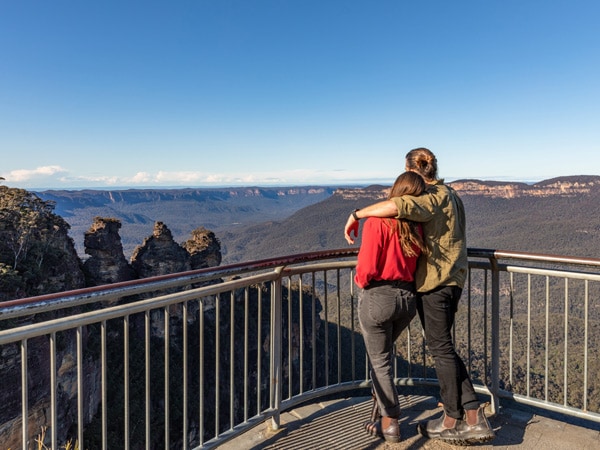
a couple admiring the Three Sisters view from Echo Point Lookout in the Blue Mountains
Take in panoramic views of the Three Sisters from Echo Point Lookout. (Image: Destination NSW)

Oreades and Lady Game lookouts

Sweeping views of the valley unfurl as you step out onto the viewing platform at Oreades Lookout. There’s plenty of room at this lookout to get your money shot and soak up those mountain vibes. Then its another 50 metres to reach Lady Game Lookout, where you find yourself at an even closer vantage point. Another stone archway to the side of the lookout leads onto the Giant Stairway.

Giant Stairway

Leading into the Jamison Valley by way of nearly 1000 steps, the Giant Stairway lives up to its name. If you’re not keen to tackle the full staircase, you need only take a handful of steep steps to reach the first of the Three Sisters via Honeymoon Bridge.

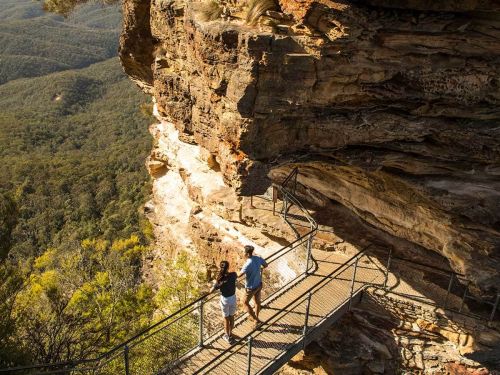
Honeymoon Bridge

This is the last part of the walk and, of course, optional for the vertigo prone. It connects walkers to an overhang on the First Sister, where you can look back to the Giant Stairway. There’s not much space on the other side, so take a quick snap and head back across.
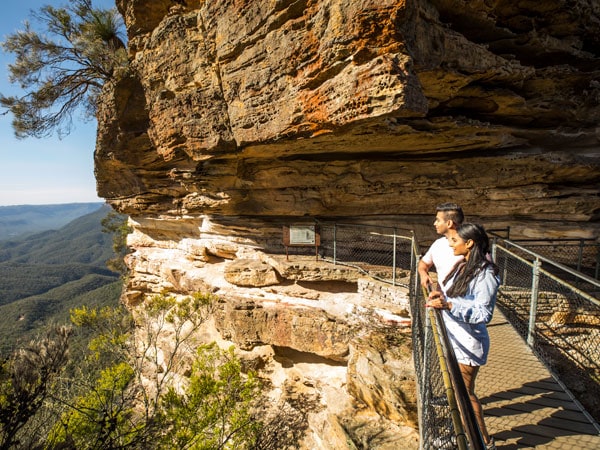
a couple overlooking the view from Honeymoon Bridge
Honeymoon Bridge is the final section of the trail and the one that gets you closest to the sisters. (Image: Destination NSW)

Spooners Lookout

A short detour from your return journey will lead you to Spooners Lookout, from where you may marvel at the Three Sisters welded to the valley below. It’s just five minutes extra, but worth the extra steps. The lookout is also accessed from Echo Point Visitor Centre and is wheelchair-friendly.

About the Three Sisters

Long a significant part of the landscape for the Gundungurra and Darung People, the Three Sisters continue to embody deep cultural importance for Traditional Custodians.

The Dreaming story of the Sisters does vary between groups, however, as told by Sharon Brown of the Burragurrang Clan of the Gundungurra Nation, the tale speaks of three beautiful sisters, Wimalah, Meeni and Gunedoo, who were in love with three brothers from the neighbouring nation of the Dharruk people.
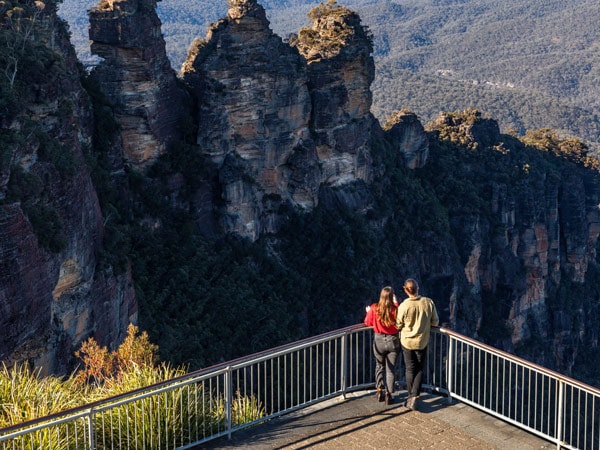
an aerial view of the Three Sisters from Echo Point Lookout in the Blue Mountains
The Three Sisters are of deep cultural importance to the traditional custodians of the region. (Image: Destination NSW)

Tribal law forbade their union, but this failed to deter the brothers, who fought to win the sisters by force. Eventually the skirmish led clever man (Kuradjuri) to turn the sisters to stone for their own safety, with the full intention of restoring them to flesh and blood once the fighting had ceased.

Unfortunately for the sisters and their would-be lovers, Kuradjuri died in the battle, and so they remain stone-bound and unmarried for eternity.
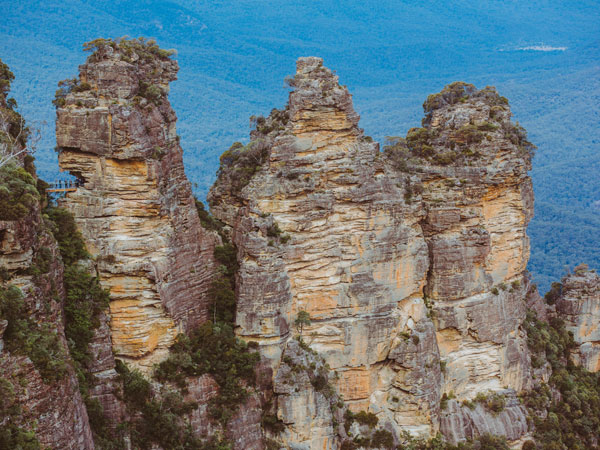
the Three Sisters, Blue Mountains
The Three Sisters rose from the northern escarpment of the Jamison Valley. (Image: Tourism Australia)

In a geological and perhaps less thrilling interpretation of events, the Three Sisters were formed from Hawkesbury sandstone by land erosion and volcanic activity around 200 million years ago.

Today, their rough-hewn and craggy beauty is shrouded in a touch of mystery and their engaging Dreamtime story continues to draw visitors from sunrise to sunset as they ponder whether the entrapped sisters will ever be free to love.
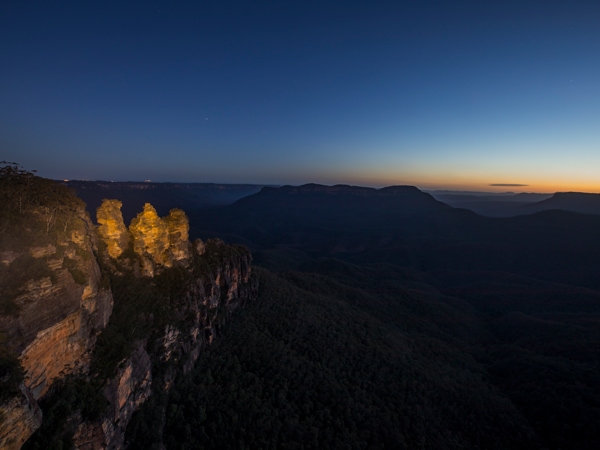
sunrise views over Three Sisters and the Jamison Valley, Blue Mountains National Park
The sun rises over Three Sisters and the Jamison Valley. (Image: Destination NSW)

Weekly travel news, experiences
insider tips, offers, and more.

Safety information

As with all bushwalking, it’s important to be properly prepared. While the Three Sisters Walk is a short and relatively easy track, if you decide to add on another walk or tackle the Giant Stairway, be sure to pack enough water, wear sun protection and let someone know where you’re going.
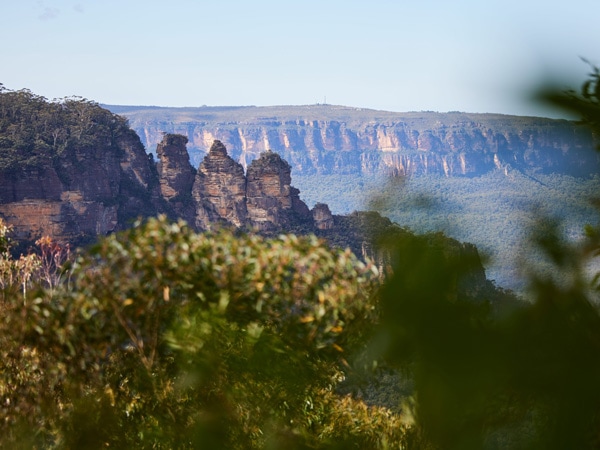
The Three Sisters in the Blue Mountains
Capture the magnificent beauty of the iconic Three Sisters. (Image: Destination NSW)

Parts of the Three Sisters Walk are close to cliff edges. Use caution and common sense, especially during busy periods, and keep children close at all times. Also, you can check the National Parks website ahead of your trip to make sure there are no closures or bushfire alerts.
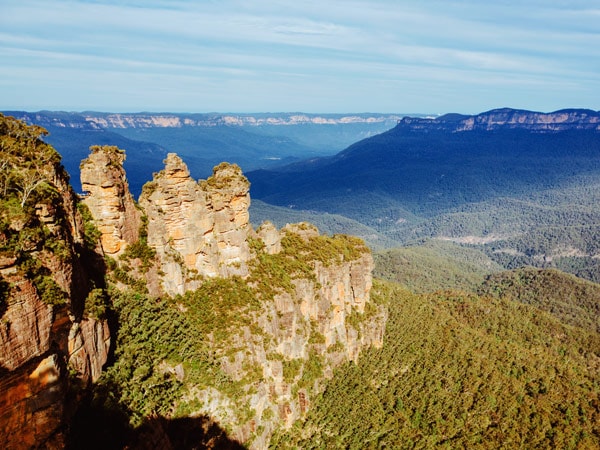
an aerial view of the Three Sisters, Blue Mountains,
Be sure to prepare before you go to the Three Sisters Walk. (Image: Tourism Australia)

Getting there and parking

Just an hour and a half from Sydney, you can reach the Three Sisters Walk from Echo Point Visitor Centre in Katoomba.

Parking is available at the Echo Point car park and on nearby streets, and there are designated disabled spaces. The car park does fill up on weekends, so try to arrive early and allow plenty of time.
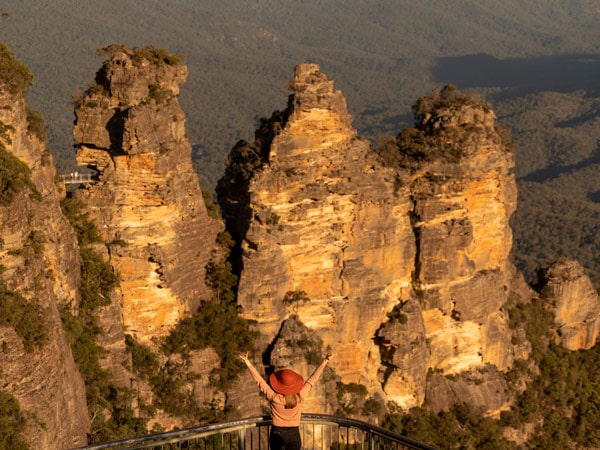
a woman posing with arms raised with Three Sisters in the background
Strike a pose in front of the spectacular sandstone backdrop. (Image: Tourism Australia)

Things to do nearby

There’s plenty to do around Katoomba and around once you’ve completed the Three Sisters Walk, with plenty to add to your day’s itinerary. Pop across the valley to Scenic World, where you can ride the world’s steepest railway. Cool off at a local waterfall, or hit nearby Leura’s eclectic collection of boutiques and shops.

If you’re here on a weekend, you should also check to see if any of the local markets are running. Or head over to Mountain Culture Beer Co, one of the best watering holes in the Blue Mountains, for a delicious craft beer and fried pickles.
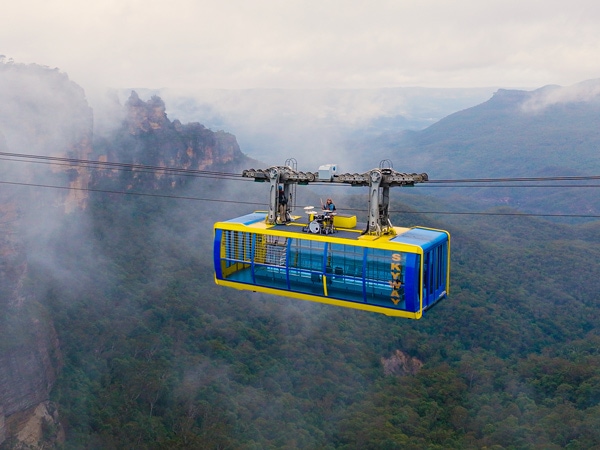
a cable car soaring above sandstone ridges and Eucalyptus forests
Soar above Jamison Valley on the Scenic World cable car. (Image: Destination NSW)

Want to see more stories from Australian Traveller in your Google search results?

  1. Click here to set Australian Traveller as a preferred source.
  2. Tick the box next to "Australian Traveller". That's it.
Lara Picone
Working for many of Australia’s top publications, Lara Picone has had the distinct pleasure of writing, editing and curating content about the finer things in life for more than 15 years. Graduating from Macquarie University with a Bachelor of Arts in Communication, her editorial foundation began at Qantas: The Australian Way magazine, before moving on to learn the fast-paced ropes of a weekly magazine at Sunday Magazine and picking up the art of brand curation at donna hay magazine. Pivoting a near-problematic travel lust into a career move by combining it with storytelling and a curious appetite, her next role was as Deputy Editor of SBS Feast magazine and later Online Editor of SBS Food online. She then stepped into her dream job as Editor of Australian Traveller before becoming Online Editor for both International Traveller and Australian Traveller. Now as a freelancer, Lara always has her passport at-the-ready to take flight on assignment for the Australian Traveller team, as well as for publications such as Qantas Magazine, Escape and The Weekend Australian. As ever, her appetite is the first thing she packs.
View profile and articles
hero media

This new tour takes you to the best and most unexpected parts of NSW’s outback

Credit: Destination NSW

    Dilvin Yasa Dilvin Yasa

    The outback is calling, and the adventure is made all the easier with this hot new AAT Kings’ tour.

    It’s the desert palette of rust-red earth and vast cobalt sky that calls you at first, for where better to get away from it all than the outback? Of course, once you start driving, taking note of all the weathered pubs, dusty tracks and tiny towns held together with humour, resilience and more corrugated iron than ever deemed possible, something else grabs a hold of you: the idea that far from the celebrated icons and landmarks associated with Australia, you’re finally immersed in an authentic slice of local life that few have ever experienced.

    Ancient landscapes, proud pastoral histories, ghost towns, culinary powerhouses and a rich Indigenous heritage; there are plenty of facets to life on the land. The best way to experience all of the above with both ease and like-minded friends? AAT Kings’ new Outback New South Wales Adventurer, a 9-day small group tour. This Sydney-return itinerary is designed to connect travellers not only with iconic outback destinations, but with the characters, culture and experiences that bring each place to life.

    Highlights? The Adventurer has more than a few, but here are eight to start.

    1. Broken Hill

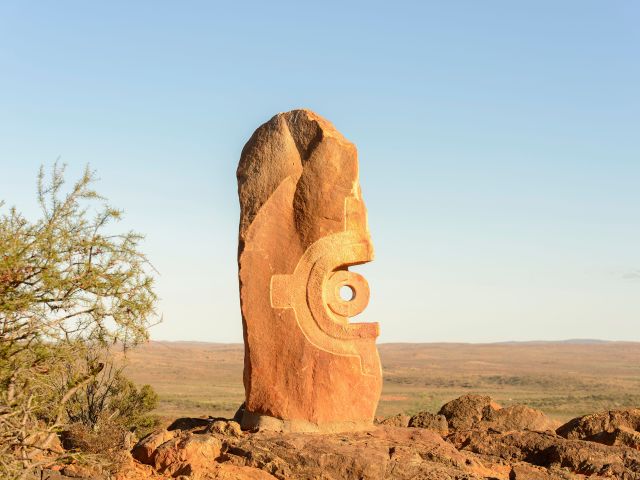
    See the striking art at Living Desert and Sculptures. (Credit: Destination NSW)

    Welcome to Broken Hill, where mining history, outback eccentricity and a surprisingly rich arts scene unite in a rusty desert landscape. In Australia’s first heritage-listed city, exploration is quickly rewarded. Begin with a guided walking tour taking in the city’s grand Victorian and Art Deco architecture. Later, enjoy visits to both the Broken Hill City Art Gallery and the Living Desert and Sculptures – the perfect place to enjoy the changing colours of an outback sunset. Of course, no visit to Broken Hill is complete without a stop at the historic Palace Hotel Broken Hill, famous for its role in The Adventures of Priscilla, Queen of the Desert. Happily, it makes for the perfect spot for dinner.

    2. White Cliffs

    people in a mine in white cliffs nsw
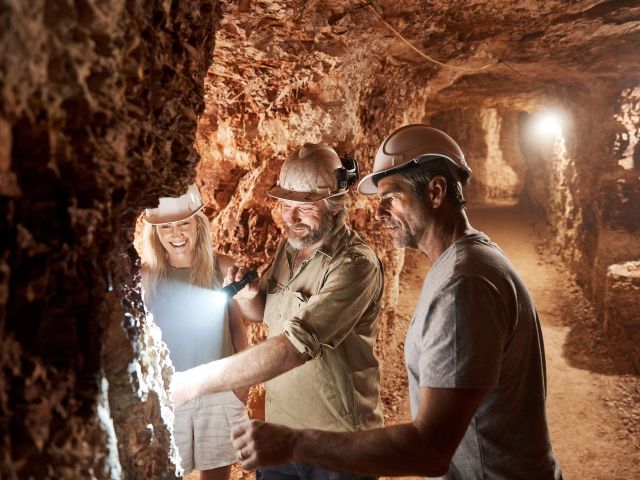
    Strap on your hardhat and head underground. (Credit: Destination NSW)

    Strap on your hardhat and start spending your imaginary fortunes; White Cliffs, Australia’s oldest commercial opal field, is begging you to come in search of rare pineapple opals. Admittedly, you’re much more likely to find white opals, but the true gems of White Cliffs – where much is built underground to escape the desert heat – are everywhere.

    Here, you’ll descend 13.5 metres underground into a working mine to learn about the region’s heritage, and observe how miners continue the search for these prized gemstones. Perhaps you’ll even find a couple yourself?

    3. Mungo National Park

    mungo national park nsw outback
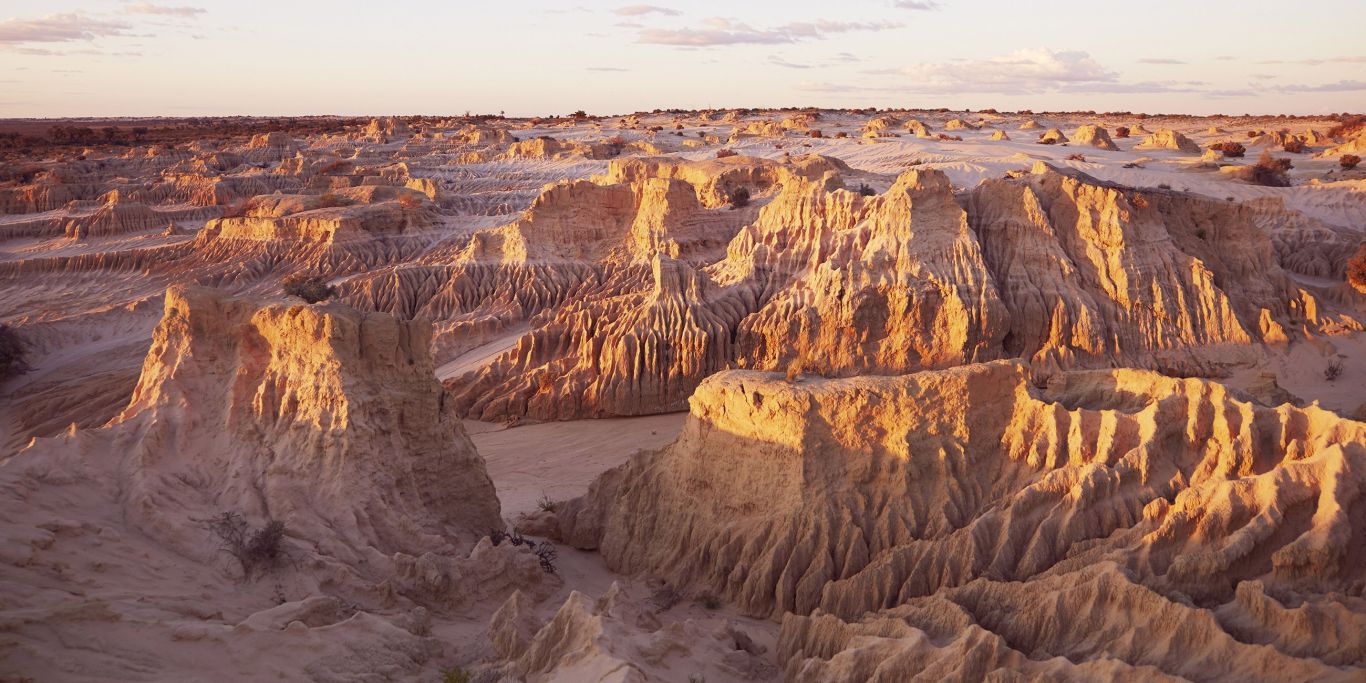
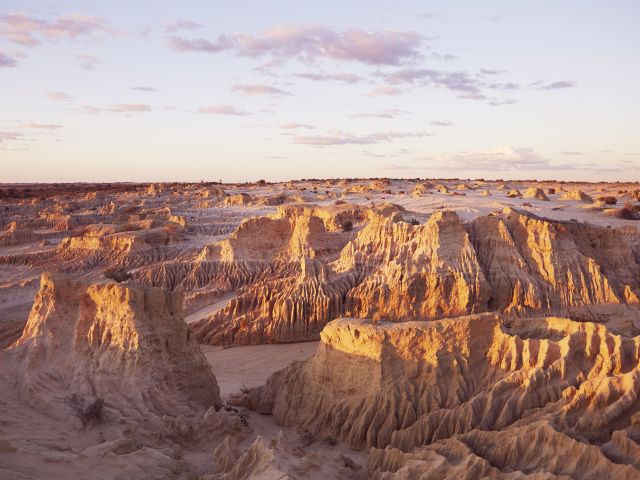
    Spend time in the striking, lunar-like landscape of Mungo National Park. (Credit: Destination NSW)

    With its lunar-like landscape made up of ancient, dried lake basins and sculpted sand and clay formations, a drive into UNESCO World Heritage-listed Mungo National Park is somehow two things all at once: uniquely Australian with vast outback skies, and somehow otherworldly, as though you’ve been dropped off by spaceship. At its heart lies the iconic Walls of China, a 30-kilometre sand-and-clay lunette shaped by thousands of years of erosion.

    Understanding more than 40,000 years of Barkindji, Mutthi Mutthi and Ngiyampaa history begins with a visit to the Visitor Centre, and concludes with a sunset tour led by local Aboriginal guides. A key experience? Learning about the discovery of Mungo Man and Mungo Lady. At 40,000+ years old, these are among the oldest human remains found anywhere in the world.

    4. Kinchega National Park

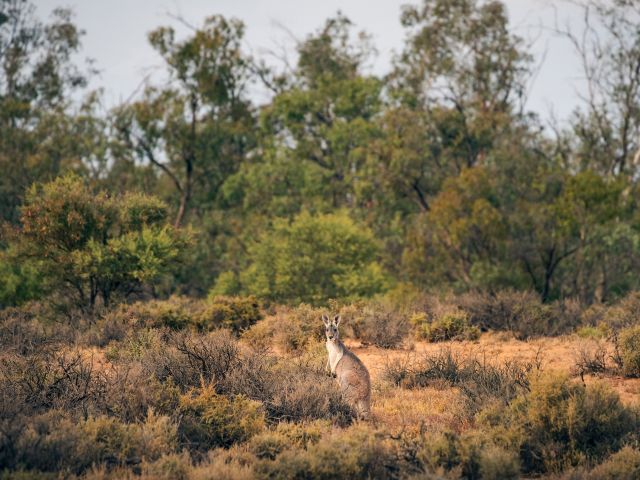
    kangaroo in Kinchenga National Park nsw
    Meet the locals of Kinchega National Park. (Credit: Destination NSW)

    Some come to Kinchega National Park for its iconic Darling River landscapes full of birdlife and haunting river red gums; others visit for its rich First Nations and pastoral history. Your visit will encompass all of the above, with a guided tour (part of AAT Kings’ MAKE TRAVEL MATTER Experience) designed to give a deeper understanding of Barkindji cultural heritage, history and traditions.

    Walk with local guide David as he shares ancestral knowledge and creation stories, and explains how native plants – through bush food and bush medicine – have sustained Indigenous communities for thousands of years. Then sit back and enjoy those views alongside native tea and sweet treats.

    5. Griffith

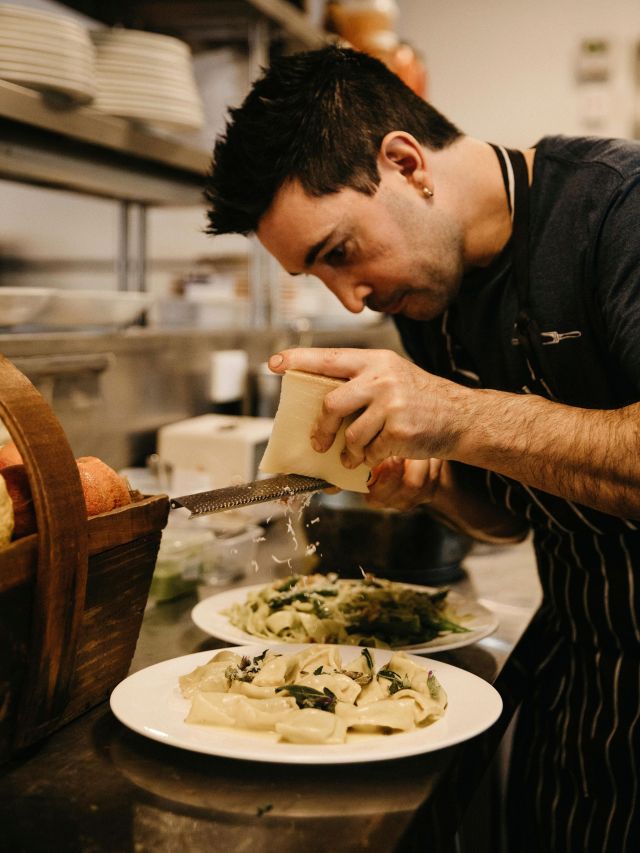
    chef at zecca restaurant in griffith
    Treat your tastebuds to ‘the food bowl of Australia’. (Credit: Destination NSW)

    How can you say no to a visit to a destination widely regarded as ‘the food bowl of Australia’? Shaped by fertile farmland and home to approximately 75 per cent of New South Wales’ wine grapes, this is a day to roll up your sleeves and enjoy the best gastronomy the state has to offer. Think vineyards, cellar doors, cafes and restaurants largely shaped by its multicultural heart (Griffith is not only home to over 60 nationalities, but has the highest proportion of Italian ancestry anywhere in Australia).

    6. Mudgee

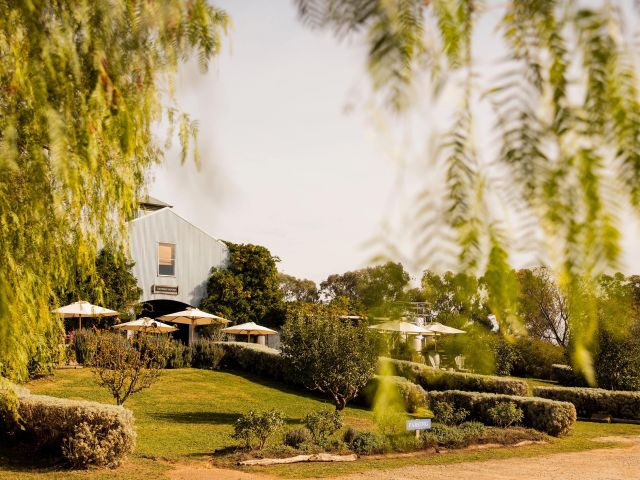
    exterior of lower wines in mudgee nsw
    Visit some of Mudgee’s best wineries. (Credit: Destination NSW)

    Nestled by the Cudgegong River, Mudgee packs a big punch for a heritage country town, having carved a reputation for itself as one of the country’s leading (and award-winning) wine regions, a key epicurean destination, and a regional arts centre growing in both visibility and vibrancy.

    Take a moment to enjoy the town’s 19th-century charm before heading to Lowe Family Wine Co. for a guided tasting of organic and biodynamic wine, followed by a relaxed lunch featuring a feast of homegrown and local produce. Will you walk away with bottles of Mudgee’s iconic reds under your arms? It’s a distinct possibility.

    7. Silverton

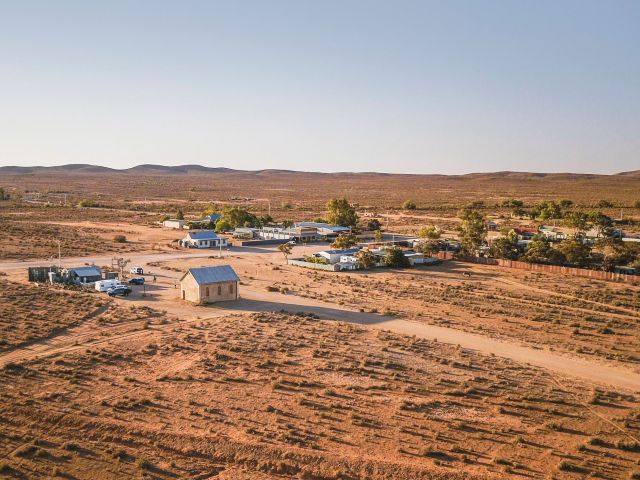
    see the living ghost town of silverton on AAT Kings new NSW outback tour
    See the living ghost town of Silverton.(Credit: Destination NSW)

    A once-booming silver mining hub, the dystopian setting for Mad Max 2, and now a tranquil settlement that’s home to around 50 people; Silverton is considered a living ghost town and remains a sight to behold.

    Take time to explore its heritage streets (and perhaps take a look at the quirky Mad Max 2 Museum) and the Silverton Hotel, an iconic outback pub, before a visit to Silverton Gaol & Historical Museum. It’s home to a wealth of colonial artefacts, early mining equipment and stories from the outback’s pioneering past which will serve to anchor you firmly in place.

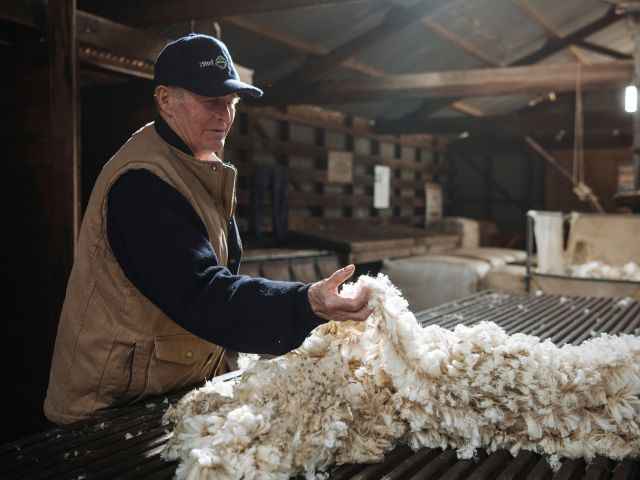
    8. Shear Outback

    man working at shear outback in nsw
    Get a glimpse behind the wool curtain. (Credit: Destination NSW)

    If you ever find yourself singing, “click go the shears boys, click, click, click…”, you’ve come to the right place. Shear Outback, an award-winning tourist and education attraction located in Hay, brings to life the traditions and stories of one of the outback’s most enduring industries: sheep shearing.

    Here, in the heart of the Riverina, you’ll enjoy live shearing demonstrations, meet the shearers, shedhands, sheepdogs and yes, sheep, who come together to show guests exactly what it takes to provide Australians with all that glorious wool.

    Discover more of Outback NSW with AAT Kings. Visit aatkings.com.