Here are the best places to swim around Australia

hero media
Caroline Clements and Dillon Seitchik-Reardon took a year off work to live the Aussie dream: travelling the country in search of the best swimming spots, from beaches to lakes to gorges. Here, they talk us through some favourites from their resulting book Places We Swim, a loving homage to our national obsession with the water.

For many of us in Australia, it is impossible to separate ourselves from the water. A thousand sensory memories flood back with every slop of sunscreen: windy days picking sand from our lunch and the feeling of salt water drying on our skin, scratching us under our clothes. As people of the world’s driest inhabited continent it’s no surprise that water should have such an elevated role in our society. It’s a fixation that has defined us since the beginning, whether we are coastal or inland dwellers.


Our fascination with water remains a critical part of our social identity. Through Places We Swim (Hardie Grant Travel, $39.99) we’ve tried to capture the very best possible representation of the country – we wanted it to be as democratic as possible. Swimming cuts through age, class, gender, religion and ethnicity. After all, what is more equalising than being outdoors in near nakedness among strangers?


In this way, swimming is a natural access point to understanding the Australian experience. On a hot day, any swimming hole in the country will provide a cross section of all people. Whether it’s the beach, an ocean pool, a lake, river, gorge, dam, waterfall, hot spring or billabong, these bodies of water and the surrounding landscapes reveal our better selves. Each place tells a story of its community.


The idea of documenting our swims is something that we had been indirectly working on through years of road trip adventures. However, it was only when our far-fetched pitch was accepted by our publisher that it coalesced into a book. We had always talked about driving a big lap around the country and suddenly found the perfect excuse to do so. Writing a book about the best places to swim in Australia felt like the ultimate study on our cultural connection to water, and maybe the best job we’d ever have. Here is a snapshot of some of our favourites.

Beach

Need tips, more detail or itinerary ideas tailored to you? Ask AT.

AI Prompt

Bay of Fires, Tasmania

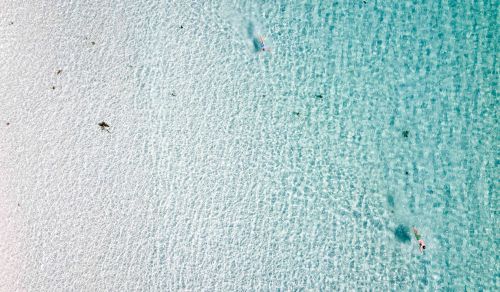
It might not be what you expect but Tasmania is home to some of Australia’s best beaches. You just have to be OK with the immune-boosting power of cold water. And if you like white sand, perfectly clear water and going to the beach but not sharing it with other people, this is the place for you.

Pool

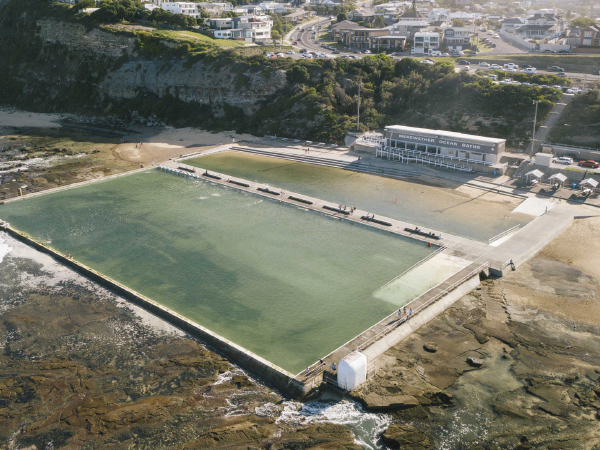
Merewether Ocean Baths, New South Wales

Newcastle has a long history of popular swimming spots, but Merewether baths is our favourite. The complex opened in 1935 and is the largest in the southern hemisphere. It’s also open year-round, 24 hours a day and is free to enter.
Lake

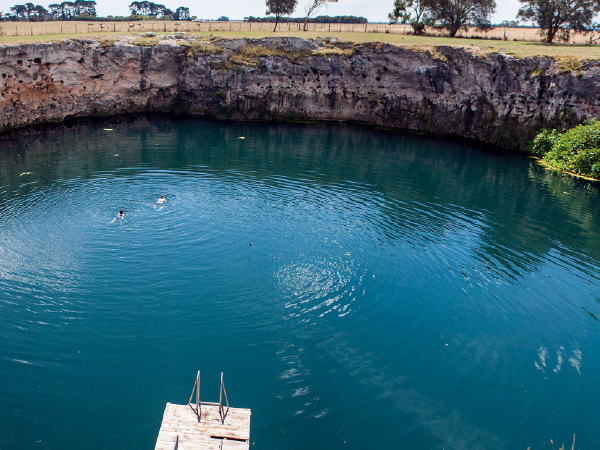
Little Blue Lake, South Australia

Little Blue Lake, also known as Baby Blue, sits in an unassuming paddock south of Mount Gambier. This lake is actually a sinkhole, formed by the gradual collapse of an underground cave. The pool’s average depth is about 35 metres and is popular for diving, though surface swimming is more our speed.
Weekly travel news, experiences
insider tips, offers, and more.

Hot Spring

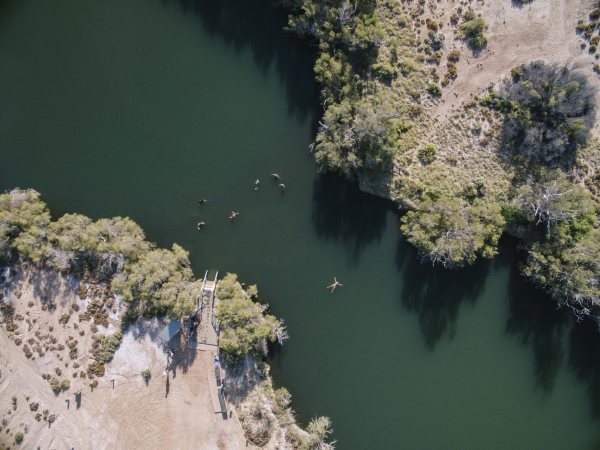
Dalhousie Springs, South Australia

Early morning is the best time to visit Dalhousie Springs, where the water temperature is 38°C. This group of 60 artesian thermal springs might be one of the most remote places in the book – sitting on the western fringe of the Simpson Desert – but is the perfect place to soak in warm waters after a long car ride. A true oasis.
Gorge

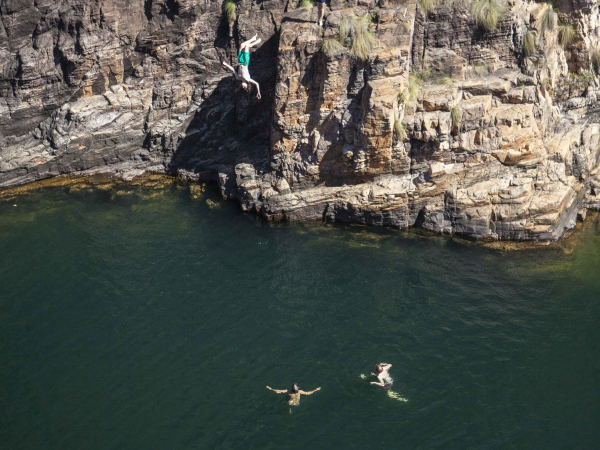
Maguk gorge, Northern Territory

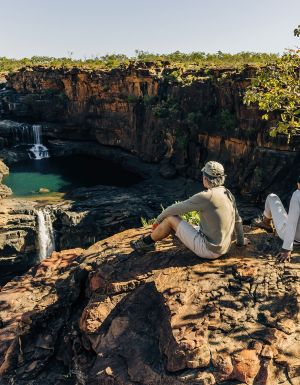
The jewel in the crown of the Kakadu swimming spots, Maguk is a deep, wide gorge where sheer cliffs drop into what seems like a bottomless pool. Find a rocky platform to sit on in the sun, or jump from the ledges (though we didn’t tell you that).
Want to see more stories from Australian Traveller in your Google search results?

  1. Click here to set Australian Traveller as a preferred source.
  2. Tick the box next to "Australian Traveller". That's it.
Caroline Clements

Caroline Clements

View profile and articles

From coast to bush: these are Gippsland’s best hikes

    Michael Turtle Michael Turtle

    Video credit: Tourism Australia

    From coast to mountains, hiking in Gippsland offers a stunning array of landscapes, with trails that take you deep into the region’s heritage.

    I step out onto the sand and it cries out underfoot. Kweek! I take another step and there’s another little yelp. Screet! Picking up the pace, the sounds follow me like my shadow, all the way down to the water. It’s obvious how this spot got its name – Squeaky Beach – from the rounded grains of quartz that make the distinctive sounds under pressure.

    For many, Wilsons Promontory National Park is the gateway to Gippsland, and the best way to explore it is by walking its network of hiking trails, from coastal gems such as Squeaky Beach through to the bushland, among the wildlife. But it’s still just a taste of what you’ll find on foot in the region.

    Venture a bit further into Gippsland and you’ll discover the lakes, the rainforest, and the alpine peaks, each changing with the season and offering summer strolls or winter walks. Just like that squeaky sand, each step along these trails has something to tell you: perhaps a story about an ancient spirit or a pioneering search for fortune.

    The best coastal hikes in Gippsland

    sunset at Wilsons Promontory National Park
    Wilsons Promontory National Park is a sprawling wilderness with many coastal bushland trails. (Image: Mark Watson)

    Wilsons Promontory National Park (or ‘The Prom’, as you’ll end up calling it) is an easy three-hour drive from Melbourne, but you might ditch the car when you arrive, with much of the park’s 50,000 hectares accessible only by foot. From the inky water of Tidal River (dyed dark purple by abundant tea trees), I like the easy walks along the coast, among lichen-laden granite boulders, to golden beaches and bays.

    a couple on Mount Oberon
    Panoramic views from the summit of Mount Oberon. (Image: Everyday Nicky)

    The trail to the panoramic views at the summit of Mount Oberon is a bit harder, up steep timber and granite steps, but it’s a popular 6.8-kilometre return. The more remote hikes are found through the open banksia and stringybark woodland of the park’s north, or along the multi-day Southern Circuit, which ranges from about 35 to 52 kilometres, with sunrises and sunsets, kangaroos and cockatoos, and maybe even whales.

    a golden sand beach at Wilsons Promontory National Park
    Walk ‘The Prom’s’ golden sand beaches. (Image: Tourism Australia/Time Out Australia)

    You might also see whales on the George Bass Coastal Walk, even closer to Melbourne on the western edge of Gippsland. This dramatic seven-kilometre trail along the clifftops takes in sweeping views of the wild ocean, occasionally dipping down from grassy green hills to coastal gullies and a secluded beach. It also now links into the Bass Coast Rail Trail for an extra 14 kilometres.

    the George Bass Coastal Walk
    George Bass Coastal Walk trails for seven kilometres along clifftops. (Image: Visit Victoria/Time Out Australia)

    Over at the eastern edge of Gippsland, in Croajingolong National Park, you can wander along the lakeshores beneath koalas and around goannas (I keep my distance since one chased me here!). For those who are even more adventurous, the park is also the starting point for the 100-kilometre Wilderness Coast Walk, usually done over seven days.

    the Croajingolong National Park, Gippsland
    Wander along the lakeshores in Croajingolong National Park. (Image: Tourism Australia)

    The best bush hikes in Gippsland

    the Baw Baw National Park
    The alpine heath of Baw Baw National Park. (Image: Everyday Nicky)

    Deep in the Long Tunnel Extended Gold Mine at Walhalla, mining guide Richard tells me how this small town in the mountains east of Melbourne boomed when prospectors found gold here in 1862. These days, you’ll find most of the town’s treasure – its heritage – above ground, with the Walhalla Tramline Walk a wonderful way to explore it.

    Just seven kilometres long, the walk takes you through decades of Gold Rush history, following the original rail trail from lush bushland to the mining sites, and through the charming village of just 20 residents with its wooden cottages and old shopfronts adorned with turn-of-the-century advertising posters. Blazing a trail where trailblazers once opened up the region, this is also the starting point for the 650-kilometre Australian Alps Walking Track.

    Nearby, Baw Baw National Park has walks through gnarled snow gums and alpine heaths that show off the colourful wildflowers in summer and the pristine carpet of white in winter. Several trails are perfect for snowshoes, including a 45-minute route from St Gwinear up to vast views across the Latrobe Valley.

    Further up into the mountains, the Toorongo and Amphitheatre Falls Loop Walk is an easy 2.2-kilometre path that serenades you with the sound of flowing water as you pass mossy rocks and tree ferns en route to two sets of waterfalls cascading over boulders in the remote wilderness.

    The best cultural hikes in Gippsland

    the Mitchell River National Park, Gippsland
    Hike the Mitchell River National Park. (Image: Parks Victoria/Grace Lewis)

    Across a pool in a natural sandstone amphitheatre, deep within a cave behind a waterfall, it’s said the Nargun has its lair. A fierce creature, half human and half stone, that abducts children and can’t be harmed by boomerangs or spears, the story of the Nargun has been told around the campfires of the local Gunaikurnai people for generations.

    As a culturally significant place for women, hikers are asked not to go into the Den of Nargun, but a 3.4-kilometre loop walk leads you through a rainforest gully to the entrance where you can feel the powerful atmosphere here in Mitchell River National Park, along Victoria’s largest remaining wild and free-flowing waterway.

    the bee-eaters at Mitchell River National Park
    Bee-eaters at Mitchell River National Park. (Image: Parks Victoria/Grace Lewis)

    The Den of Nargun is part of the Bataluk Cultural Trail, a series of important traditional Gunaikurnai sites through central Gippsland. Another location is Victoria’s largest cave system, Buchan Caves Reserve, with trails to important archaeological sites of human artefacts up to 18,000 years old. The FJ Wilson Interpreted Walk includes the naturally sculpted white limestone steps of the 400-metre-long Federal Cave, while the Granite Pools Walk goes among tall timber and moss-covered gullies.

    the ancient rainforest of Tarra-Bulga National Park
    The ancient rainforest of Tarra-Bulga National Park. (Image: Josie Withers)

    Also important to the Gunaikurnai people is Tarra-Bulga National Park, known for its ancient myrtle beeches and enormous mountain ash trees. Just 40 minutes return, the Tarra Valley Rainforest Walk offers a taste of this verdant landscape, while the Grand Strzelecki Track takes you deep into the lost world of forest giants on an epic 100-kilometre trail rich with tradition.

    A traveller’s checklist

    Staying there

    the WildernessRetreats in The Prom
    Wilderness Retreats in The Prom. (Image: Christian Pearson)

    Wilderness Retreats in Wilsons Promontory offers glamping-style tents with luxurious queen beds. Star Hotel is a reconstruction of a Gold Rush-era hotel from 1863 in the heart of heritage Walhalla. Caves House is a historic three-bedroom house with views over the Buchan River.

    Eating there

    the Carrajung Estate, Gippsland
    Enjoy a post-hike lunch at Carrajung Estate. (Image: Everyday Nicky)

    Kilcunda General Store serves great coffee and meals of local produce at the George Bass Coastal Walk. Alpine Trout Farm is located near Toorongo Falls in Noojee. Fish for your own lunch and barbecue it with the provided cookware.

    Carrajung Estate is a short drive from Tarra-Bulga National Park. The winery’s restaurant offers a seasonal menu of regional ingredients and you can stay at The Lodge.

    a seafood feast at Carrajung Estate, Gippsland
    The table is set for a seafood feast at the estate.

    Video credit: Tourism Australia