From ocean to plate: catch and cook on the South Coast

hero media
Elisha Kennedy dives into the catch-and-cook philosophy, literally, by taking a hands-on tour through the bountiful waters of NSW’s Far South Coast.

We had always planned to make our road trip to the base of the New South Wales south coast our ‘seafood holiday’. As city-dwellers, my partner and I relished the opportunity to cast our phones aside and drive to a place where the ocean is sapphire blue and you can pick up a dozen delicious oysters from a roadside stall for under $10.


That is our idea of heaven, but we wanted more than just buying our meals – we wanted to physically catch our own. We’re both competent at fishing and were keen to try something more hands-on, but how would we know where to look? What to bring? Or what to do with it when we found it? Easy – ask a local.


Scott Proctor grew up on the Sapphire Coast and has spent a large portion of his life either in the ocean, or learning about it. After studying marine science at the University of Wollongong, he returned to his hometown of Pambula, deciding to share his passion for the sustainable seafood that is available there through his tour company, Australia’s Coastal Wilderness Adventures (ACWA).


Through ACWA, Scott offers small-group marine experiences including snorkelling, prawning and ocean to plate. We chose the ocean-to-plate experience, which incorporates a targeted dive for abalone, lobsters, mussels, crayfish and sea urchins followed by a cook-up of the seafood harvest for lunch. The market value alone to buy this produce is hundreds of dollars, but it was the opportunity to pick the brains of a local marine expert that really had us hooked.


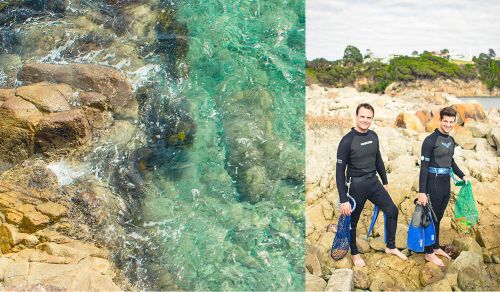
We met Scott at the Eden Visitor Information Centre, and from here he drove us to a remote access point to Twofold Bay. All necessary gear, equipment and a fishing licence is provided and, after kitting up, we clambered over rocks to the shore.


A quick verbal run-through from Scott on snorkelling and breathing techniques, and we were in practising our dives. It doesn’t take long to get the hang of it, and we improved with each resurfacing. When we felt comfortable in depths of several metres, Scott led us further offshore to begin ‘the hunt’. We snorkelled through a changing ocean landscape: rocky walls, seagrass beds and shallow reefs.


The bay was teeming with marine life. On our two-hour dive we encountered wobbegong sharks, eastern rock lobsters, black and red spined urchins, starfish, abalone, blue mussels and a variety of fish species. But only some of those are good eating, and we were after a meal.


The prized abalone hide in crevices, cementing themselves between the curves of rocks in the deep. The smaller ones are plentiful here in the bays of Eden, but the minimum legal size to keep is 11.7 centimetres, and finding the larger ones takes patience. What we were really after were lobsters, and finding them is no easy feat. They’re extremely well camouflaged and surprisingly strong. Scott’s well-trained eye spots them, lying low in the crayweed – given away only by their thin and reddish antennae. A quick and agile grab secured them, and we kept them in netted bags attached to our weight belts. Deeper offshore we found mussel beds, easy enough to twist off the rocks – if you can hold your breath long enough to do so.


Between the three of us we bag two crayfish, four abalone and 40 mussels. Scott chats about the importance of bag limits, encouraging you to take “just enough for lunch", and he always varies dive locations. “It’s crucial not to harvest too much from the same area," he tells us. “It might be tempting but it’s not sustainable, for you or the ecology."


We carted our harvest up the hill to Eden’s Rotary Park lookout, to cook what we would go on to confidently claim as the best meal of our lives. After two hours of intense swimming and diving in the salty ocean we had worked up a healthy appetite and, as we readied lunch together, Scott demonstrated the best ways to prepare and cook our catch.


We couldn’t believe the immense satisfaction and overall sense of wellbeing we gained from a single meal. You haven’t tasted fresh until you’ve eaten seafood that your own hands have plucked out of the ocean and thrown into the frypan in a matter of minutes. Our catch is paired with a local sourdough from Wild Rye’s Baking Co in Pambula and oysters fresh from the Merimbula leases. “It’s so important for me to support the local producers," Scott explains. “In this way, we’re working together." Everything we ate for lunch came from the local region – even the tomatoes were grown in Scott’s family’s backyard.


At the end of our ocean-to-plate experience, our bodies felt fit and full. In such a short amount of time we had gained a skillset that could feed us for many meals to come, and that is an invaluable experience.


Need tips, more detail or itinerary ideas tailored to you? Ask AT.

AI Prompt

Want to see more stories from Australian Traveller in your Google search results?

  1. Click here to set Australian Traveller as a preferred source.
  2. Tick the box next to "Australian Traveller". That's it.
hero media

Victoria’s most memorable guided tours to book now

    Lara Picone Lara Picone
    Get around the natural beauty and bounty of regional Victoria on a guided tour that reveals extraordinary moments from coast to country.

    Walk the Great Ocean Road

    forest walk along the Great Ocean Road
    Swap your car for walking shoes on the Great Ocean Road.

    The Australian Walking Co’s immersive three-day, lodge-based walk is absolute bucket-list fodder. The easy-going, guided coastal hike is marked by epic scenery and end-of-day luxury. You’ll have no need for heavy packs or tents, instead expect fresh-caught crayfish, post-walk canapés and local wines. Each day explores the drama of this ocean-facing landscape with an approachable three-hour-ish walk, leaving plenty of time to unwind at the lodge.

    Swim with seals and dolphins at Port Phillip Heads

    dolphins swimming in Port Phillip Head Marine Park
    Swim with dolphins in Port Phillip Head Marine Park.

    Dive into Popes Eye, within Port Phillip Heads Marine National Park, for this wild swimming experience with mankind’s BFFs of the sea. On the See All Dolphin Swims 3.5-hour experience, departing from Queenscliff, you’ll begin in shallow, calm waters before venturing off to Chinaman’s Hat and beyond to meet seals and dolphins in their own habitat. All gear is provided and all ages are welcome.

    Get your ghost on in the Grampians

    For those with a penchant for the paranormal, get ready for goosebumps when you embark on the Lantern Tours J Ward Paranormal Investigation excursion that takes place under the moonlight in the west wing of Aradale Lunatic Asylum. As you keep a lookout for supernatural activity, you’ll enjoy tales of the criminally insane inmates that will make the hairs on your neck stand to attention.

    Paddle along the mighty Murray

    a woman on a stand-up paddle board along the Murray
    Glide along the scenic Murray on a stand-up paddleboard.

    Swoosh softly through the silky waters of the mighty Murray on a stand-up paddle board with Echuca Moama Stand Up Paddle. This gentle downstream sojourn meanders for one-and-a-half hours covering 4.5 kilometres of the river, taking in the beauty on the banks and the vibrant birdlife.

    From Echuca Moama slip under the Moama Bridge and glide beside its iconic paddlesteamers and the historic port.

    Sip and cycle in the Yarra Valley

    cyclists exploring Yarra Valley
    Cycle around Yarra Valley wine country.

    Wine and wheels make a great pairing on the Tour De Vines six-hour Yarra Valley tour that weaves through vine-threaded roads. It’s a relaxed pace along 20 kilometres of the Warburton Rail Trail as you spot native birds and stop in at local vineyards and produce stores. You’ll pull in at a local winery for a tasting and enjoy lunch before hitting up a couple of cellar doors. Depending on your pedal power, there may be time to sneak in a visit to a chocolate or cheese factory.

    Dig for gold in Bendigo

    Think you have what it takes to unearth a gilded treasure? Try your hand at prospecting and learn the art of gold-digging (in the geological sense) on the two-hour Gold Nugget Hunter tour in the Loddon Valley. On the tour, mine the wisdom of locals Shane and Jackie – who have honed their hobby of gold-detecting into an art – to learn how to read the land and use a gold detector. You may even go home with a nugget of your own.

    Cruise around Wilsons Promontory

    the Skull Rock in Wilsons Prom
    Cruise around Skull Rock in Wilsons Prom. (Image: Connor Vaughan)

    It’s a thrill to drive directly from the sand into the waves aboard the Wanderer Adventures’ bright-yellow amphibious boat. On this 2.5-hour tour, you’ll skip along the water to take in Wilsons Prom’s top highlights, such as the imposing Skull Rock, The Glennies, Anderson Islets and Anser Island. Spot seals, penguins and seabirds as you absorb the tranquillity of this stunning environment.

    Walk with llamas in the Macedon Ranges

    a llama in the Macedon Ranges
    Make friends with a llama in the Macedon Ranges.

    If you’ve always felt an affinity for long-lashed camelids, then bonding with a llama on a leisurely walk might just be the thing for you. Opt for either a three-hour, five-kilometre hike or a longer 12-kilometre trek along the Domino Rail Trail paired with a gentle, hooved friend. Things kick off with a llama orientation, where you’ll learn how to lead and look out for your new mate before you hit the track. It’s a lovely way to explore the beauty of the region with a sensitive and curious companion by your side.

    Go underground in the Grampians

    a subterranean tour of Seppelt Wines
    Take a subterranean tour of Seppelt Wines. (Image: Ben Savage/We Are Explorers)

    Oenophiles and cave-lovers alike will enjoy going underground at Seppelt’s ‘Drives’. The largest underground cellar in Australia, The Drives were dug by local goldminers in 1868 and meander for three-kilometres – keeping wine treasures at a temperate 16-degrees year-round. A 50-minute tour through the heritage-listed granite tunnels happily conclude with a tasting of the label’s celebrated sparkling wines.

    Discover island life in the Mornington Peninsula

    a guided tour of French Island
    Discover the Mornington Peninsula’s flora and fauna on a guided tour of French Island.

    Eject from the mainland on a catamaran bound for the wildlife haven of French Island with Naturaliste Tours. Once you disembark from the boat, you’ll hop into a 4WD to explore the pristine flora and fauna, from salt marshes to vast Fairhaven Beach.

    Look out for echidnas and koalas and enjoy short walks and historic sites on this half-day tour.

    seals in Wilsons Prom
    The southernmost tip is a haven for wildlife. (Image: CMcConville)