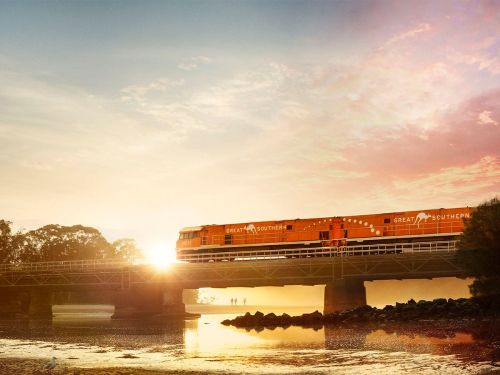
The Great Southern that connects Brisbane and Adelaide is a rail journey of a lifetime, rendering a vivid image of the vast landscapes it traverses.
Distance is not measured in kilometres onboard the Great Southern that travels between Brisbane and Adelaide. Instead, vignettes of rural Australia serve as waymarkers: A white mare flicking its tail on the emerald slopes of the Byron hinterland; A lone shack – weatherboarded and timeworn – perched by the briny banks of the Hawkesbury River; Silos rising from the golden grasslands of regional Victoria, rendered tender in the honeyed glow of the evening sun.
In the early 20th century, Australian bush poet Henry Lawson popularised ‘the sketch’ – a literary form consisting of a short, descriptive narrative containing little plot, if any at all. Before the advent of mainstream photography, ‘the sketch’ served to evoke the essence of a place and transport readers, however briefly, into an unfamiliar world.
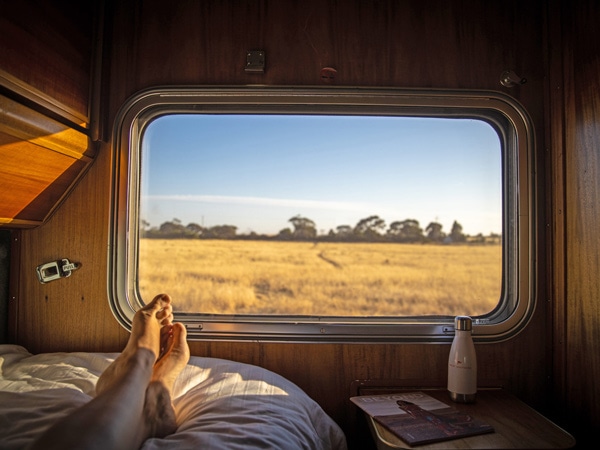
Journeying aboard the Great Southern feels analogous. From the window of my cabin, pastoral scenes rush by, fading from view just as quickly as they enter. The motion of the train melds the colours – all dusty greens, mottled browns and smoky greys – into painterly impressions, rough sketches of life in the country.
Just like ‘the sketch’, there is no plot to the sequence; each scene is stitched together only by threads of the imagination that conjure up fleeting images of what life might look like in the places we pass by. In another life, I’m watching the train pass me instead. From the quaint cottage with a horse in its paddock. The sun-bleached porch of the riverside shack. The dinky little farmhouse on Victorian cattle country.
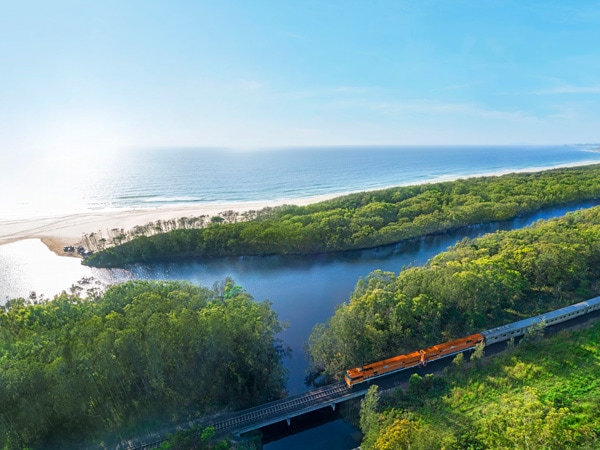
Over four states, three days and 2885 kilometres of railroad, the Great Southern renders a sketch of the country. It’s a mammoth journey that takes in diverse landscapes, food and people from all walks of life.
Tracking down dinner in Coffs Harbour
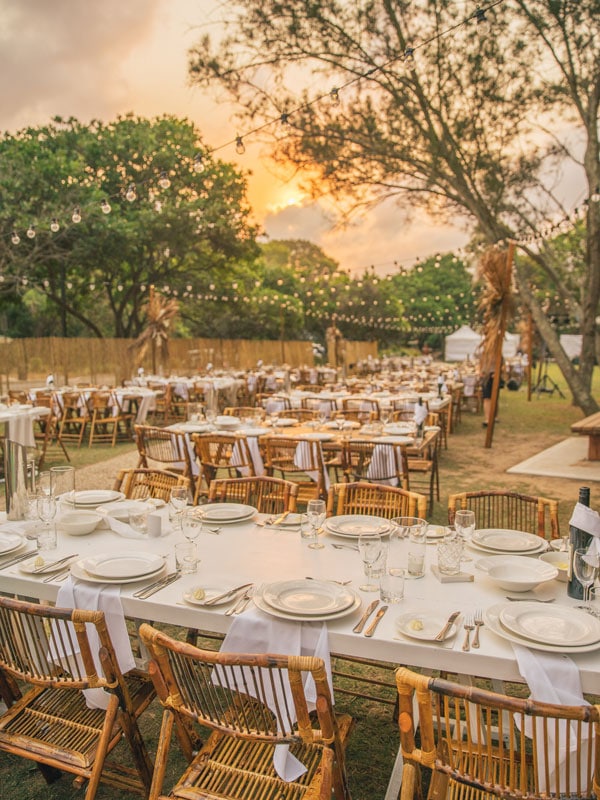
Smoke perfumes the air like incense as we’re welcomed to Gumbaynggirr Country. A crescent moon hangs above us like an opalescent crack in the sky, dusk mellowing the coastal hues of the landscape, now a delicate wash of seafoam, terracotta and ivory. We’ve disembarked at Coffs Harbour for the Great Southern’s first off-train excursion, a beachside dinner that showcases al fresco dining at its very finest.
Long tables have been set out, dressed in fresh white and festooned with fairy lights, perfectly encapsulating the airy coastal charm of the setting. Caterers have plated up a taste of the region. There are oysters from Nambucca Heads, so fresh the brackishness is palpable. Beef from Casino paired with potatoes from Dorrigo (aka ‘spud country’). And, best of all, local bananas that have been crafted into sumptuous bites of banoffee tart for dessert.
As we dine, we’re accompanied by the sound of the ocean’s churn, the croon of a live jazz band and the ebullient buzz of chatter among fellow passengers getting to know one another. They may be strangers now, but once the train reaches its terminus, many will disembark as friends. This is thanks to the social nature of the Great Southern, where the lounge and bar car serve as the communal hub and beating heart of the train. Back onboard, I make a beeline for the bar as soon as I hear the engine begin to hiss and groan into motion.
A snapshot of daily life onboard
The carriage is flush with crimson and gold, Tasmanian Blackwood timber and Art Deco flourishes – a nod to an era when rail travel was in its prime. Entering the bar feels like stepping into a Hitchcock film. It’s not just the old-world feel of it all – I’m walking in the opposite direction of motion, giving the surreal effect of the filmmaker’s infamous ‘Dolly Zoom’ as I approach the bar.
I order a nightcap of Baileys over ice and soak in the evening’s entertainment – singalong tunes courtesy of guitarist and vocalist Kev Jones. The vintage theme is reflected in the song choices – Kev has come prepared with an arsenal of golden oldies, from Billie Holiday to The Beatles and Elvis’s entire discography.
Kev singles me out to sing the vocals on ABBA’s Dancing Queen and, despite my best efforts to decline the invitation, I end up in front of the car, reluctantly holding the microphone. I’m not singing the right lyrics, in the right key, or even the right tune. But none of that matters. The whole carriage is singing along with me, erupting when it comes to the chorus. The train hurtles on through the night.
Need tips, more detail or itinerary ideas tailored to you? Ask AT.
AI Prompt
Riding on a night train
When I retire to my cabin, I find that the room has miraculously been made up, the couch transformed into a cosy, single berth. I settle in, keeping the blinds open so I can watch the skeletal silhouettes of the eucalypts whizz past.
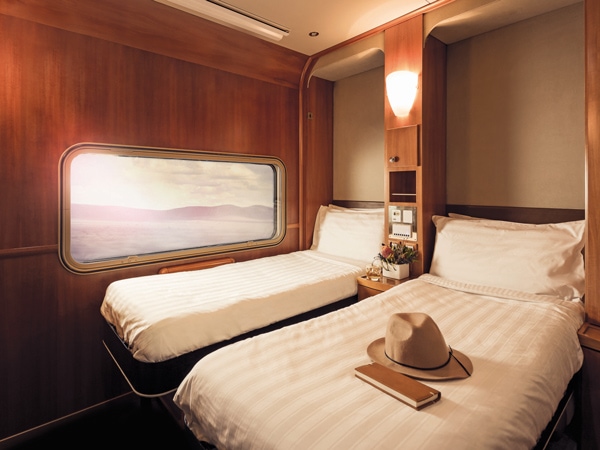
There’s something enduringly romantic about riding a night train; the latent sense of adventure; the link to a bygone era; the fact that it’s a prevailing, almost archetypal symbol in literature and folk music.
Henry Lawson surmised the sentiment best in On The Night Train, a poem he wrote in 1922 that would also be one of his last: Have you seen the bush by moonlight, from the train, go running by? / Blackened log and stump and sapling, ghostly trees all dead and dry.
I think of all who have taken in similar vistas before me, swagmen stowing away on freight trains as they moved through the country, commuters and coal miners throughout the ages. Sleep finds me eventually, and I’m rocked into a restful repose by the rumbling of the locomotive charging due south.
A stopover in Port Stephens
There are no roads to Tin City. Instead, I’m bouncing over sand dunes in the back of a 4WD bus as our guide, Craig Hallam, steers us onto Stockton Beach in Newcastle, NSW. While the majority of passengers have opted for a wine-tasting excursion in the Hunter, an intrepid few of us have set out exploring Port Stephens by land.
The evening primrose flowers leap out in contrast against the overcast grey of the morning. A colony of pied oystercatchers totter across the beach, poking their orange bills in the sand in search of pipis. A white-bellied sea eagle sits regally, hidden among the scrub. “These are the largest moving sand dunes in the southern hemisphere," Craig booms over the intercom as fellow passengers and I rock and sway in our seats.
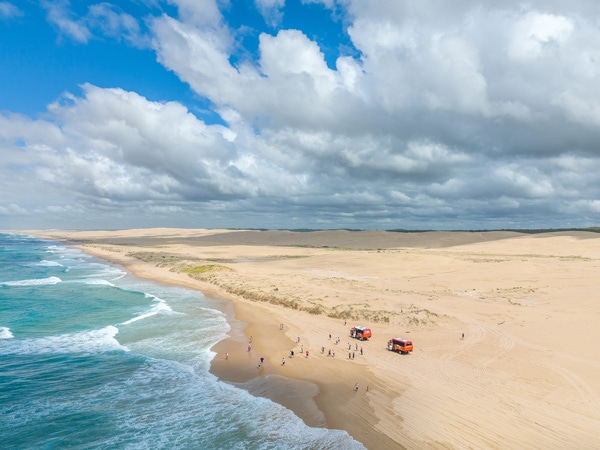
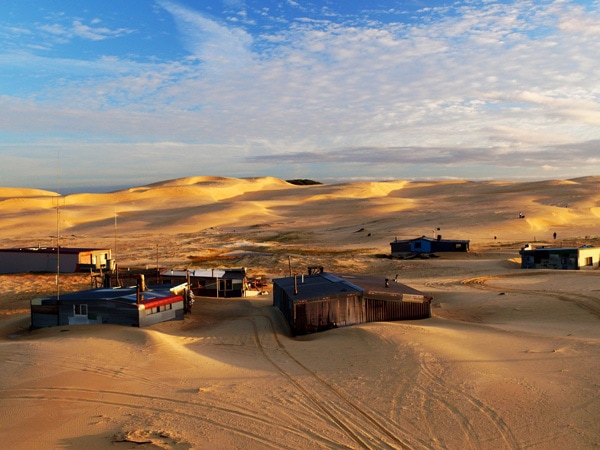
A Sahara-like scene looms behind us, mighty dunes that can rise up to 30 metres tall and reach a gradient of more than that of the world’s steepest ski pistes. This is the backdrop to Tin City, a shantytown of a dozen shacks at the end of the beach. Originally built for shipwrecked sailors in the early 1900s, the settlement mushroomed in the Great Depression of the ’30s. Now, there are just three permanent residents.
Each shack is a motley patchwork of scrap metal, taking ‘off-grid living’ to a new level. The height of tech here is a beer keg strapped to the roof of a resident’s house “so the sun can heat the water for hot showers".
If this sounds like something straight out of Mad Max, that’s because it is – Tin City appeared in the original 1979 action flick. But stranger than fiction is the real-life post-apocalyptic undertones of the beach. Traces of the region’s Second World War military history are very much alive today, in unearthed explosives scattered across the sand. “Every few years, they’ll uncover something they didn’t know was here," Craig explains. Recently, a bomb had to be blown up onsite and, not long before that, a dog presented its owner with an unexploded military mortar during a game of fetch.
A beer can’s kick away, two residents sit chatting beneath the shade of one of the shacks. On the roof, a black flag flutters in the wind. There’s something drawn on it that I can’t quite make out, so I ask Craig if he knows what it is. “I sure do," he replies with a chuckle. “It’s the Jack Daniels logo."
Weekly travel news, experiences
insider tips, offers, and more.
Travelling over the Hawkesbury River
Launched in 2019, Great Southern is the latest to join Journey Beyond’s fleet of great Australian rail journeys. Although it’s in its infancy compared to historic trains such as The Ghan, what the Great Southern lacks in age it makes up for in vistas.
“As far as I’m concerned, the [Great Southern] is certainly a superior journey for the scenery," says Bruce Smith, service operation manager of the train. And he would know. Bruce has worked on trains for 28 years, journeying all over the country with passengers among the likes of late PM Bob Hawke, singer Paul Kelly and actress Margot Robbie. Bruce isn’t the type to get starstruck, but certain sections of the route never fail to arrest him. The Hawkesbury River is one of them, and its bush-clad banks and gleaming boat-flecked bays are rolling into view now.
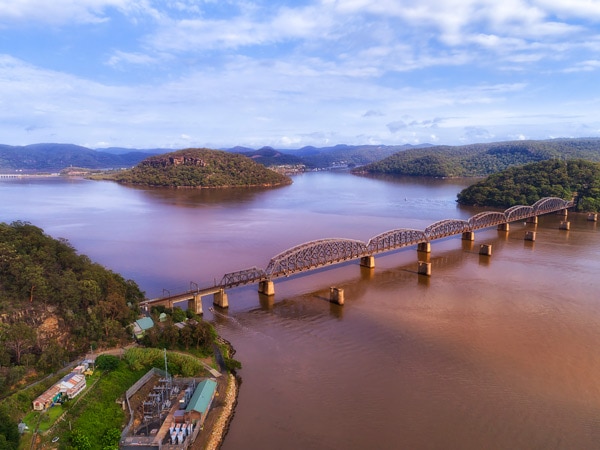
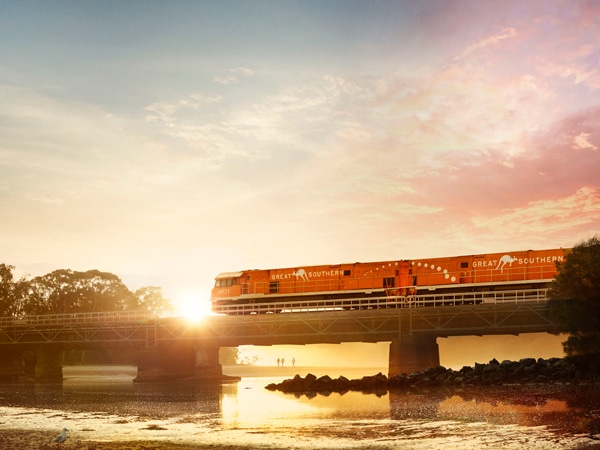
We cross over the Hawkesbury River railway bridge, which was the final link connecting the rail network between Adelaide, Melbourne, Sydney and Brisbane. Built in 1889, it was a major feat of 19th-century engineering. I imagine the first train passengers crossing it, hovering over the dimpled green water for nearly a kilometre, vaulting towards the warm sandstone shades of Darkinjung Country, captivated by it all as I am now.
A winery stop in Inverleigh
We alight in Inverleigh in regional Victoria, where we spend the afternoon lingering over a long lunch at the family-owned Clyde Park Winery. Nearly all the ingredients come from within a 20-kilometre radius. There’s local duck served glazed and sticky on a woodfired Peking duck pizza, roast lamb from ‘just across the river’ that’s been rubbed generously with herbs from the garden and succulent pork belly from a nearby farm. I sample the pinot noir: the crisp cherry, strawberry and rosewater notes refreshing my palate between bites.

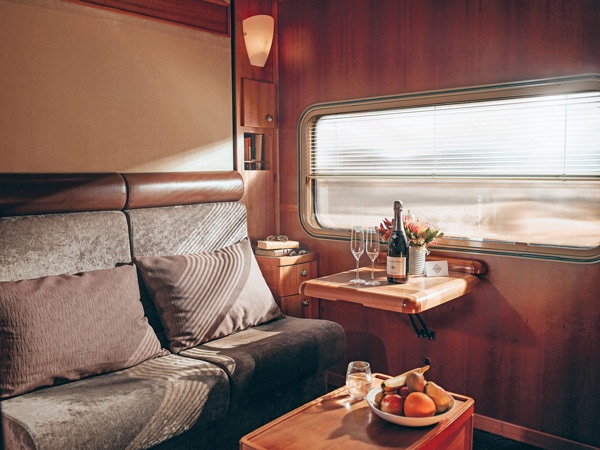
I return to the train so stuffed that I’m forced to pass on dinner, but I opt for a drink in the Queen Adelaide dining car to soak up the ambience. The sunset pierces the window, illuminating the bubbles rising in my Champagne glass and flooding the carriage with a honeyed hue.
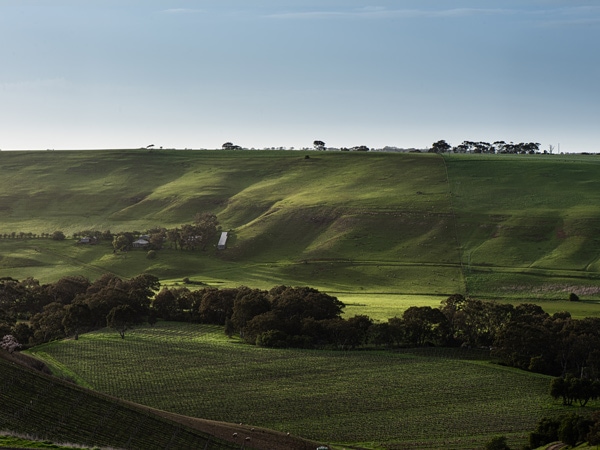
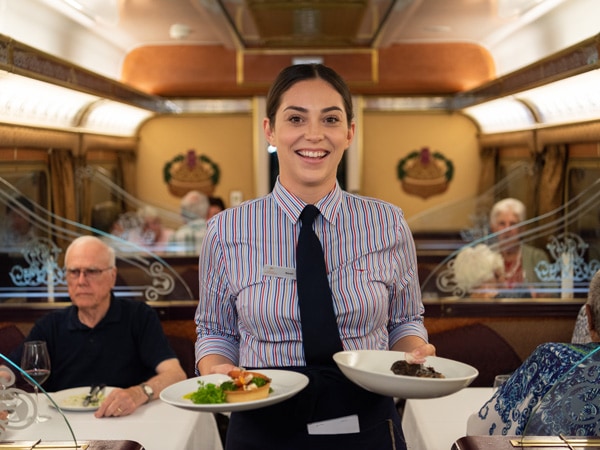
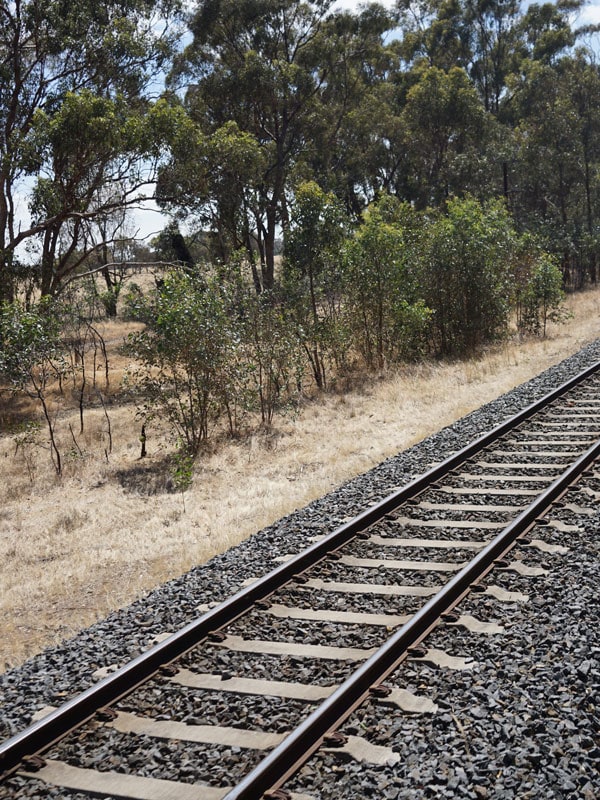
I watch snapshots of the country flash by in the day’s final light. Stringy eucalypts reflecting in glassy patches of water. Cows roaming across the tawny grass. Haze filming over mountains in the distance. These are the final wayposts on the route of the Great Southern, completing the final leg of its journey through the nation’s bucolic heart.
Want to see more stories from Australian Traveller in your Google search results?
- Click here to set Australian Traveller as a preferred source.
- Tick the box next to "Australian Traveller". That's it.