hero media

Where to swim with whales around Australia

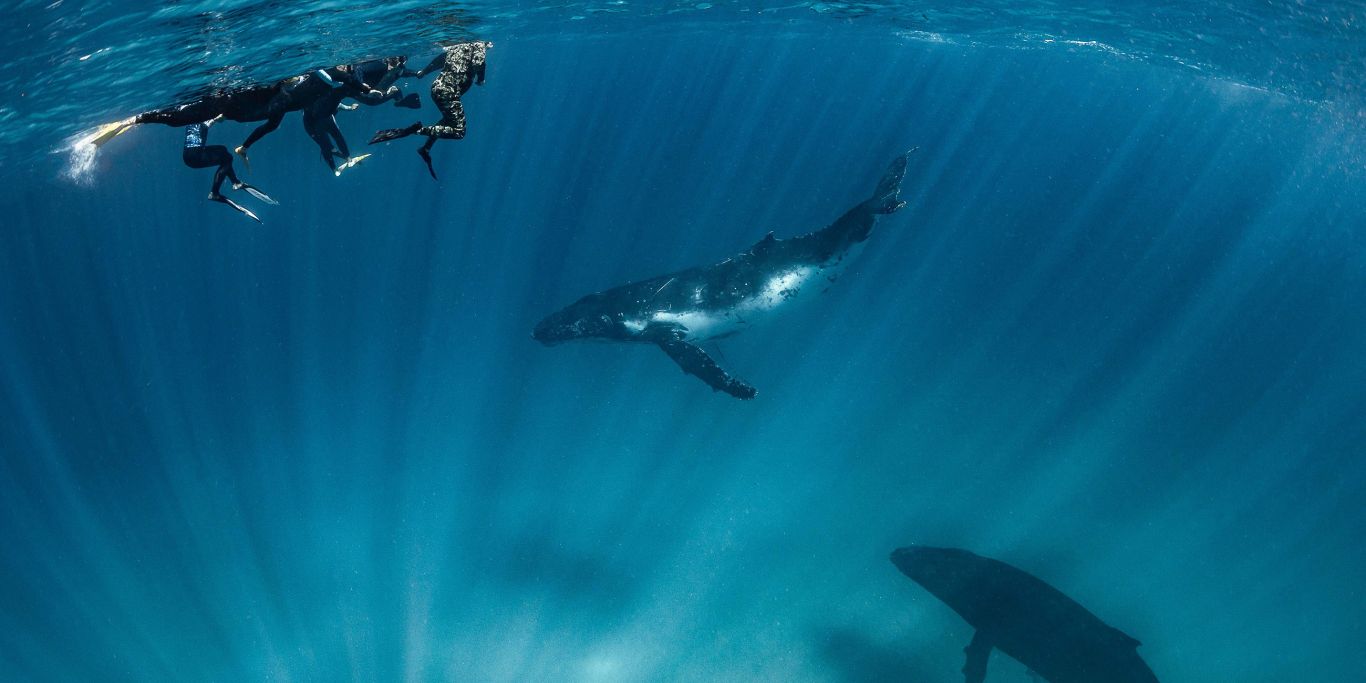
Credit: Tourism Western Australia/Brooke Pyke

Here is our guide to the best places to swim with southern right whales, dwarf minke whales, humpbacks and orca whales around Australia.

Swimming with whales has become a popular activity in Australia as the majestic mammals make their way up and down the Australian coastline during their annual migration. Here are the best places to take the plunge and swim with whales around Australia.

Swim with whales off Jervis Bay
Jervis Bay
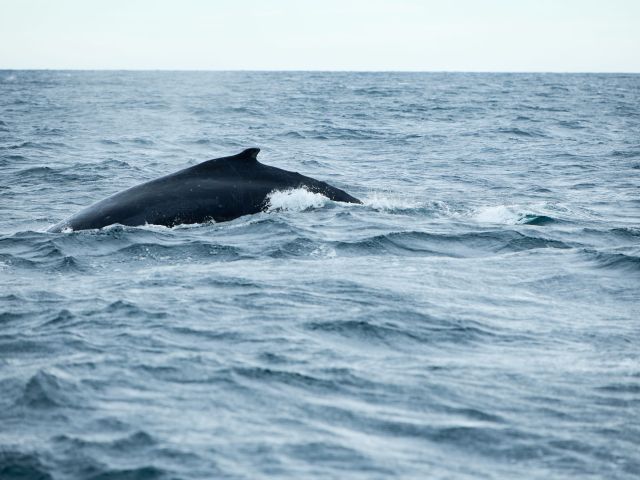
Swim with whales near Jervis Bay. (Image: Destination NSW)

You don’t have to swim with whales while on the NSW South Coast. You can clock them, cocktail in hand, by the pool bar when staying at Bannisters By the Sea.

But those feeling a tad more adventurous should book a Mollymook Migration package during their stay at the boutique South Coast property.

As part of the package, the Mollymook hotel has partnered with Woebegone Free Dive to offer a watery wonderland escape that includes a swim with whales. Dylan Boag and Lara Hindmarsh, of Woebegone Free Dive, are passionate about conservation, sustainability, ethical tourism and marine life.

Jervis Bay is halfway along the 5000-kilometre-long migration route and the whales often pull in for a pitstop to rest and play with newborn whales. It’s because of this that Jervis Bay is one of the best locations in Australia to see whales.

Best time to go: June to October

Eco credentials: Woebegone Free Dive takes its responsibilities with the environment seriously and tries to minimise its impact. The tour group operates a community clean-up event once a month and hosts a charity event for to raise funds for South Coast wildlife rescue Float 4 Wildlife. There’s a strict ‘no touch and no harassment’ policy during the tours. No single-use plastic items are onboard and lunch is plant-based.

Swim with whales in Shoalhaven
whale sharks in Shoalhaven
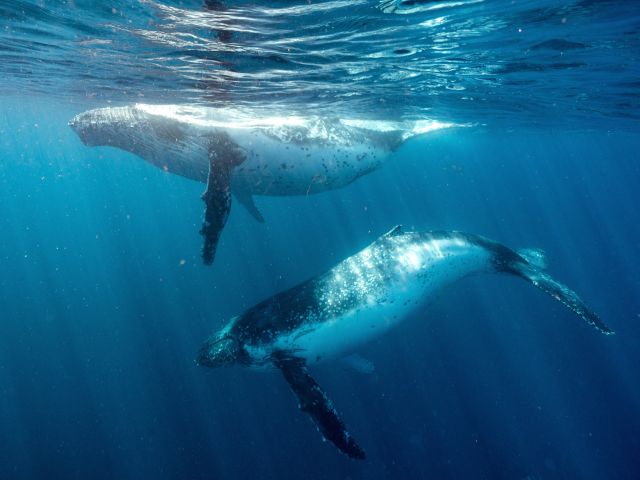
Humpback whales migrate off the Shoalhaven coast. (Credit Jordan Robins)

Between May and November, tens of thousands of humpback whales migrate from Antarctica through the stunning turquoise waters off the Shoalhaven coast. From winter through to spring, they travel to warmer northern waters to give birth and nurse their calves. Seeing them swim alongside their newborn calves is a truly unforgettable experience.

Join one of Dive Jervis Bay’s small group tours and jump in the waters of Jervis Bay Marine Park, located on the Humpback Highway. This thrilling 4–6 hour adventure gets you up close to gentle giants and playful seals, while a local expert shares the history of whaling in Jervis Bay, current conservation efforts and fascinating facts about whales to enrich the experience.

If you want to combine whale watching and fishing, book a tour with Ulladulla Fishing Charters, which offers excellent whale watching opportunities from the pristine waters off Ulladulla.

Best time to go: May to November

Eco credentials: Dive Jervis Bay is Sea Shepherd approved and operates under strict NSW permits. They follow regulated, non-invasive whale interaction practices. Their tours are small-group and education-focused, with a strong emphasis on marine conservation and wildlife respect.

Swim with humpbacks off Hervey Bay
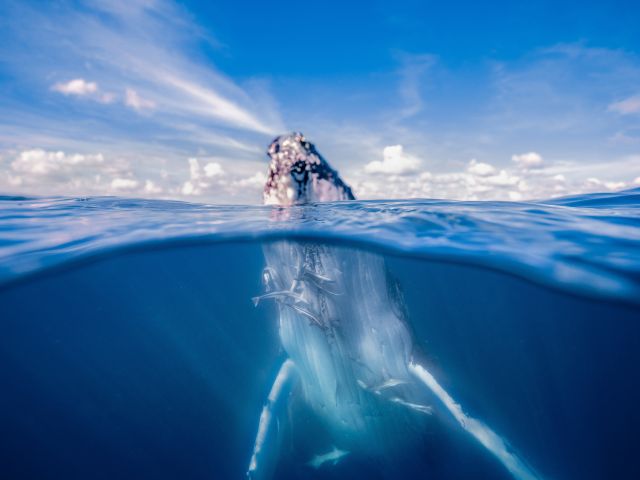
whales in Hervey Bay
Hervey Bay is a haven for humpback whales. (Credit: Tourism and Events Queensland)

The waterways around Hervey Bay are one of the best places to swim with whales in Australia. It wasn’t on a whim that the World Cetacean Alliance named Hervey Bay as the world’s first Whale Heritage Site at the World Whale Conference in 2019.

The Fraser Coast region jumps out as a haven for humpback whales because of its unique geography and ecology. In fact, it’s the only place on Earth that provides landfall between the feeding grounds and the breeding grounds with K’gari on one side and the Queensland coastline on the other.
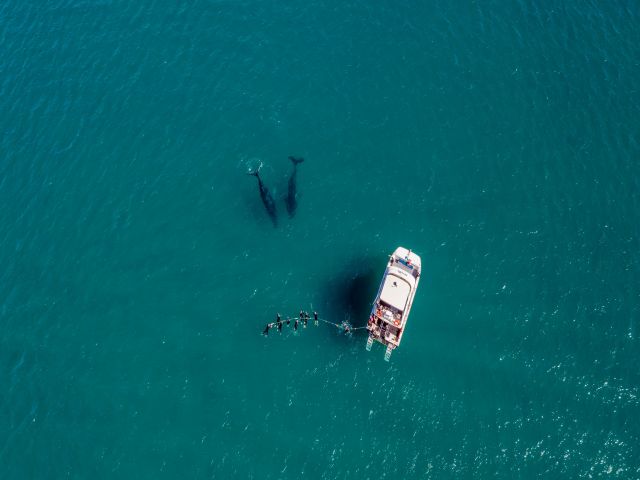
Hervey Bay whales
Embark on a whale-watching tour off Hervey Bay. (Image: Tourism and Events Queensland)

Dive Hervey Bay operates the region’s only dedicated ‘swim with whales’ experience and is one of the best places in the world to see humpback whales.
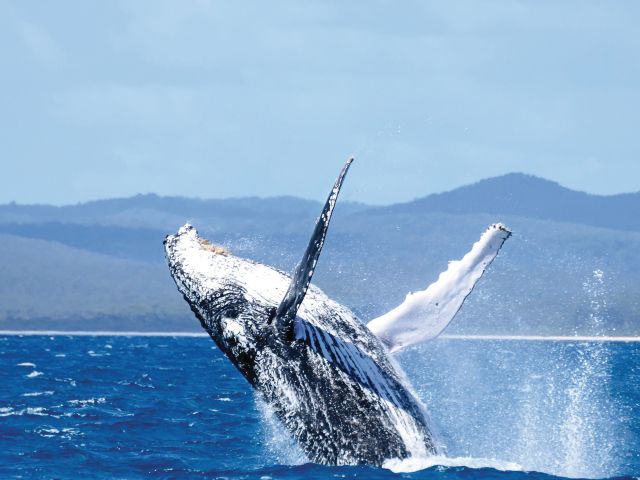
humpback whales in Hervey Bay
See humpback whales up close. (Credit: Tourism and Events Queensland)

Best time to go: Mid-July to late October.
Eco credentials: Guest numbers are strictly limited and the tour operator’s core philosophy is to interact with whales on their terms and to approach a whale at a 100-metre distance.

Need tips, more detail or itinerary ideas tailored to you? Ask AT.

AI Prompt

Swim with humpback whales off K’gari
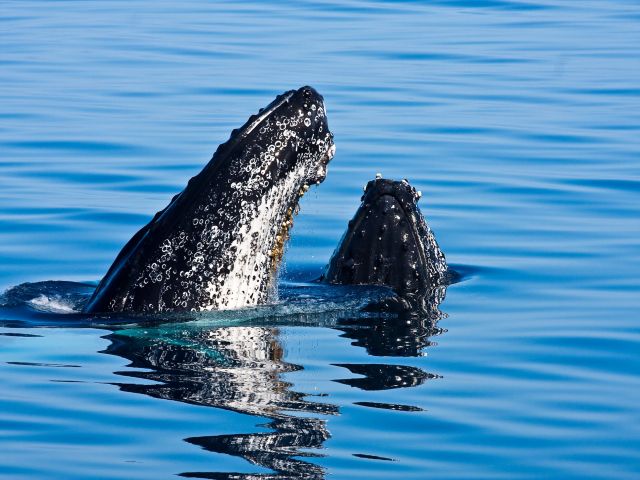
K'gari whales
Spy on K’gari’s majestic giants. (Credit: Michael Dawes)

The world’s largest sand island draws visitors to its shores for a multitude of reasons.

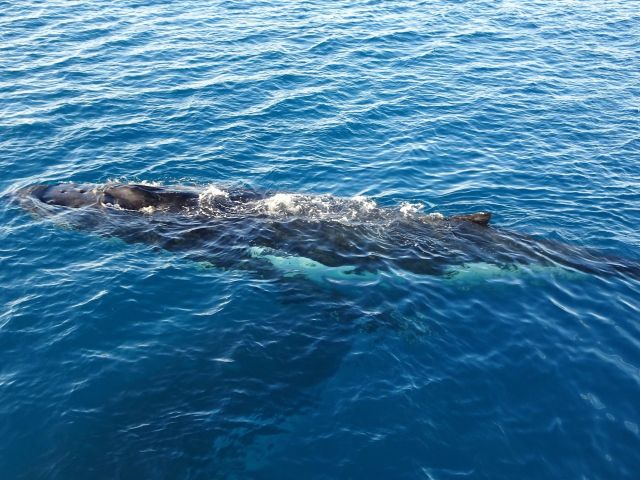
Now, guests staying at the Kingfisher Bay Resort can board a tour from the jetty for a jaunt out to the sheltered waters of Platypus Bay for the chance to frolic in the water with humpback whales.

Hervey Bay Whale Watch has partnered with Kingfisher Bay Resort to offer a package aimed at those who want to slide in the water with the whales.
humpback whales in K'gari
Have the chance to frolic in the water with humpback whales. (Credit: denisbin)

Best time to go: Between July and early September.
Eco credentials: The vessel used for the tours is purpose-built for whale watching, is wheelchair-friendly and has a cap on numbers. The whale swims are at the whim of the whales.

Swim with minke whales off Port Douglas
whales in Port Douglas
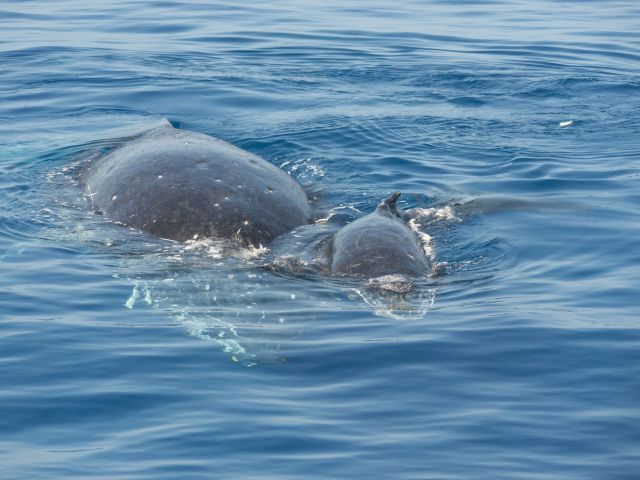
The Ribbon Reef region off Port Douglas is the only place in Australia to swim with dwarf minke whales. (Credit: Tourism Australia)

The Ribbon Reef region off Port Douglas is the only place in Australia to swim with dwarf minke whales. And according to scientist Dr Alastair Birtles it’s one of the longest wildlife interactions with whales on offer.

The Ribbon Reef region, some 240 kilometres north of Cairns, attracts up to 80 minke whales during the season and the whales come very close as they are ‘extraordinarily curious’ says Dr Birtles.

The tourism vessels licensed to conduct swims with the whales include Mike Ball Dive Expeditions, Silverseries, Pro Dive and the Spirit of Freedom.

Best time to go: June and July.
Eco credentials: Chasing whales is outlawed. Interactions are decided by the whales. Tours allow visitors to contribute to ongoing research and conservation efforts to protect them.

Swim with humpback whales on the Sunshine Coast
Sunreef Mooloolaba
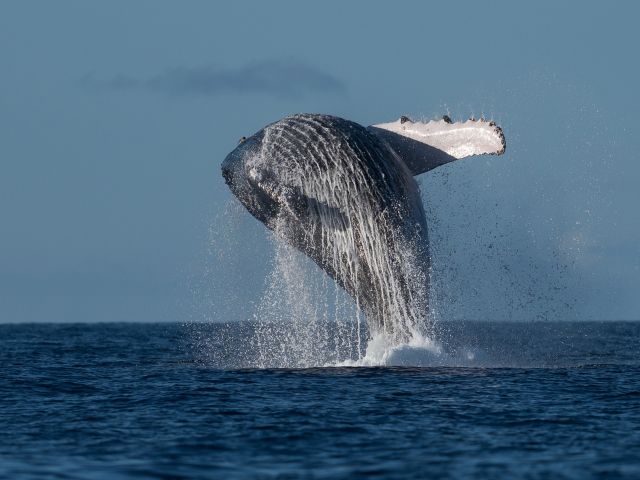
Spot these gentle giants from the Sunreef Mooloolaba boat.

Humpback whales are drawn to the nutrient-rich waters off Mooloolaba during their annual migration. And now, Sunreef Mooloolaba offers visitors to the Sunshine Coast the chance to swim with these majestic marine creatures.

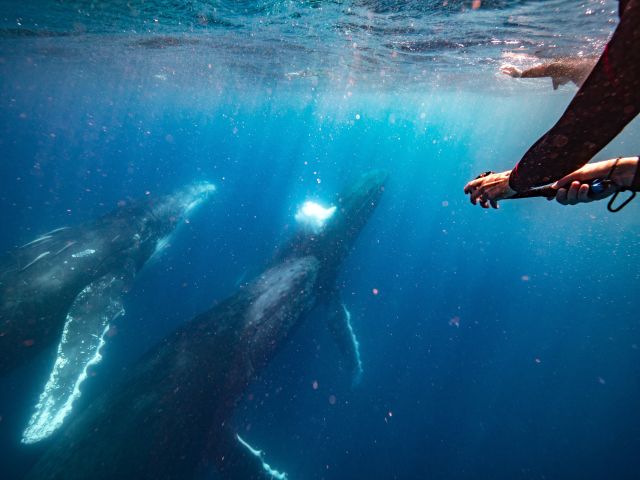
Snorkellers are given the opportunity to hold a rope off the back of the Sunreef Mooloolaba boat to eyeball the whales as they swim along the Pacific (Ocean) highway.

If swimming with whales is not your thing, you can still enjoy spotting the whales throughout the season. The pioneering Swim with Whales experience celebrated its 10th anniversary in 2024.
humpback whale on Sunshine Coast
The humpback whale migration on the Sunshine Coast starts in early June. (Credit: Tourism Australia)

Best time to go: From July to mid-October
Eco credentials: The boat operates under a strict code of conduct to protect both whales and swimmers in accordance with the Australian National Guidelines for whale and dolphin watching.

Weekly travel news, experiences
insider tips, offers, and more.

Swim with humpback whales (or whale sharks) on WA’s Coral Coast
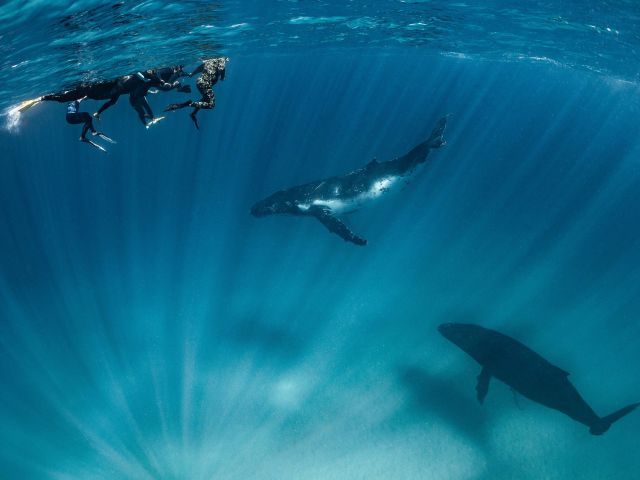
Ningaloo sharks
Swim with whales in Ningaloo. (Credit: Brooke Pyke Photography and Live Ningaloo)

Ningaloo Marine Park is the only place in Western Australia where you can have an in-water interaction with humpbacks on a tour.

An estimated 40,000 humpback whales embark on the annual migration along the coastline each year which means there’s a 78 per cent in-water interaction success rate.

In addition to the in-water interaction tours, visitors can embark on a whale-watching tour off the coast from Exmouth and Coral Bay on the Coral Coast.

Best of all: humpback whale in-water interaction includes onboard education from dive instructors, many of whom are marine biologists or scientists.
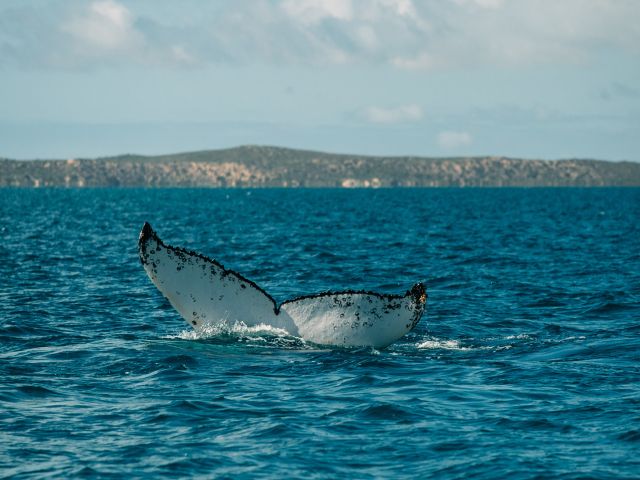
majestic whales in Ningaloo
Witness majestic whales. (Credit: Tourism Western Australia)

While a whale shark is not a whale but a filter-feeding shark, it’s also possible to swim with these gentle giants off the WA coast.

Check out Ningaloo Whaleshark Swim, 3 Islands Shark Dive, Aussie Marine Adventures, Ningaloo Discovery, Ocean Eco Adventures, Coral Bay Ecotours, Live Ningaloo, Exmouth Dive and Whalesharks Ningaloo and Ningaloo Blue Dive.
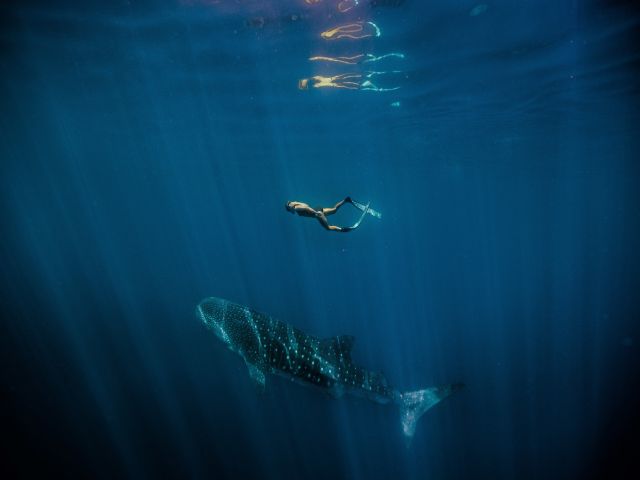
whale sharks in Ningaloo
Go freediving with whale sharks in Ningaloo. (Credit: Tourism Western Australia)

Best time to go: Between July and October
Eco credentials: The humpback whale and whale shark interaction guidelines have been modelled on the world’s best practice for whale shark swim tours to have minimal impact on the whales. Swimmers are not allowed near mothers and calves.

Carla Grossetti
Carla Grossetti has written across print and digital for Australian Traveller and International Traveller for more than a decade and has spent more than two decades finding excuses to eat well and travel far. A prestigious News Corp cadetship launched her career at The Cairns Post, before a stint at The Canberra Times and The Sydney Morning Herald gave way to extended wanders through Canada, the US, Mexico, Central America, Asia and Europe. Carla was chief sub editor at delicious and has contributed to Good Food, Travel & Luxury, Explore Travel, Escape. While living in London, Carla was on staff at Condé Nast Traveller and The Sunday Times Travel desk and was part of the pioneering digital team at The Guardian UK.
View profile and articles
hero media

8 experiences to get the most out of Victoria’s Great Ocean Road

    Louis Costello Louis Costello
    Beyond the winding bitumen and coastal views lies another side to Victoria’s most famous route.

    There’s something hypnotic about this stretch of Victoria’s coast. Maybe it’s the way the road hugs the ocean so tightly, or how the cliffs catch the sun in colours you can’t name. Or, for local Victorians who drove this route as kids, maybe it’s the memories of winding through the impossibly tall trees as they seemingly guide you on your journey like wooden guardian angels. Most travellers know it for the 12 Apostles, but there are plenty of alternate experiences on the Great Ocean Road equally as worthy of your time.

    So, next time you’re in that neck of the woods, park that car, stretch those legs and try these experiences.

    1. Discover living culture at Budj Bim

    Budj Bim Cultural Landscape Tourism
    Walk across the world’s oldest known aquaculture system. (Image: Visit Victoria)

    Breakaway Creek’s Budj Bim Cultural Landscape is a masterclass in educational storytelling. Join a guided tour with Budj Bim Cultural Landscape Tourism to walk across the world’s oldest known aquaculture system, where the Gunditjmara people built sophisticated eel traps and stone channels more than 6,000 years ago.

    Budj Bim’s aquaculture system predates Egypt’s pyramids by roughly 2,000 years, making it one of the oldest examples of human engineering on Earth. If that’s not enough to get your history-loving family members involved in this road trip, we’re out of ideas.

    2. Unwind in the hot springs at Warnambool

    woman relaxing at Deep Blue Hot Springs
    Let mineral-rich water heal you.

    If your legs need a break after a long drive, Deep Blue Hot Springs is your remedy. The geothermal pools sit just metres from the coastline, filled with mineral-rich water that bubbles up from deep underground. Move between open-air baths, waterfall pools and quiet zones made for meditation.

    The water in Deep Blue’s geothermal pools comes from an ancient aquifer nearly 850 metres below the Earth’s surface, which, in non-scientific terms, means it’s far more likely to have healing properties than the mineral water you’d find at the supermarket.

    3. Take to the air at Princetown

    12 Apostles Helicopters flight alternate experiences on the Great Ocean Road
    See an icon from a different view.

    You may have seen the Twelve Apostles from the trusty viewing platform, but a helicopter flight with 12 Apostles Helicopters shows you just how sprawling and rugged this coastline really is.

    The trip covers everything from Port Campbell to London Bridge (not to be confused with the UK’s own), giving you a rare chance to watch waves carving the limestone cliffs from above. It’s worth noting that the limestone stacks of the Twelve Apostles are said to erode by roughly two centimetres each year, so the longer you leave it, the less of the Apostles you’ll see.

    4. Step into the past at Flagstaff Hill

    Flagstaff Hill Maritime Village and Museum
    Visit a time of yore.

    Continue the tour through Warnambool at Flagstaff Hill Maritime Village and Museum, a recreated 19th-century port town. Hear stories from the days when shipwrecks were as common as seagulls, with an astounding 180 ships believed to have sunk along the Shipwreck Coast in less than five years.

    The night show, complete with lights, sound, and sea spray, brings the coastline’s most dramatic stories to life.

    If you’re staying the night, Simon’s Waterfront offers relaxed dining with fresh local seafood and oceanfront views. Order the catch of the day and toast to the sailors who never made it ashore.

    5. Learn to surf in Torquay, Lorne, or Anglesea

    kid having a lesson with Go Ride A Wave
    Learn how to hang 10. (Image: Visit Victoria)

    Whether you’ve surfed before or can barely stand on a board, Go Ride A Wave will have you upright in no time. Torquay’s calm beaches are ideal for first-timers, while Lorne and Anglesea bring a bit more energy for those unafraid to get dunked.

    Bells Beach, just down the road from Torquay, has even hosted the world’s longest-running professional surfing competition since 1962. So, for those eager to have a gander at pros using surfboards like they’re an additional appendage, the competition usually runs sometime in autumn.

    6. Tackle the trails in Forrest

    Barwon Flow Trails Otways Flow MTB
    Hire a bike and explore MTB trails through the Otways.

    Forrest is a haven for mountain bikers thanks to an expansive network of trails through stunning natural scenery. The Forrest trail network has almost 100 kilometres of singletrack across 36 trails, so there’s something for every level of rider. That’s including more than 60 kilometres of purpose-built mountain bike trails winding through the Otways’ dense forest. Cycle through ancient myrtle beech trees and towering tree ferns, with smaller ferns and soft mosses forming a carpet at your feet.

    Hire a bike from Forrest MTB Hire and take your pick from easy, scenic rides to more challenging singletracks, such as Red Carpet or Rollercoaster.

    7. See wildlife up close in Apollo Bay

    bush rat on Wildlife Wonders tour
    Get help spotting the locals. (Image: Doug Gimsey)

    If spotting koalas and kangaroos in the wild feels like winning the lottery, Wildlife Wonders gives you guaranteed sightings without cages or crowds. Every visit to the sanctuary helps fund the Conservation Ecology Centre which supports endangered species across the Otways, so your business is appreciated by humans and animals alike.

    The guided walk takes you through protected Otways habitat where you might spot potoroos (or joey lookalikes for those unfamiliar with a potoroo), wallabies, and sleepy koalas lounging in the trees.

    8. Visit the Cape Otway Lightstation

    Cape Otway Lightstation
    Delve into the tales of Cape Otway Lightstation.

    Towering over the sea on a cliff above the Southern Ocean, Cape Otway Lightstation has been guiding ships since 1848. Before the lighthouse was built, Cape Otway was one of the most treacherous points on the Victorian coast, with dozens of shipwrecks occurring in its surrounding waters. Pick the right day, and you may bump into a local willing to tell you about the wreck of Eric the Red.

    While at the Cape Otway Lightstation, explore the keeper’s quarters, walk the coastal trails, and take in views that only stop short at the horizon.

    And no, contrary to popular belief, the Round the Twist lighthouse is actually located in Split Point, just shy of two hours in the direction of Melbourne. Nothing’s stopping you from embarking on a lighthouse crawl, though.

    Plan your next no-stone-unturned journey along this iconic Aussie road at visitgreatoceanroad.org.au.