hero media

The 8 best places to see jacarandas around Australia

From Sydney to the Scenic Rim, the purple haze of jacaranda trees is synonymous with Australian spring.

Every spring, Australian social media accounts become flooded with purple as people line up in front of vibrant jacaranda trees in full bloom. Despite being imported, over the last 100 years or so, they’ve become a symbol of Australian spring, and their popularity only seems to increase yearly. Heck, they even have a 90-year-long annual festival in their honour. Read on for the best places around Australia to see jacarandas and join in the purple craze.

History
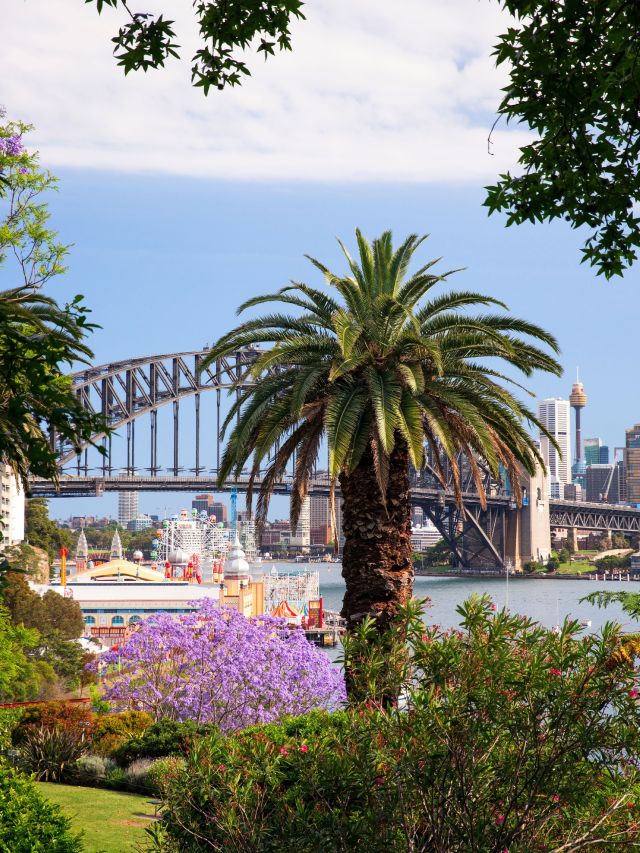
view of Lavender Bay with jacarandas in the spring
Sydney is taken over by purple in spring. (Image: Destination NSW)

Endemic to South America, the first jacaranda specimens were sent to British shores by Botanist Alan Cunningham from Rio de Janeiro. They were planted in Kew Gardens in 1818, and one theory of how they got into Australia is that they were brought from these very gardens during colonisation. But it’s also possible Cunningham himself brought them here during his later postings.

So, who got the first jacaranda tree in Australia? Brisbane claims the titles with its earliest tree being planted in 1864, but records show that the Sydney Botanic Garden jacaranda is dated to about 1850. Not to mention, jacarandas were listed for sale around Sydney in 1861. Sorry, Brisbane.

1. Grafton, NSW
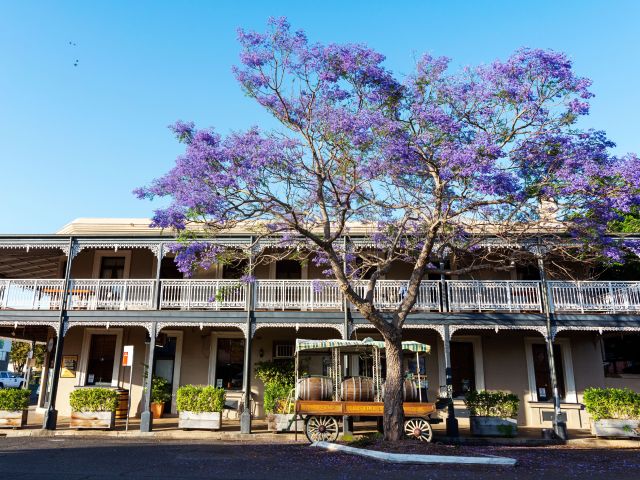
Jacarandas Grafton Roches Family Hotel
Grafton is arguably Australia’s most famous destination for jacaranda trees. (Image: My Clarence Valley)

It would be remiss not to start with Grafton, arguably Australia’s most famous destination for jacaranda trees and home to the Jacaranda Festival, which turns 90 this year (making it the country’s longest-running floral festival). Join in long lunch events, stay after dark to see the purple trees in lights, learn from the three Traditional Custodians of the Clarence Valley and bring the kids for plenty of family-friendly events.

2. Sydney, NSW
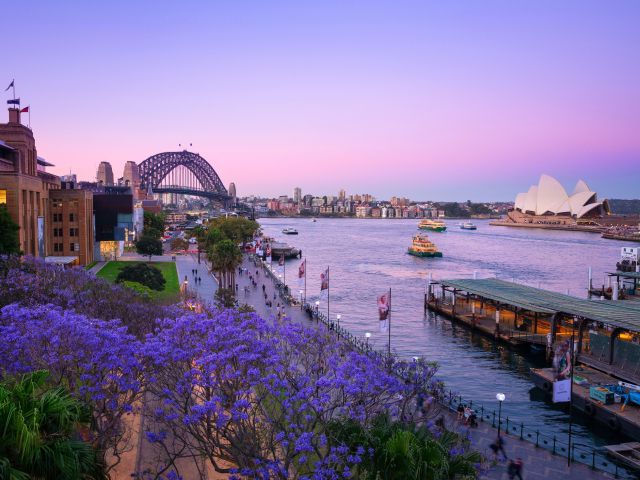
view of Circular Quay from The Rocks with jacarandas in the spring
Sydney is awash with purple as it dusts off the chill of winter. (Image: Destination NSW)

It’s hard to avoid jacaranda trees in Sydney, the city is awash with purple as it dusts off the chill of winter. Inner-city areas like Circular Quay and The Rocks, Paddington and Kirribilli are all very popular photo spots and tend to provide beautiful Harbour Bridge and city or sandstone backdrops for the trees. Lavender Bay, Hunters Hill and the lower North Shore also put on a show, though they’re harder to get around if you’re relying on public transport. The University of Sydney has a beautiful campus already, and it becomes dotted with purple each year.

The Inner West joins in the show, especially around Camperdown, Newtown and Glebe. Out west, Parramatta isn’t to be outdone, especially around the popular River Walk. A little further afield of the city, Argyle Street in Camden is popular for jacaranda photos, as is Macarthur.

Need tips, more detail or itinerary ideas tailored to you? Ask AT.

AI Prompt

3. Brisbane, Qld
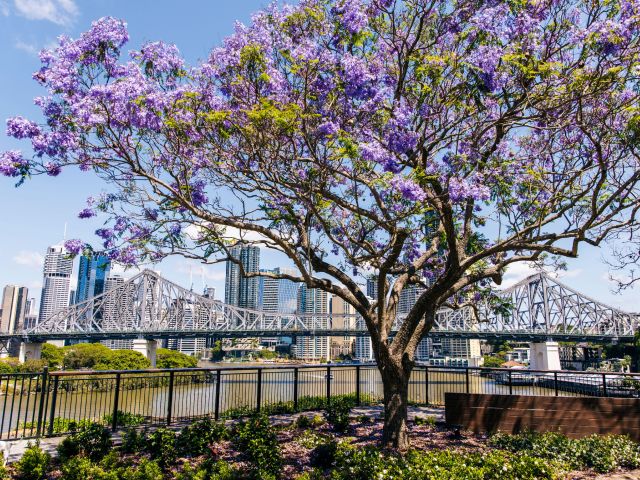
Jacaranda at Brisbane's Wilsons Lookout
Jacarandas can be spotted all around Brisbane. (Image: Tourism and Events Queensland)

Queensland’s capital has proven itself to be just as jacaranda happy as its southern counterpart. The first stop for those hoping to see jacarandas must be Brisbane City Botanic Gardens. In fact, this is where the state’s first Jacaranda tree was planted, in 1864 (as we know, Queensland does claim this is the first in Australia, but it seems unlikely). It was blown down by weather events, but these days, plenty bloom in its place.

Also around the city, the University of Queensland campus, Princess Street in the CBD, Goodna and New Farm all fill with a purple haze. While the Dockside walk at Kangaroo Point is the perfect way to enjoy these trees, Yeronga even has an aptly named Jacaranda Park.

If you have the time (and you should make time), Leis Park in Lawnton is an hour out of the CBD and doesn’t play with its jacaranda display, while sipping local wine and looking out at a purple Mt Tamborine is pretty spectacular.

4. Melbourne, Vic
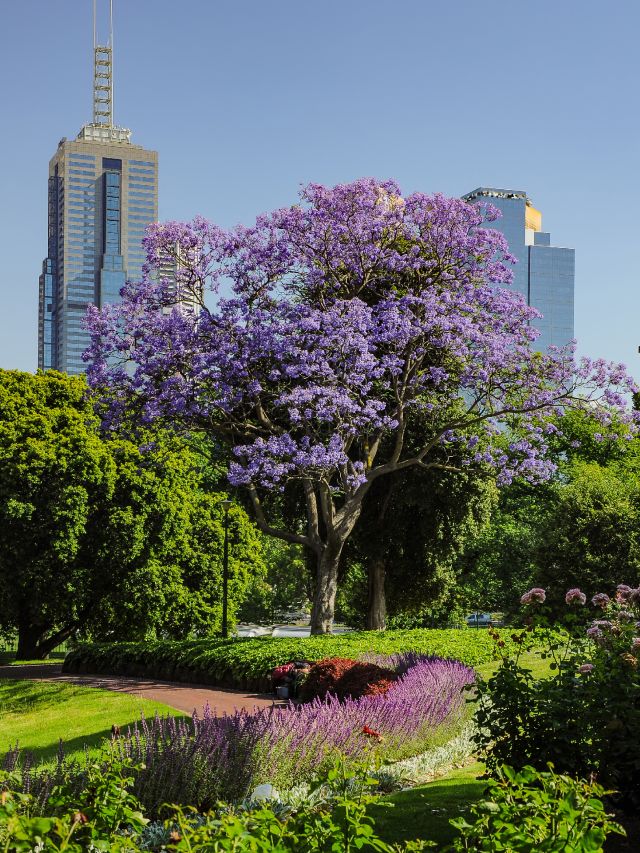
Jacaranda tree in Park in Melbourne
See jacarandas dot Melbourne Royal Botanic Gardens in spring. (Image: Getty Images / Zoya Avenirovna)

Melbourne may already draw crowds keen to sip its world-renowned coffee while they gaze at its plentiful and colourful street art. But come spring, there’s one more, purple, reason to visit. Head to the Royal Botanical Gardens to wander through a range of stunning florals, see jacarandas against the historic sandstone Parliament House and the University of Melbourne buildings, or drive a little further out of the CBD to see the impressive display in Fitzroy North’s Edinburgh Gardens.

5. Perth, WA
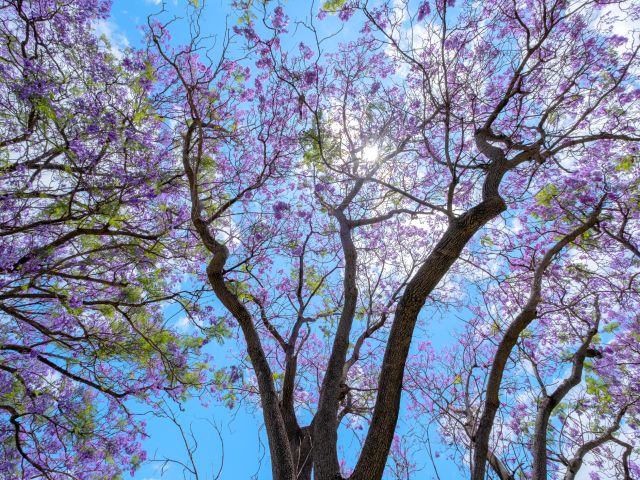
Beautiful Jacaranda trees are reaching out to sky on a sunny blue sky day, Perth, Australia
Perth is not to be left out in the jacaranda season. (Image: Getty Images / Hideaki Edo)

Home to another jacaranda festival, Perth is not to be left out in the jacaranda season. Head to Applecross for the annual Rotary Jacaranda Festival to find stalls and live entertainment to celebrate these beauties, as well as all things community. Elsewhere around the capital, Highgate, Inglewood and Marlborough Street in East Perth all present photo opportunities. While Old Jacaranda Way in Subiaco is famous for these trees, it was even named after them.

Weekly travel news, experiences
insider tips, offers, and more.

6. Adelaide, SA
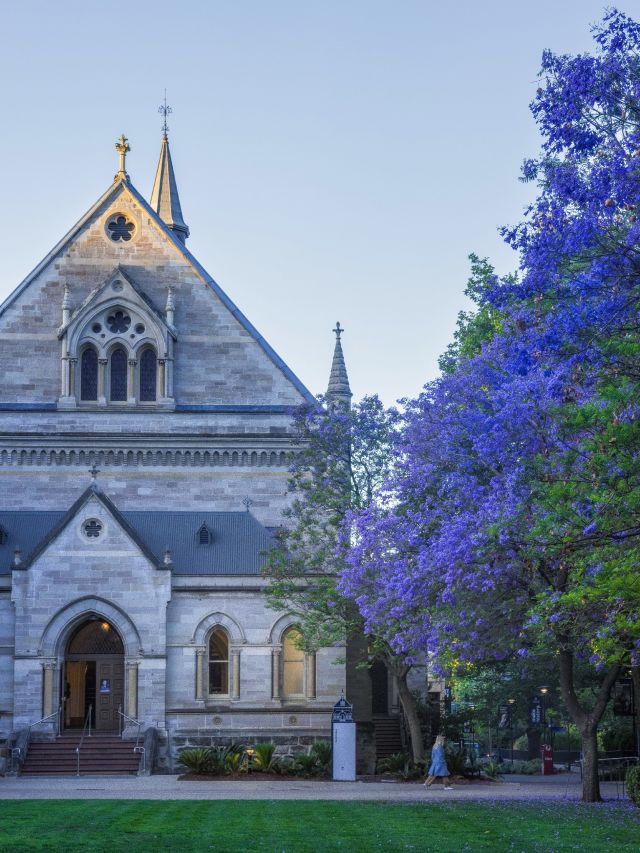
Jacarandas in Adelaide North Terrace
Seek out jacarandas in Adelaide. (Image: Michael Waterhouse Photography)

Perhaps not as filled with these purple trees as other capital cities, you’ll still find a decent smattering of purple all around the Adelaide CBD, as we as throughout the suburbs of Goodwood, Blair Athol, Blackforest, Beulah Park, Clarence Gardens and Clarence Park.

7. Southeast Queensland
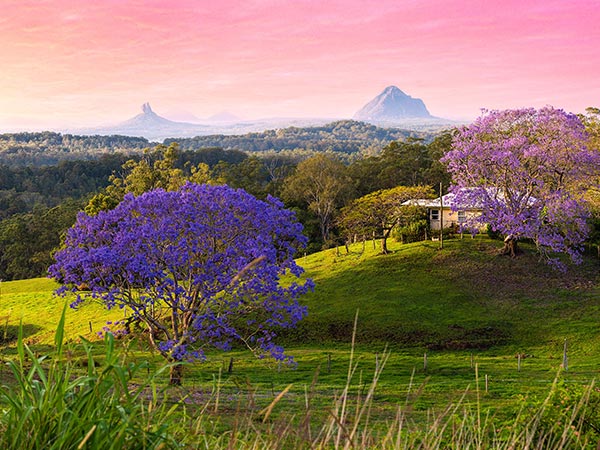
a jacaranda tree in bloom in front of glasshouse mountains queensland
View jacarandas and the usual stunning view from the Mary Cairncross Scenic Reserve lookout.

The Glasshouse Mountains in Sunshine Coast’s hinterlands, seen from the lookout by Mary Cairncross Scenic Reserve, are a stunning sight year-round, but over spring, when the foreground becomes dotted with purple jacaranda flowers, the colour palette becomes unbeatable. A quaint country town, Boonah, also has a reputation for its purple blooms (and its world heritage-listed surrounds), and the adorable Scenic Rim Farm Shop & Cafe sits in the shade of a giant jacaranda. Here, you can taste an ever-changing menu that champions local ingredients, and a particularly popular range of house-made cakes.

8. Herberton, Qld
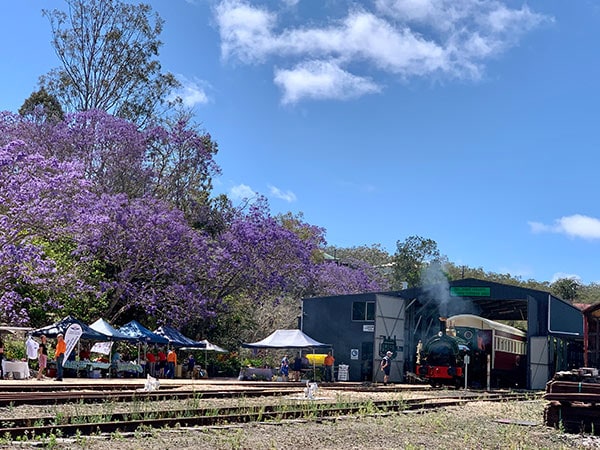
train and stalls at Herberton Jacaranda Festival in queensland
Head to Herberton in October for the Jacaranda Festival.

Further north, near Atherton and its famous Tablelands in Tropical North Queensland, Herberton also puts on a seasonal festival. During October, one weekend is filled with live music, entertainment, food trucks and even competitions, all in the name of jacaranda trees.

Want to see more stories from Australian Traveller in your Google search results?

  1. Click here to set Australian Traveller as a preferred source.
  2. Tick the box next to "Australian Traveller". That's it.
Kassia Byrnes
Kassia Byrnes is the Native Content Editor for Australian Traveller and International Traveller. She's come a long way since writing in her diary about family trips to Grandma's. After graduating a BA of Communication from University of Technology Sydney, she has been writing about her travels (and more) professionally for over 10 years for titles like AWOL, News.com.au, Pedestrian.TV, Body + Soul and Punkee. She's addicted to travel but has a terrible sense of direction, so you can usually find her getting lost somewhere new around the world. Luckily, she loves to explore and have new adventures – whether that’s exploring the backstreets, bungee jumping off a bridge or hiking for days. You can follow her adventures on Instagram @probably_kassia.
View profile and articles

From coast to bush: these are Gippsland’s best hikes

    Michael Turtle Michael Turtle

    Video credit: Tourism Australia

    From coast to mountains, hiking in Gippsland offers a stunning array of landscapes, with trails that take you deep into the region’s heritage.

    I step out onto the sand and it cries out underfoot. Kweek! I take another step and there’s another little yelp. Screet! Picking up the pace, the sounds follow me like my shadow, all the way down to the water. It’s obvious how this spot got its name – Squeaky Beach – from the rounded grains of quartz that make the distinctive sounds under pressure.

    For many, Wilsons Promontory National Park is the gateway to Gippsland, and the best way to explore it is by walking its network of hiking trails, from coastal gems such as Squeaky Beach through to the bushland, among the wildlife. But it’s still just a taste of what you’ll find on foot in the region.

    Venture a bit further into Gippsland and you’ll discover the lakes, the rainforest, and the alpine peaks, each changing with the season and offering summer strolls or winter walks. Just like that squeaky sand, each step along these trails has something to tell you: perhaps a story about an ancient spirit or a pioneering search for fortune.

    The best coastal hikes in Gippsland

    sunset at Wilsons Promontory National Park
    Wilsons Promontory National Park is a sprawling wilderness with many coastal bushland trails. (Image: Mark Watson)

    Wilsons Promontory National Park (or ‘The Prom’, as you’ll end up calling it) is an easy three-hour drive from Melbourne, but you might ditch the car when you arrive, with much of the park’s 50,000 hectares accessible only by foot. From the inky water of Tidal River (dyed dark purple by abundant tea trees), I like the easy walks along the coast, among lichen-laden granite boulders, to golden beaches and bays.

    a couple on Mount Oberon
    Panoramic views from the summit of Mount Oberon. (Image: Everyday Nicky)

    The trail to the panoramic views at the summit of Mount Oberon is a bit harder, up steep timber and granite steps, but it’s a popular 6.8-kilometre return. The more remote hikes are found through the open banksia and stringybark woodland of the park’s north, or along the multi-day Southern Circuit, which ranges from about 35 to 52 kilometres, with sunrises and sunsets, kangaroos and cockatoos, and maybe even whales.

    a golden sand beach at Wilsons Promontory National Park
    Walk ‘The Prom’s’ golden sand beaches. (Image: Tourism Australia/Time Out Australia)

    You might also see whales on the George Bass Coastal Walk, even closer to Melbourne on the western edge of Gippsland. This dramatic seven-kilometre trail along the clifftops takes in sweeping views of the wild ocean, occasionally dipping down from grassy green hills to coastal gullies and a secluded beach. It also now links into the Bass Coast Rail Trail for an extra 14 kilometres.

    the George Bass Coastal Walk
    George Bass Coastal Walk trails for seven kilometres along clifftops. (Image: Visit Victoria/Time Out Australia)

    Over at the eastern edge of Gippsland, in Croajingolong National Park, you can wander along the lakeshores beneath koalas and around goannas (I keep my distance since one chased me here!). For those who are even more adventurous, the park is also the starting point for the 100-kilometre Wilderness Coast Walk, usually done over seven days.

    the Croajingolong National Park, Gippsland
    Wander along the lakeshores in Croajingolong National Park. (Image: Tourism Australia)

    The best bush hikes in Gippsland

    the Baw Baw National Park
    The alpine heath of Baw Baw National Park. (Image: Everyday Nicky)

    Deep in the Long Tunnel Extended Gold Mine at Walhalla, mining guide Richard tells me how this small town in the mountains east of Melbourne boomed when prospectors found gold here in 1862. These days, you’ll find most of the town’s treasure – its heritage – above ground, with the Walhalla Tramline Walk a wonderful way to explore it.

    Just seven kilometres long, the walk takes you through decades of Gold Rush history, following the original rail trail from lush bushland to the mining sites, and through the charming village of just 20 residents with its wooden cottages and old shopfronts adorned with turn-of-the-century advertising posters. Blazing a trail where trailblazers once opened up the region, this is also the starting point for the 650-kilometre Australian Alps Walking Track.

    Nearby, Baw Baw National Park has walks through gnarled snow gums and alpine heaths that show off the colourful wildflowers in summer and the pristine carpet of white in winter. Several trails are perfect for snowshoes, including a 45-minute route from St Gwinear up to vast views across the Latrobe Valley.

    Further up into the mountains, the Toorongo and Amphitheatre Falls Loop Walk is an easy 2.2-kilometre path that serenades you with the sound of flowing water as you pass mossy rocks and tree ferns en route to two sets of waterfalls cascading over boulders in the remote wilderness.

    The best cultural hikes in Gippsland

    the Mitchell River National Park, Gippsland
    Hike the Mitchell River National Park. (Image: Parks Victoria/Grace Lewis)

    Across a pool in a natural sandstone amphitheatre, deep within a cave behind a waterfall, it’s said the Nargun has its lair. A fierce creature, half human and half stone, that abducts children and can’t be harmed by boomerangs or spears, the story of the Nargun has been told around the campfires of the local Gunaikurnai people for generations.

    As a culturally significant place for women, hikers are asked not to go into the Den of Nargun, but a 3.4-kilometre loop walk leads you through a rainforest gully to the entrance where you can feel the powerful atmosphere here in Mitchell River National Park, along Victoria’s largest remaining wild and free-flowing waterway.

    the bee-eaters at Mitchell River National Park
    Bee-eaters at Mitchell River National Park. (Image: Parks Victoria/Grace Lewis)

    The Den of Nargun is part of the Bataluk Cultural Trail, a series of important traditional Gunaikurnai sites through central Gippsland. Another location is Victoria’s largest cave system, Buchan Caves Reserve, with trails to important archaeological sites of human artefacts up to 18,000 years old. The FJ Wilson Interpreted Walk includes the naturally sculpted white limestone steps of the 400-metre-long Federal Cave, while the Granite Pools Walk goes among tall timber and moss-covered gullies.

    the ancient rainforest of Tarra-Bulga National Park
    The ancient rainforest of Tarra-Bulga National Park. (Image: Josie Withers)

    Also important to the Gunaikurnai people is Tarra-Bulga National Park, known for its ancient myrtle beeches and enormous mountain ash trees. Just 40 minutes return, the Tarra Valley Rainforest Walk offers a taste of this verdant landscape, while the Grand Strzelecki Track takes you deep into the lost world of forest giants on an epic 100-kilometre trail rich with tradition.

    A traveller’s checklist

    Staying there

    the WildernessRetreats in The Prom
    Wilderness Retreats in The Prom. (Image: Christian Pearson)

    Wilderness Retreats in Wilsons Promontory offers glamping-style tents with luxurious queen beds. Star Hotel is a reconstruction of a Gold Rush-era hotel from 1863 in the heart of heritage Walhalla. Caves House is a historic three-bedroom house with views over the Buchan River.

    Eating there

    the Carrajung Estate, Gippsland
    Enjoy a post-hike lunch at Carrajung Estate. (Image: Everyday Nicky)

    Kilcunda General Store serves great coffee and meals of local produce at the George Bass Coastal Walk. Alpine Trout Farm is located near Toorongo Falls in Noojee. Fish for your own lunch and barbecue it with the provided cookware.

    Carrajung Estate is a short drive from Tarra-Bulga National Park. The winery’s restaurant offers a seasonal menu of regional ingredients and you can stay at The Lodge.

    a seafood feast at Carrajung Estate, Gippsland
    The table is set for a seafood feast at the estate.

    Video credit: Tourism Australia