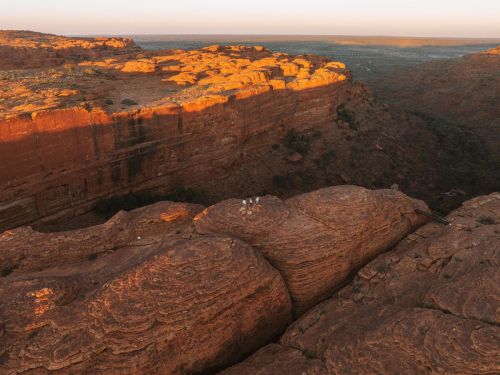
A mother-daughter road trip through the heart of Central Australia uncovers a landscape deeper than its red dirt reveals.
The Northern Territory is a place that stirs something tender within. A familiarity without a memory. A near-unconscious shift that began when my mum and I arrived in the Northern Territory just four days ago for the road trip of a lifetime.
It roused softly as I pushed down on the accelerator of my recently acquired rental, a 2022 Toyota Prado, heading out of Alice Springs and into the blissful unknown promised by Larapinta Drive. The slight intimidation I felt upon climbing into the car back at Alice Springs Airport melts away as I clock 110kph on the speedometer – a pace we’re told to maintain if we want to make it to our destination before nightfall.
“You’ll want to be on the Mereenie Loop by 1pm at the latest to avoid any driving after dark," the receptionist at the Alice Springs Visitor Centre had told us when we arrived to purchase the required driving permit earlier that morning. She circled Discovery Resorts – Kings Canyon on a fold-out map before handing it to us. “You won’t have any service out there, so don’t lose it," she winked. Mum and I had laughed, hoping she didn’t catch the brief but furtive glance we’d shared.
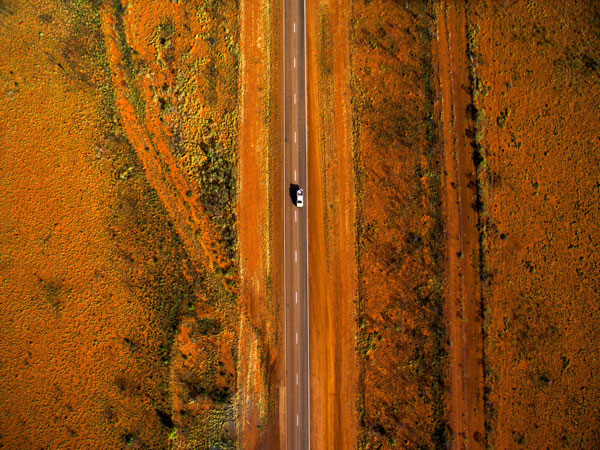
The Prado’s mammoth exterior is far from my trusty Subaru Forester back home, but there’s something exhilarating about being so high off the road, the car’s suspension specifically designed to take the brunt of each bump in the bitumen. I try not to let the unfamiliar landscape beginning to unravel itself around us distract from my focus on the road. But the towering topography, dotted with ancient rock formations and awash in an ink pot of all-new colours, makes it almost impossible for my easily distracted eyes to look only ahead.
Towering rock faces of Standley Chasm
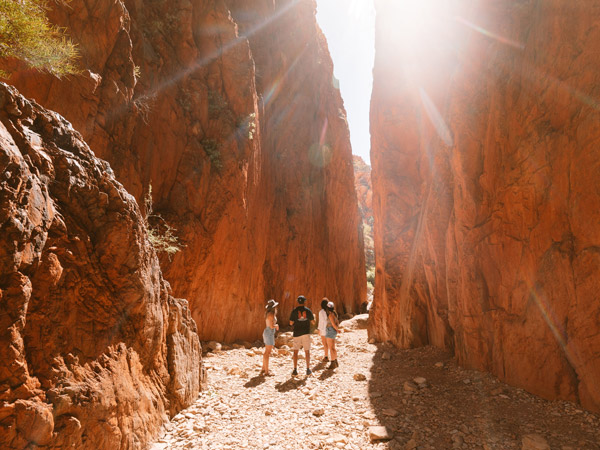
Just over 45 minutes in and the unmistakable font of a dilapidated green sign offers a welcome break. And after a quick detour, we’re pulling into the car park of Standley Chasm/Angkerle Atwatye. Owned and operated by the land’s Traditional Owners, the Western Arrernte People, this 80-metre-tall gorge is accessed via a 2.4-kilometre walking trail.
We hustle for some happy snaps between the towering rock faces, torn between drinking in its beauty and scurrying back to the car to escape the outback’s unrelenting fly population. These are not the buzzy locals we were hoping to meet; unaware that the flies are, to put it politely, a nuisance at this time of year. Unsurprisingly, the netted hats worn by other tourists seem to be sold out everywhere.
But my mum, ever the innovator, comes up with a solution. Handing me a dried-out and long-discarded eucalyptus branch, she coolly swings her own from one shoulder, around her face and to the other in one swift motion, swatting any particularly intrusive flies aside in doing so. She dubs it the ‘NT wave’ and it becomes our saving grace.
Hiking the Kings Canyon Rim Walk
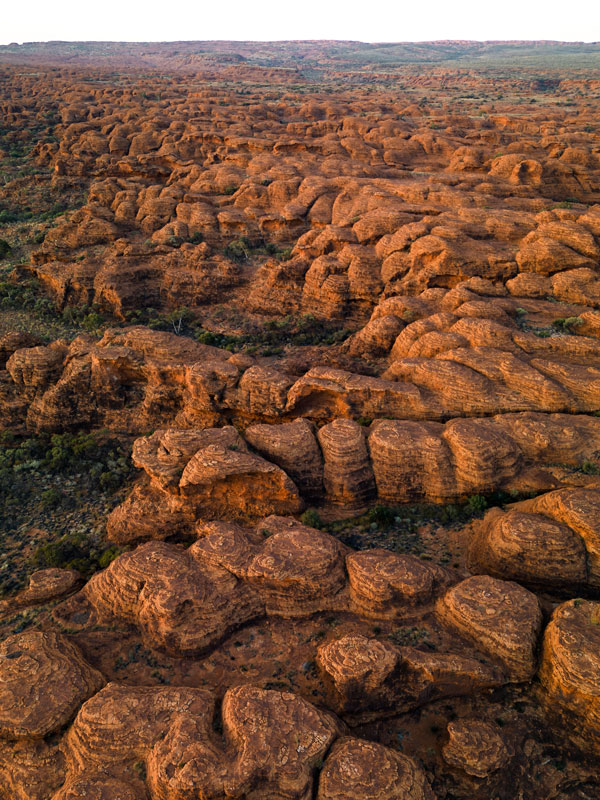
“Put me in a classroom, teachers will tell you I’m too shy and quiet. But put me out here, and I can talk for hours," says Luke Fraser, gazing out over the ancient sandstone domes and crevasses of Kings Canyon on the Traditional Lands of the Arrernte and Luritja Peoples.
The 22-year-old, originally from Sydney, has only been in the Northern Territory for three months, working as a tour guide for guests of Discovery Resorts – Kings Canyon along its signature Kings Canyon Rim Walk. But I can tell from the look on his face, this golden landscape already feels like home.
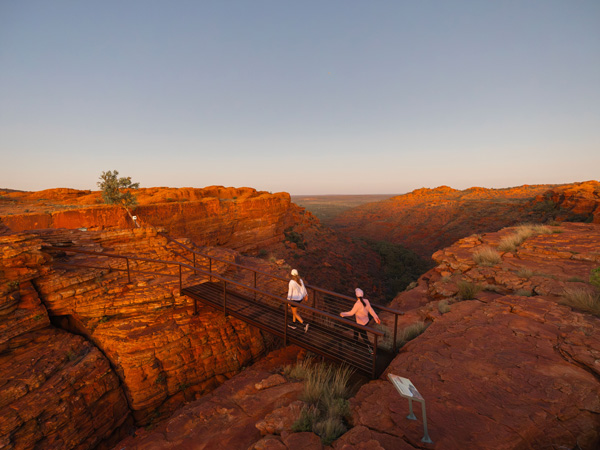
Despite Luke’s evident passion for the job, he has clearly been bitten by the travel bug, and his desire to explore this plentiful land will see him moving on to another part of Australia soon. Jake Fowler, who only arrived here from Western Australia’s Coral Coast two weeks ago, will be taking his place as tour guide through the 400-million-year-old canyon. Luke’s eagerness to share his impressive breadth of knowledge, most of which he learnt during time he volunteered to spend on Country with Matutjara man Terence Stephen Clyne, is evident.
The young man is clearly a natural leader, but is also proving to be a brilliant teacher, gently stepping back so Jake can practise before guiding groups of his own in the coming weeks. The pair seem to strike the perfect balance, Luke’s detailed descriptions, punctuated with personal insight and unwavering enthusiasm, coupled with Jake’s dry humour and penchant for sarcasm, make the four-hour hike seem too short.
It’s a shame the two can’t run tours together officially, but I consider myself lucky enough to tag along for the informal handover, growing increasingly fond of – and entertained by – the dynamic duo as our morning hike around Kings Canyon continues.
Need tips, more detail or itinerary ideas tailored to you? Ask AT.
AI Prompt
Tackling the Mereenie Loop
Mum’s makeshift fly swatter comes in especially handy during our guided Rim Walk, much to the amusement of Luke and Jake. We laugh about it over post-hike beers and pizza at Kings Canyon Bar & Grill, the resort’s onsite pub and the only venue of its kind for hundreds of kilometres.
The four of us are an unlikely crew – two newly acquainted coworkers brought together by a four-hour training session and a mother-daughter duo visiting from Sydney. But the conversation flows and the energy is effortless. We sip on cans of stout from Alice Springs Brewery and swap a lifetime of stories, from the educational to the emotional and the downright embarrassing.
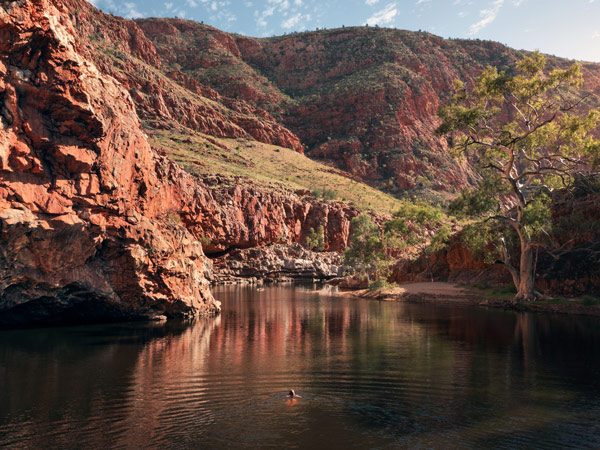
I blush a shade similar to the red dirt outside as Mum tells of our drive to Kings Canyon the day before. We’d hit the road from Discovery Parks – Alice Springs bright and early, guided by our fold-out map, no GPS signal and a misplaced sense of direction, which had us veering off-course after Standley Chasm. It was a mistake only realised 104 kilometres later, when the road sign for Ormiston Gorge, our next stop, didn’t appear. We’d looped the loop the wrong way, and with our deadline looming, decided to push on, earmarking the gorge for our journey back.
My embarrassment intensifies as Mum continues to recount our journey along the Mereenie Loop, the roughly 150 final kilometres of unsealed road to Discovery Resorts – Kings Canyon. Here, the smooth asphalt of Larapinta Drive is replaced with corrugated dirt, generously sprinkled with soft-sand deposits, hidden potholes and steep floodways.
As a first-time 4WD-er, I’d struggled to find the right gear, turning a typically 2.5-hour drive into a four-hour comedy of errors. While it meant full bladders, sore bums and a few choice expletives shared along the way, the slow journey allowed us to soak in the landscape around us. It’s ironic, the sense of belonging I felt being so far from home. Not knowing if I’m going in the right direction. Not quite sure of our destination. Yet, as we chased the sun towards the horizon, the last emotion I felt was fear. This land has been so kind to us, why would it stop now? In the end, we managed to make it before nightfall – just.
A helicopter flight over Kings Canyon
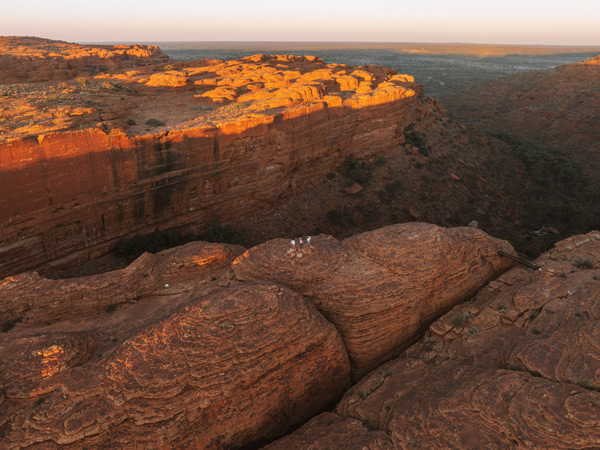
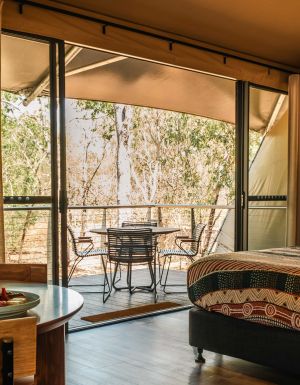
Despite the freestanding bathtub in our Deluxe Cabin calling my name, I clamber into the helicopter, wishing I’d gone a little easier on the pizza. It’s an experience neither Mum nor I have had before, I tell our jovial pilot Cal Hodgson as he prepares for take-off. “Oh, it’s your first time? Me too! Now quiet for a second, I need to figure out how to fly this thing."
Cal’s witticisms are peppered throughout the commentary he delivers during our 15-minute joyride, the practised ease of his tone signalling he has, in fact, flown the helicopter before.
He loops the chopper over the canyon Mum and I had tackled just hours earlier, hikers now the size of ants among the massive mounds and chasms, before smoothly guiding us off the flat-topped peak of Carmichael Crag, a sacred site from a local Luritja Dreamtime story.
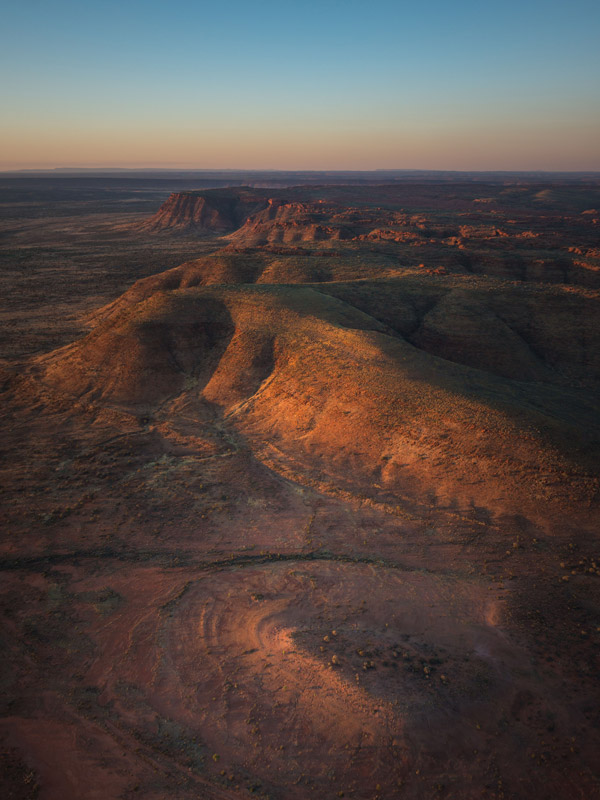
Despite Cal’s insistence that “on a clear day, you can spot Uluru on the horizon," cloud cover prevents a sighting of the ancient monolith some 200 kilometres away as the crow flies. “You’ll just have to come back to the NT so you can see it in person," he smiles, dipping the helicopter back towards the resort.
Seeing rainfall in the heart of Australia
It’s a trip I’m already mapping out in my head as Jake and Luke fiddle over the Prado the next morning. After a quick lesson in 4WD-ing from Jake and another moment of mortification for myself – “You don’t need to press anything, the car will switch over automatically," – they’re waving us off.
As we often do, Mum and I swap a quick look to clock the situation, neither of us surprised to catch the other blinking back tears. Our new friends will be missed. Our memories will fade. But an intangible tether remains.
There’s an undeniable pull to this place, a magnetism that clings to you with quiet intensity and anchors itself in your soul long before you’re even aware. It’s only upon leaving you realise that the land holds more than its arid surface could ever reveal, understood not with the eyes but with the heart.
The difference between our entry and exit from Kings Canyon is instantaneously obvious, the car’s speedometer continuing to tick over smoothly as we hit unsealed road. Just when a comfortable silence has settled between us, interposed only by a few small sniffles and the rustling of a freshly opened lolly packet, a sharp, unfamiliar sound causes both of us to jump.
Before we can catastrophise a flat tyre into existence, the noise increases in frequency and I steer the Prado to the side of the road, hazard lights on for good measure. We watch, in awe, as fat droplets of rain hit the dehydrated earth around us, small rivulets making patterns through the red dust that has accumulated on the car’s white bonnet. It’s a typically dry month in Central Australia, yet the sky has opened to weep with us – proof that this ancient land feels those who pass through it, too.
Weekly travel news, experiences
insider tips, offers, and more.
A traveller’s checklist
Getting there
Fly direct to Alice Springs/Mparntwe from most Australian capital cities with Qantas and Virgin Australia. Hire cars are available at the airport.
Staying there
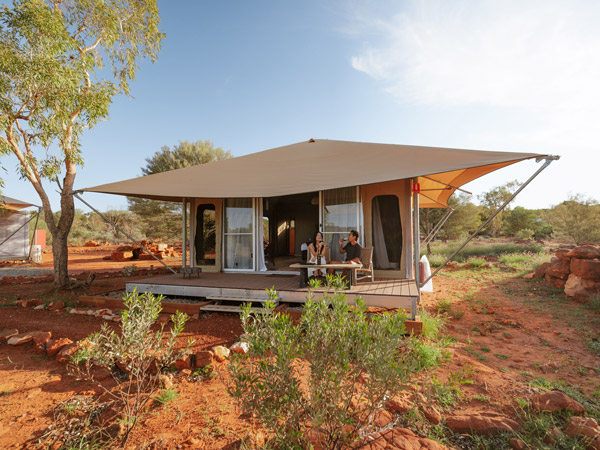
Stay at Discovery Resorts – Kings Canyon for easy access to Watarrka National Park. Discovery Parks – Alice Springs offers convenient facilities close to town.
Eating there
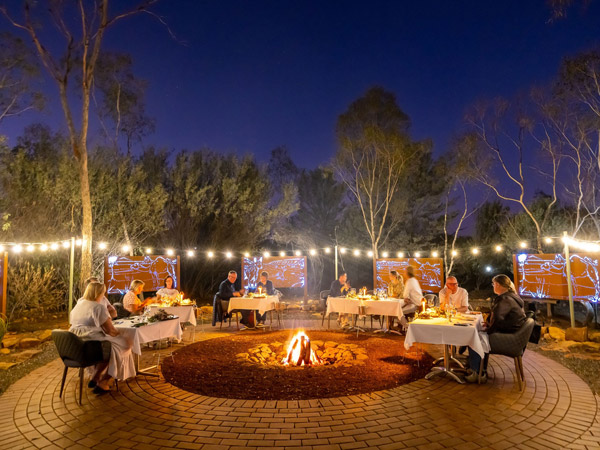
Enjoy a burger and a beer at Alice Springs Brewery . Or a five-course meal paired with premium wines with Discovery Resorts – Kings Canyon’s Under a Desert Moon outdoor dining experience.
Playing there
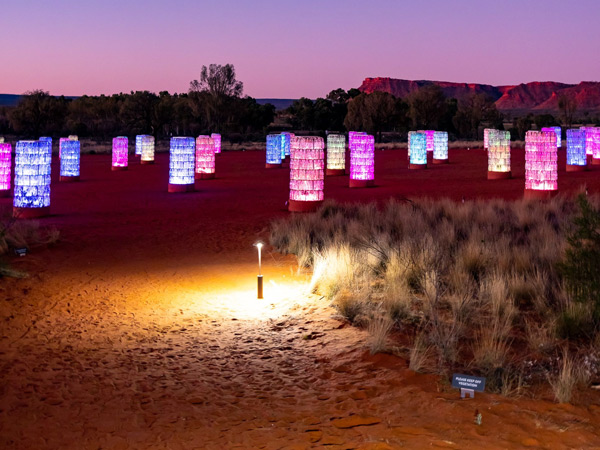
The Kings Canyon Rim Walk is a six-kilometre loop, taking roughly four hours to complete. It starts with a steep climb, so plenty of water, good hiking shoes, a hat and sunscreen are a must. It’s best done early to avoid the heat. See Light-Towers by Bruce Munro at Discovery Resorts – Kings Canyon. Get a different perspective of the landscape during a helicopter flight with PHS (Professional Helicopter Services) .