hero media

Kangaroo, a heartwarming new Aussie outback film inspired by real events

Director of Kangaroo Kate Woods on the filming of the movie and falling in love with Alice Springs and the Australian outback.

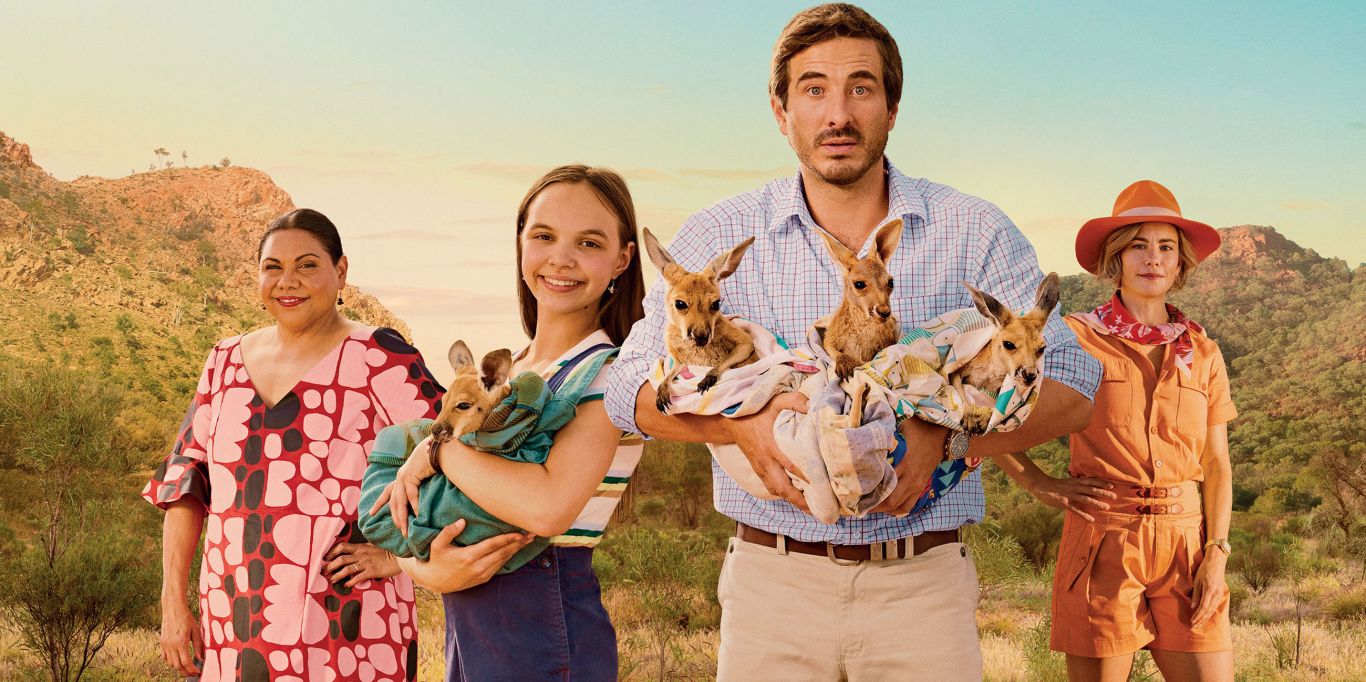
Kangaroo is a heart-warming film inspired by real events and the work done by the founder of the Kangaroo Sanctuary in Alice Springs, Chris ‘Brolga’ Barns. The Studiocanal film version tells the story of ex-TV personality Chris Masterman (Ryan Corr) who becomes stranded in a town outside Alice Springs (Mparntwe) where he forms an unlikely friendship with 12-year-old Indigenous girl Charlie (Lily Whiteley). The pair work together to rescue and rehabilitate orphaned joeys in the remote but stunning outback community, an endeavour that proves life-changing for them both. We spoke to director Kate Woods about the making of the film.

What was it that jumped (pardon the pun) out at you about this film?

When I read that first scene, which is word-for-word what Harry Cripps wrote on the page, I just thought, ‘Oh my god, this is gorgeous!’. The fact that you get to spend time with these little creatures in a very personal way is very special. But essentially, it was that there is a lot of depth and meaning within this really great story that is both funny and heartfelt.
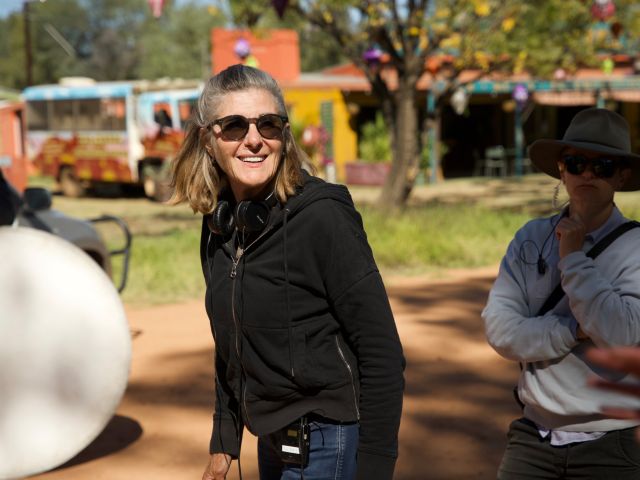
Director Kate Woods on set filming Kangaroo in Alice Springs.
Director Kate Woods on set filming Kangaroo in Alice Springs. (Image: Matt Sav)

The film highlights the work done by the Kangaroo Sanctuary in Alice Springs. It’s also billed as a comedy. What is the film’s broader message?

For me, the broader message is about community. Both of the main characters, Chris and Charlie, are sort of lost at the beginning of the film. Chris has kind of lost his whole life in the city. And, you know, Charlie’s lost her dad. And together they find a family within this community that envelops them. The broad message is really that we can’t live without each other. It’s as simple as that. That’s what I love about the film. And funnily enough, it really wasn’t until we put it all together that you see how strong that theme is in the film. And I’m thrilled about that.
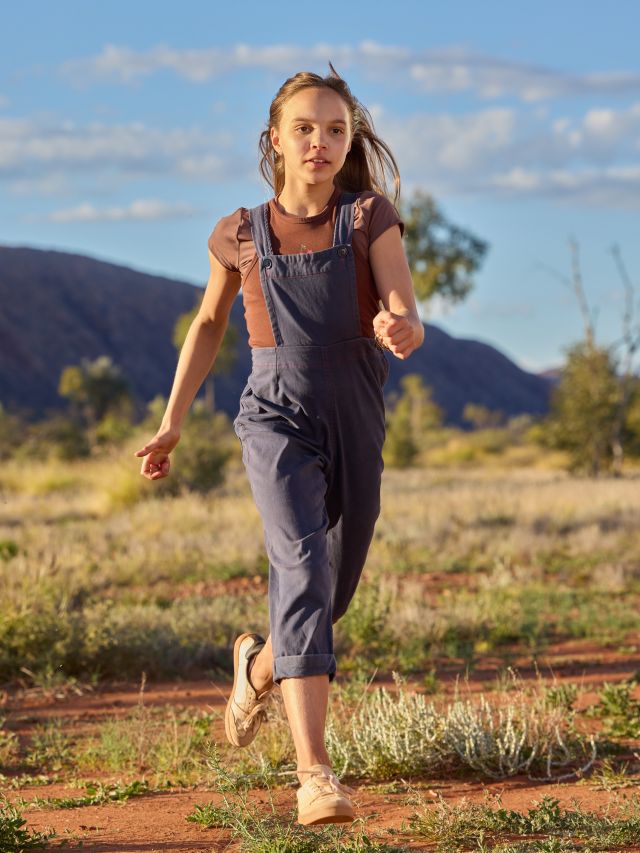
Lily Whiteley as Charlie in Kangaroo
Lily Whiteley’s character Charlie is grieving the loss of her dad in the film. (Image: Narelle Portanier)

Need tips, more detail or itinerary ideas tailored to you? Ask AT.

AI Prompt

Most of Kangaroo is filmed in Alice Springs and the Northern Territory. What did filming here teach you about the destination and the people who live there?

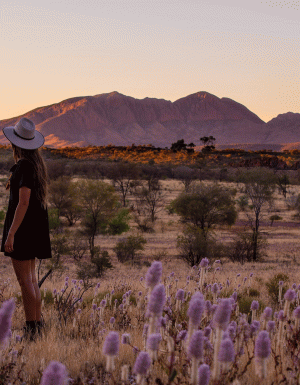
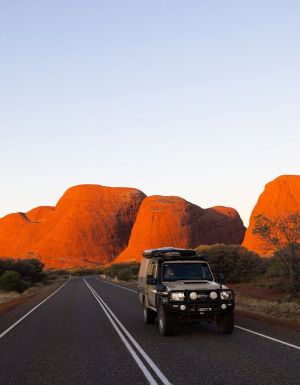
That Alice Springs and the Northern Territory are amazing. As Australians, we have seen so much imagery of the outback. But until you get there, you cannot believe the vastness of it, the redness of it. I mean, there really is no place like it on Earth. And it’s the colour of that Earth and the age of it. It has been there so much longer than we could even possibly imagine. And it’s the community. A lot of the film was shot around Alice Springs and we got to know many of the Arrernte people. We learned about what is important to them, their traditional places, their spiritual places, and how they look after them. It gives you a whole different perspective on what’s important. You stand in the middle of that kind of environment, and the weight of the spirituality is just mind-blowing. It makes you feel differently about being on the planet. It really does.

What aspects of the Australian wilderness do you think will inspire viewers’ sense of wanderlust?

The sunsets. Every single one of them. They are indescribably beautiful. It sounds kind of wanky to say but it really does something to your soul, to your very being. The colours are amazing, and the quiet of it all is amazing. We usually visited the Kangaroo Sanctuary at around dusk and to be with the animals and see them come alive at that time, with all the different colours in the sky, is incredibly moving. I can’t say there was a singular experience that stood out because there were many. I hope it gives people a different perspective on travelling to the Australian outback. We could not have made that movie without the Traditional Owners. I hope that when people visit this part of the world, they keep in mind who was there first and what it means to them. That’s incredibly important to me. We had a make-believe community in the film but there we were, black and white, working together and that was really special.
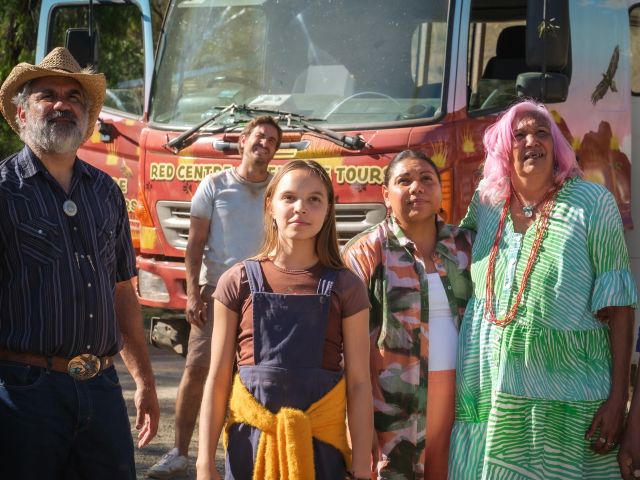
The cast of Kangaroo on set in Alice Springs
The cast of Kangaroo on set. (Image: John Platt)

You are based in LA. What did you learn during your time filming in outback Australia that surprised you or changed your perspective on the land or our wildlife?

We have a lot of myths and, dare I say, cliches about kangaroos with images of the boxing kangaroo and that kind of thing. By default, the kangaroo has become our national symbol. It’s unique because it’s only in Australia. And this film was an opportunity to show adult kangaroos and joeys exactly as they are in a really intimate way. I mean, what Chris Brolga Barns (founder of the Kangaroo Sanctuary) does is amazing. And the experience of going there and walking among the kangaroos is very moving. There are some of the older kangaroos that Chris keeps at the sanctuary because he doesn’t feel comfortable about letting them back into the wild. They come up close to you and you feel like you have a connection with them. And those little babies. They are wild animals and they’re traumatised. They’ve lost their mum and they are orphans, yet they are so affectionate and so communicative.
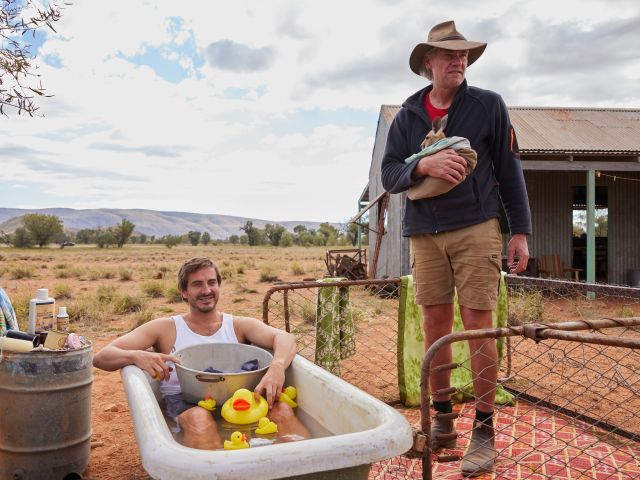
Ryan Corr on set alongside Chris 'Brolga' Barns at The Shed in Ilparpa
Ryan Corr on set alongside Chris ‘Brolga’ Barns, whose story inspired the film. (Image: Narelle Portanier)

Weekly travel news, experiences
insider tips, offers, and more.

What do you hope viewers take away from Kangaroo, both in terms of the film’s message and their appreciation for the Australian environment and wildlife?

I’m hoping it’s going to change a lot of people’s perspective about kangaroos, Central Australia and the outback. I hope it makes audiences think very differently about kangaroos and change their perspective about our native fauna and the wilderness.
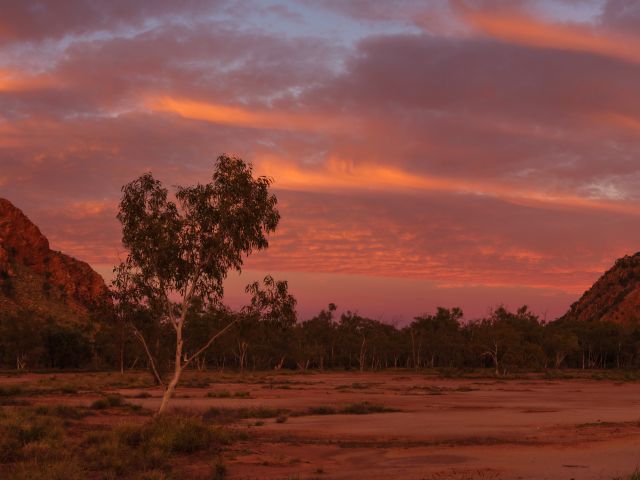
Location of The Shed Ilparpa with view of Mount Ertwa
Kate Woods says the sunsets of the Red Centre are incomparable. (Image: John Platt)

Australia is known for its incredible biodiversity. Did you or any of the actors develop any deeper connection to the animals or nature in general during the production?

It wasn’t just the actors. It was the crew as well. We were mesmerised by the kangaroos. Holding one of those little orphaned joeys was a really moving experience. The amazing thing is that the little kangaroo who played Liz was the same kangaroo all the way through until she got too big, which was about three-quarters of the way through the film. She was so great. She knew how to look at the camera. She kind of reacted to things in a beautiful way. You can’t train them. It was her personality, her willingness to trust humans, and that really says a lot about Chris and the Kangaroo Sanctuary and the way he looks after them.
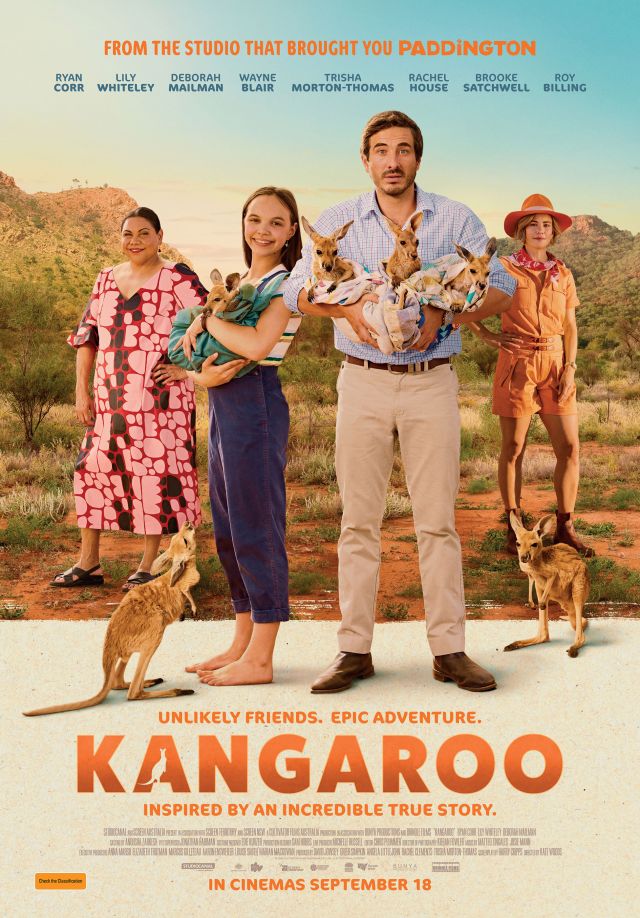
Movie poster for Kangaroo in cinemas September 18
Kangaroo is in cinemas nationwide from September 18, 2025.

Kangaroo will be in Australian cinemas from September 18. To learn more about the work being done by Chris ‘Brolga’ Barns and his team at the Kangaroo Sanctuary, visit the website

Carla Grossetti
Carla Grossetti has written across print and digital for Australian Traveller and International Traveller for more than a decade and has spent more than two decades finding excuses to eat well and travel far. A prestigious News Corp cadetship launched her career at The Cairns Post, before a stint at The Canberra Times and The Sydney Morning Herald gave way to extended wanders through Canada, the US, Mexico, Central America, Asia and Europe. Carla was chief sub editor at delicious and has contributed to Good Food, Travel & Luxury, Explore Travel, Escape. While living in London, Carla was on staff at Condé Nast Traveller and The Sunday Times Travel desk and was part of the pioneering digital team at The Guardian UK.
View profile and articles
hero media

Discovering East Arnhem: Australia’s most unique and rewarding corner

    Joanne Millares Joanne Millares

    Hard to reach and harder to forget, East Arnhem offers something rare in modern travel: the chance to slow down and experience Country on its own terms.

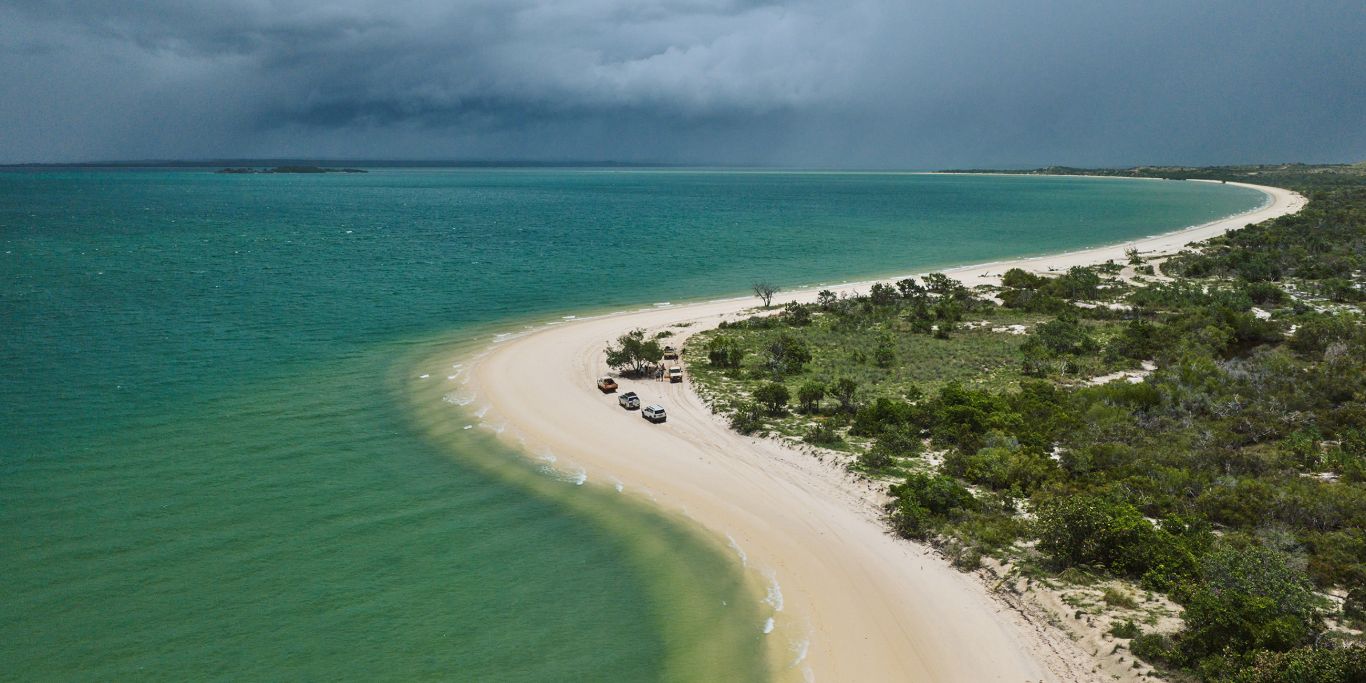
    The sky feels bigger in East Arnhem. It stretches wide and uninterrupted above rouged earth, stringybark woodland and beaches so empty they seem to belong to another era. The coastline curves for kilometres without a footprint and the horizon runs on forever.

    For comedian Lou Wall, the scale of the place was the first thing that hit them.

    “The sheer openness,” they say. “The sky feels infinite and the land stretches out endlessly. It’s pretty breathtaking visually.”

    But the physical landscape is only part of the story. The real reward isn’t only the scenery but the shift in perspective the journey brings. Visitors stop trying to tick off the destination and a real engagement takes over.

    “It made me never want to travel again,” Wall jokes. “In that I never wanted to leave East Arnhem.”

    Getting there

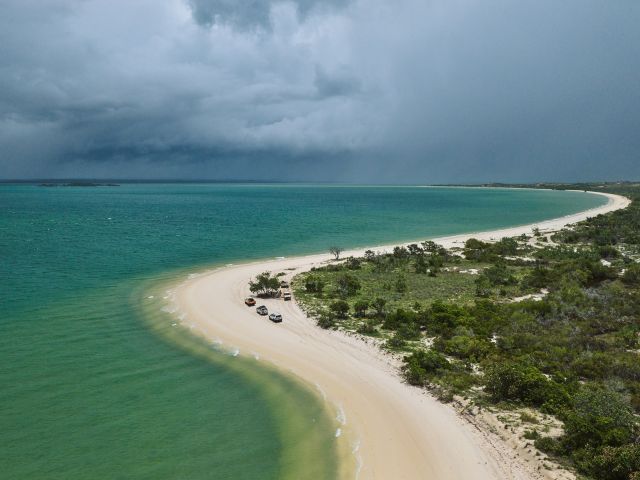
    Aerial shot of East Arnhem’s coastline as cars trace the curve of the shore.
    Sail along the remote coastline on an expedition cruise.

    Reaching East Arnhem is part of the adventure. Travellers typically fly into Gove Airport near Nhulunbuy via Darwin or Cairns, or arrive by expedition cruise along the remote coastline. Others make the journey overland along rutted dirt roads that cut through East Arnhem’s small pockets of monsoon forest.

    However you arrive, there’s a distinct feeling of crossing into somewhere different. Permits are required to visit the region, reflecting the fact that this is Yolŋu land where communities and traditional owners maintain deep cultural connections to Country.

    The extra planning becomes part of the experience. By the time visitors arrive, they understand they’re entering a place not just of respect, but also patience and curiosity.

    At one with nature

    East Arnhem’s  landscapes leave a strong imprint. For Wall, one place in particular still lingers in their memory: Ngalarrkpuy, also known as Lonely Beach, near Bawaka Homeland.

    “I genuinely felt like I was living inside an Instagram filter,” they say. “One of the most stunning feats of nature I’ve ever seen. The water was so clear I swear I could see even the fish smiling.”

    Across the region, natural experiences unfold at a slower pace. Fishing, beachcombing and island hopping reveal the rhythm of the coastline. The tides shape daily life and the vastness of the landscape makes even simple moments feel downright cinematic.

    For visitors with limited time, Wall says the Bawaka Homeland experience is unmissable.

    “I just left and I’m already planning when I can get back there.”

    The sense of remoteness is part of the appeal. In a country where many beaches are crowded and well-trodden, East Arnhem’s coastline still feels wonderfully wild.

    Immersing in local culture

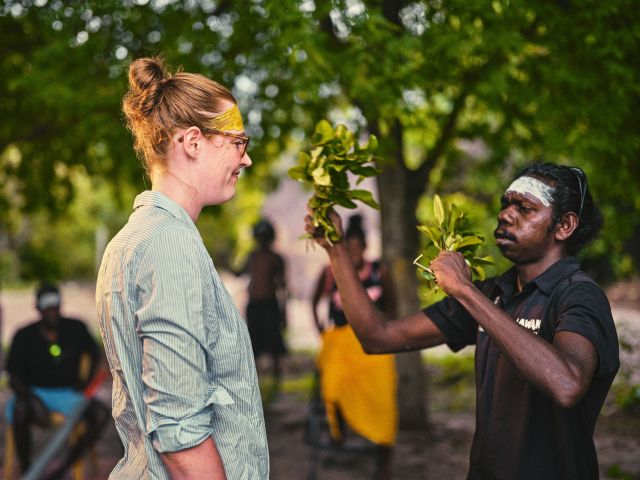
    A visitor spends a meaningful moment alongside Yolŋu guides, gaining insight into their deep cultural knowledge and connection to the land.
    Experience authentic moments with the locals.

    Culture is woven through every experience in East Arnhem. Visitors have the opportunity to spend time on Country with Yolŋu guides and knowledge holders who share stories and traditions that have been passed down for generations.

    For Wall, one of the most powerful moments came during a conversation with a Yolŋu elder.

    “I got to meet a traditional elder, Mayalil, in Nhulunbuy,” they say. “Listening to her talk about her home made the land feel alive in ways I couldn’t have imagined.”

    The region is also home to internationally recognised Aboriginal art centres where artists shape works deeply connected to land and family knowledge.

    Music carries the same cultural energy. East Arnhem has produced globally recognised artists such as King Stingray and Baker Boy, blending Yolŋu language, storytelling and contemporary sound.

    Wall experienced this musical spirit first-hand.

    “A jam session around the fire was it for me,” they say. “Letting the deep joy and history of their music wash over me…  and meeting a few of the King Stingray musicians was unreal.”

    These moments of human connection often become the most memorable part of a visit.

    Spotting local wildlife

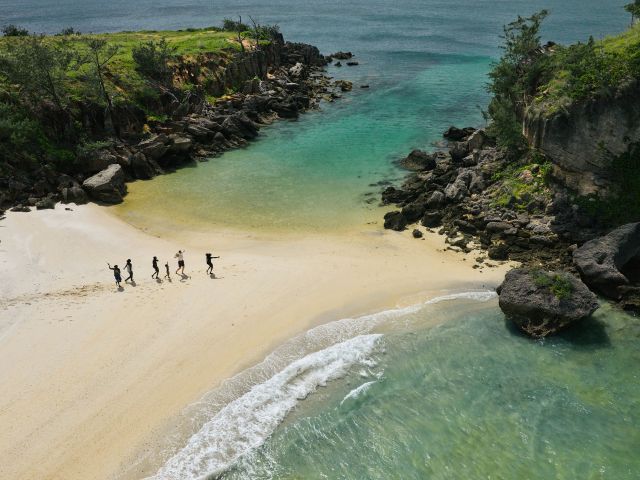
    An aerial view of the beach shows tiny figures lined up across the white sand, moving as if in a rhythmic dance.
    Step into a world where nature reigns.

    The wildlife of East Arnhem adds another layer to the experience. The region is home to an extraordinary range of animals, from waterbirds and turtles to dugongs, dolphins and the formidable saltwater crocodile.

    Wall admits they didn’t actually spot a croc during their visit.

    “Devastatingly, I didn’t see one,” they laugh. “But with all the stories from the locals I definitely gained a healthy respect for caution.”

    Some of the most memorable wildlife encounters can be surprisingly small., At Banubanu Beach Retreat on Bremer Island, Wall remembers walking along the beach one morning and watching it come alive.

    “As you walk through the sand you see hundreds of crabs scurrying into their holes as you pass by,” they say. “Such a small thing, but it was completely magical.”

    Moments like this reveal the quieter rhythms of East Arnhem, where even the smallest creatures seem to play a part in the landscape.

    Visitors who make the journey soon learn the most important travel tip of all.

    “Go in open-minded with a sense of curiosity,” Wall says. “Be prepared to ditch your plans. The land and the locals will guide you on an adventure no spreadsheets could ever compete with.”

    And most importantly, they add, don’t rush.

    “The land and people deserve your time and attention. You’ll be all the better for slowing down.”

    For more information on visiting East Arnhem, head to eastarnhem.com.au.