The only Alice to Uluṟu itinerary you’ll ever need

hero media
From the heart of the Red Centre to an Australian icon, Alice Springs to Uluṟu makes an epic road trip. Here’s everything you’ll ever need to know about doing it.

Alice Springs

Red earth, sunshine and quirky characters make Alice Springs a great place to launch an outback road trip.

Sitting at the epicentre of the Explorers Way (a 3000-kilometre route from Adelaide to Darwin), Alice Springs – simply ‘Alice’ to locals – is a popular base for visitors looking to explore the Northern Territory’s outback.
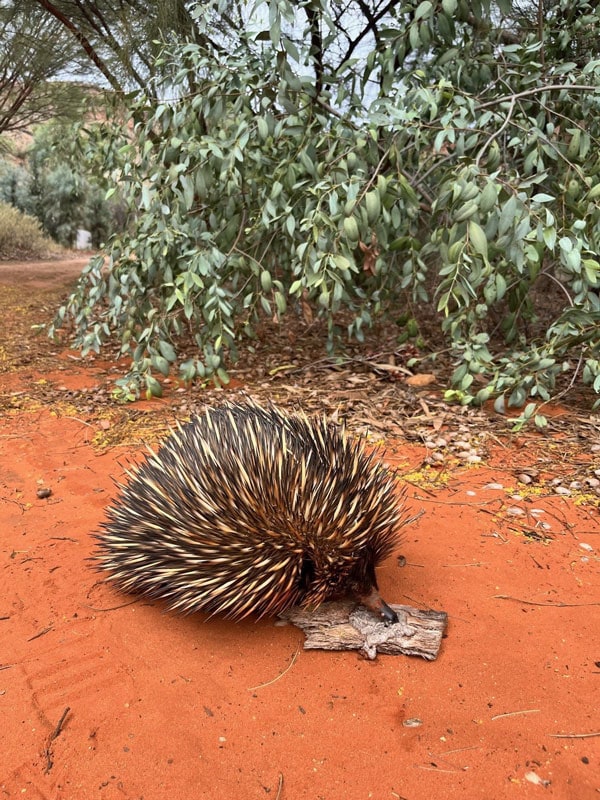
an echidna at Alice Springs Desert Park
See wildlife at Alice Springs Desert Park. (Image: Tourism NT)

There’s plenty to do in the outback town. Bird shows at Alice Springs Desert Park and venomous snakes at Alice Springs Reptile Centre wow animal lovers. History buffs can whittle away hours checking out historic sites such as the National Pioneer Women’s Hall of Fame or the Alice Springs Telegraph Station, where Europeans first settled in town. Throw in sunset atop ANZAC Hill, and you’ll be itching to see more of the Red Centre. Here’s where to head to soak in the very best of the region.

MacDonnell Ranges

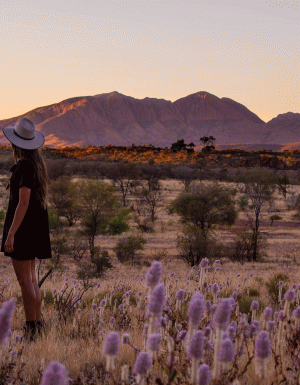
You can easily get from Alice to Uluru in 5.5 hours along the sealed Stuart and Lasseter highways, but where’s the fun in that? Instead, head into the MacDonnell Ranges for an outback adventure bound to leave a lasting impression. The ranges are split in two – Tjoritja/West MacDonnell ranges and the East Macs – and both are impressive.
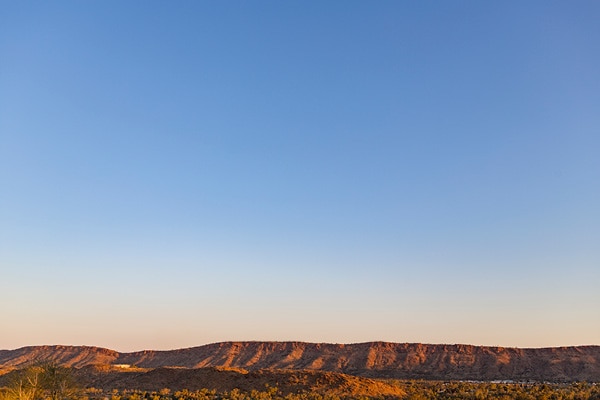
MacDonnell Ranges
The MacDonnell Ranges are an outback adventure bound to leave a lasting impression.

Tjoritja/The West MacDonnell Ranges

The better known of the two, The West MacDonnell Ranges stretch 200 kilometres and are etched with gorges, chasms and dry creek beds. They can be reached by following the Red Centre Way (an 1135-kilometre loop from Alice).
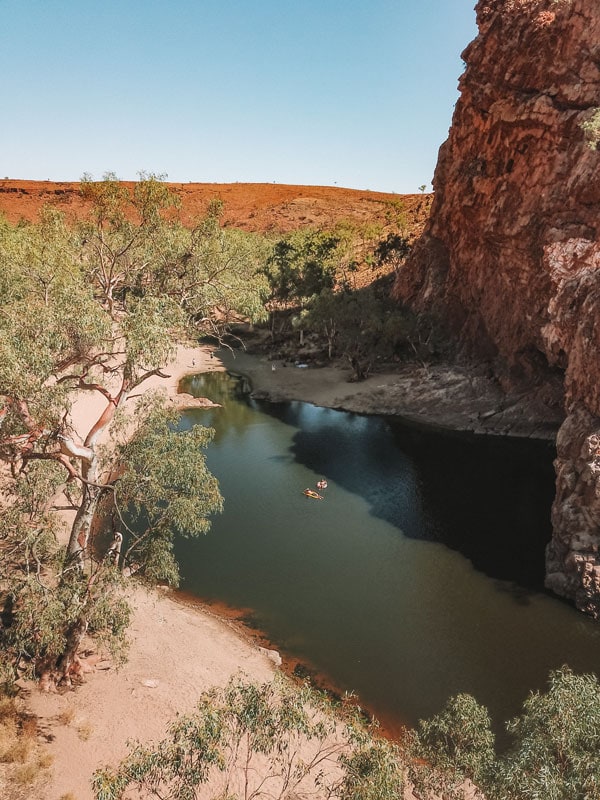
an aerial view of the Ormiston Gorge
You don’t want to miss the spectacular views in Ormiston Gorge. (Image: Tourism NT/Salty Aura)

Places not to miss include the Standley Chasm, a dramatic, 80-metre-high rock face; the refreshing pools at Ellery Creek Big Hole and Ormiston Gorge; and Simpsons Gap, an important spiritual site with several Indigenous dreaming trails.
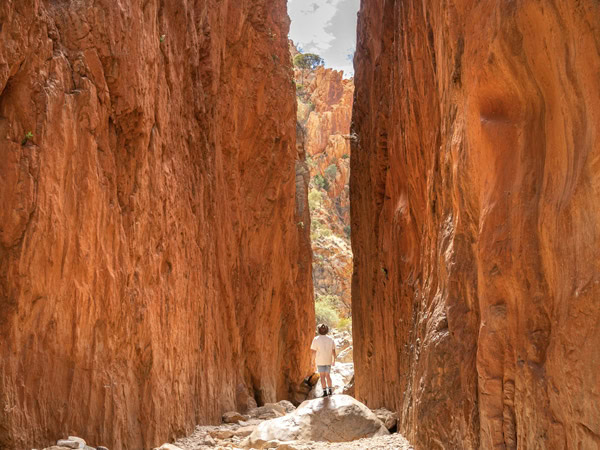
a man standing between the towering red cliffs at Standley Chasm
Make your way through the towering red cliffs at Standley Chasm. (Image: Tourism NT/Mark Fitzpatrick)

If you’re camping, unfurl a swag and enjoy a campfire at Redbank Gorge. Alternatively, Glen Helen Lodge offers basic accommodation close to Glen Helen Gorge and thr 1380-metre-high Mt Sonder.
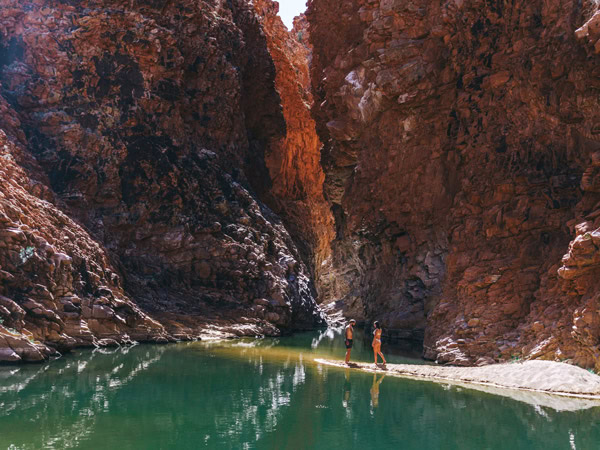
a couple walking along Redbank Gorge
Camp at Redbank Gorge, a stone’s throw from a secluded waterhole you can swim at. (Tourism NT/Jess Caldwell & Luke Riddle)

Don’t miss

Alice Springs Helicopters offer scenic flights over the MacDonnell Ranges and thrilling mountain bike tours that drop you at sections along the mountain biking trails in the West Macs area.
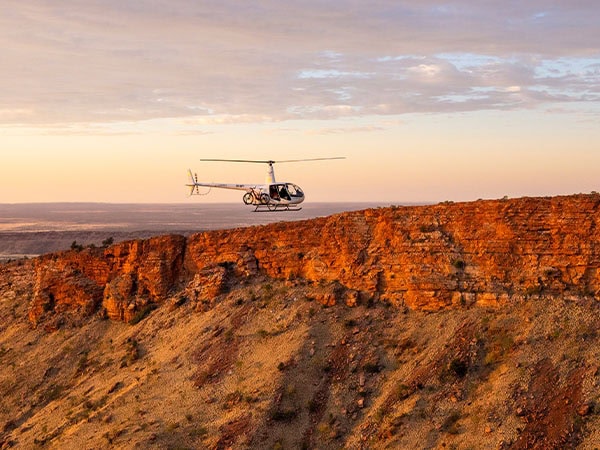
Alice Springs Helicopters
Get a new perspective on the landscape with Alice Springs Helicopters. (Tourism NT/Tourism Australia)

The East MacDonnell

Less touristed, but arguably as stunning, the East Macs offer travellers insight into the Indigenous and gold rush history of the area.

Located 150 kilometres east of Alice Springs, bushwalking, camping and four-wheel driving is to be expected here.

A main attraction is Trephina Gorge Nature Park, where you’ll be surrounded by rising walls of red and purple quartzite. The gorge is also home to what’s said to be the largest ghost gum in Australia (at 33 metres high and about 300 years old) and forms part of the Wallaby Dreaming Trail, significant to the Eastern Arrernte Aboriginal people.
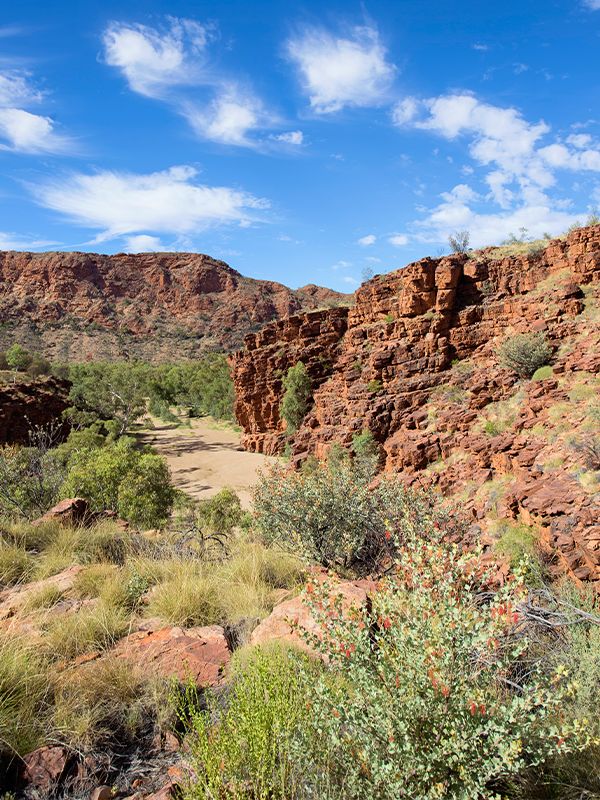
Trephina Gorge Nature Park
Trephina Gorge Nature Park is a geological marvel. (Image: Tourism NT/Shaana McNaught)

While you’re here, visit N’Dhala Gorge Nature Park, home to 6000 rock carvings, as well as the old gold rush town of Arltunga, which dates back to the late 1800s. You can stay at Hale River Homestead at Old Ambalindum, which offers a true outback experience.
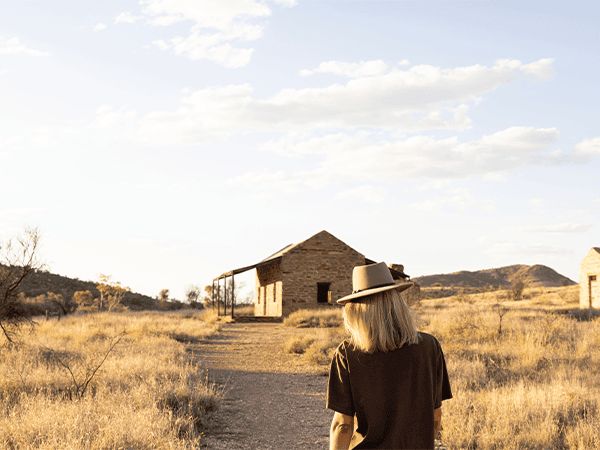
Arltunga Historical Reserve Trephina Gorge Nature Park Northern Territory
Arltunga Historical Reserve (Image: ourism NT/Sean Scott)


Need tips, more detail or itinerary ideas tailored to you? Ask AT.

AI Prompt

Hermannsburg and Finke Gorge

Thought to be 350 million years old, The Finke River winds through Finke Gorge National Park, an important wilderness reserve between Alice Springs and Kings Canyon. Within the park’s confines is the ancient Palm Valley, where rare red cabbage palms, also dating back millennia, grow.
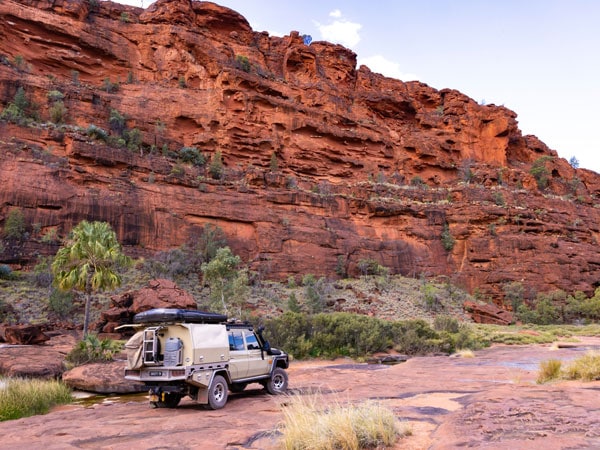
a 4WD driving across Finke Gorge
Finke Gorge National Park is an ancient, spectacular landscape. (Image: Tourism NT/Sean Scott)

To get into the park, you’ll need a high-clearance 4WD and be comfortable conquering rocky tracks. You will also want sturdy hiking boots as there are a tonne of trails.

Call into Hermannsburg prior to entering the park: it’s a historic precinct where a Lutheran Mission was active in the late 1880s and where renowned Aboriginal artist Albert Namatjira resided.
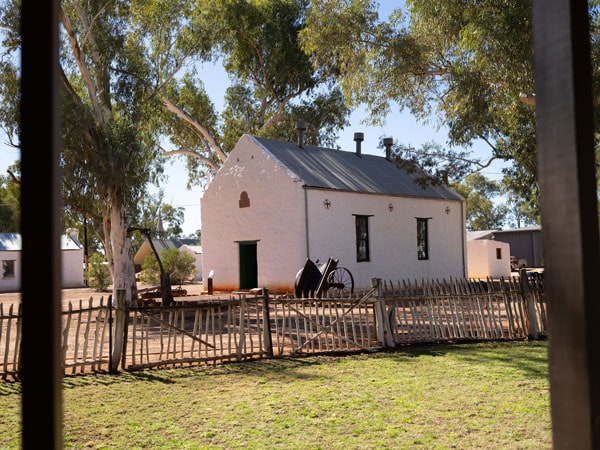
the historical precinct in Hermannsburg
Check out the historical precinct in Hermannsburg. (Image: Tourism NT/Charlie Bliss)


Kings Canyon and Watarrka National Park

After exploring the West Macdonnell Ranges head off-road along the Mereenie Loop as you make your way to Kings Canyon (you’ll need a 4WD and a permit). The canyon, plunging 270 metres, is the highlight of the park and an oasis of palms and ferns.
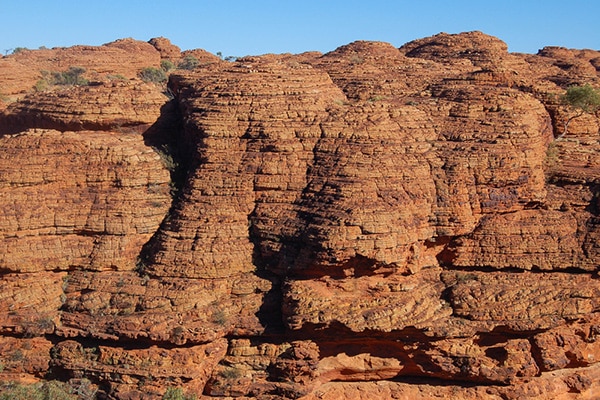
Kings Canyon, Watarrka National Park
The canyon, plunging 270 metres, is the highlight of the park.

Rise early and set off on the six-kilometre Canyon Rim Walk, which will lead you to the sandstone domes of the Lost City and a sacred watering hole aptly named the Garden of Eden. There is also the much gentler 2.6-kilometre Kings Creek Hike to a lookout.
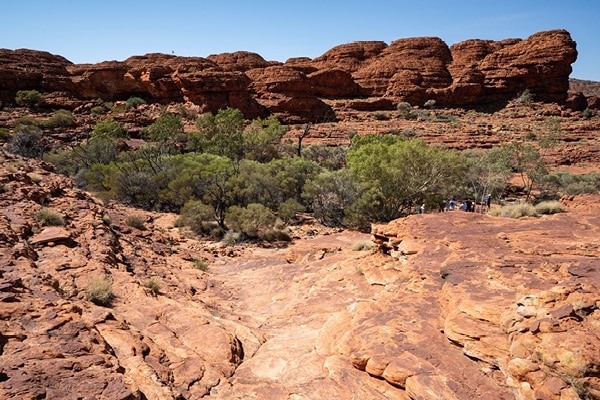
Kings Canyon Walk
Take the Canyon Rim Walk to the sandstone domes of the Lost City.

You can Base yourself at Kings Creek Station, not far from Watarrka National Park. The 1800-square-kilometre property is open year-round and is a top spot to experience life on the land with both campsites and basic cabins available. Make time to enjoy traditional damper with a cup of billy tea.

Uluru

Uluru is a 3 hour drive from Kings Creek. Nothing says ‘outback’ more than the big red rock in the middle of the country, and you will certainly appreciate its isolation as you drive the road to reach it.

In spite of its remoteness, there is plenty to do at UNESCO World Heritage-listed Uluṟu. First up, you’ll want to explore on foot, so rise early and walk Uluru’s 10-kilometre base. You can also join a guided Mala Walk (two kilometres), which is a great option if you want to learn about Uluru’s cultural significance and Indigenous rock art.
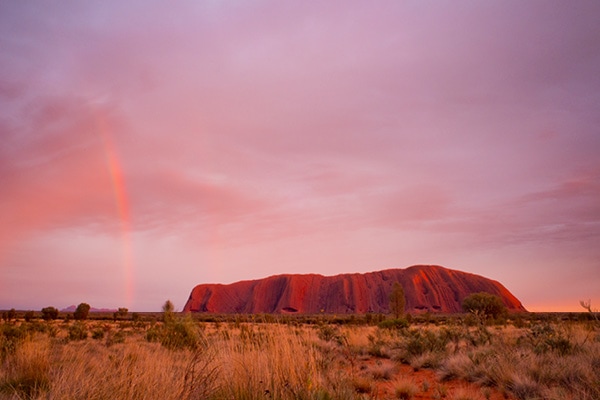
Ayers Rock
A outback road trip wouldn’t be the same without visiting Uluru.

While you’re there, sign up for a plod atop a camel, hop aboard a Segway, enjoy a Harley Davidson ride or plummet toward Uluru on a thrilling sky dive.

Weekly travel news, experiences
insider tips, offers, and more.

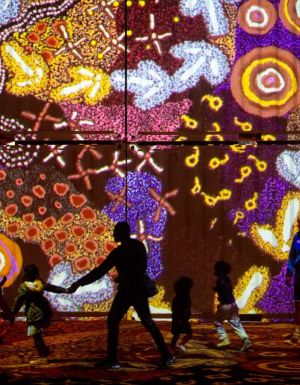
Set your alarm so you can drive to one of the viewing platforms and watch Uluru change color at sunrise. Come nightfall, head to Field of Light where a carpet of 50,000 lights will shine.
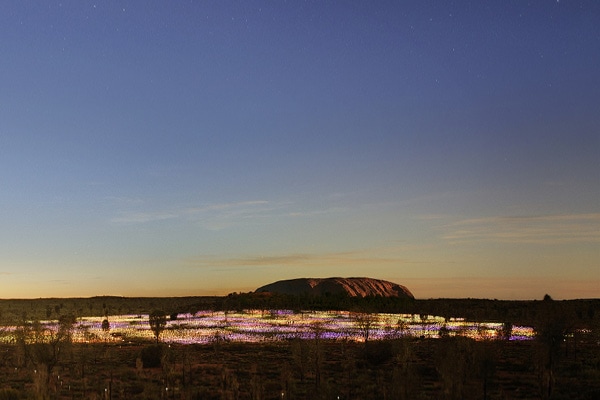
Uluru Field of Light
Field of Light; one of the largest art installations in Australia’s history.

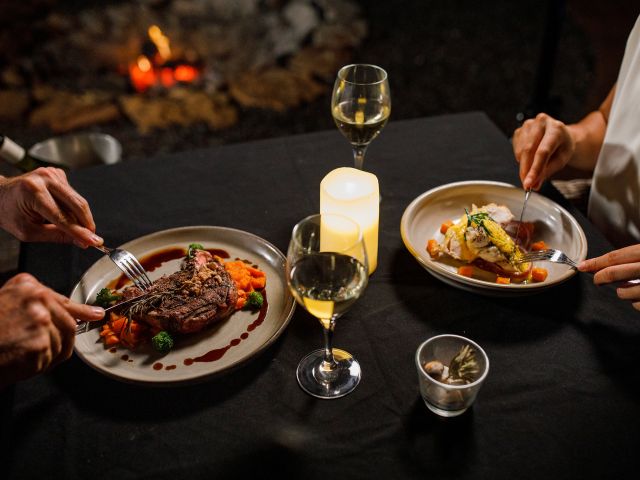
For a special outback dining experience, you can’t go past Sounds of Silence. Savour native Australian ingredients, such as kangaroo, finger lime and lemon myrtle, while the Milky Way dazzles from above.

Kata Tjuta

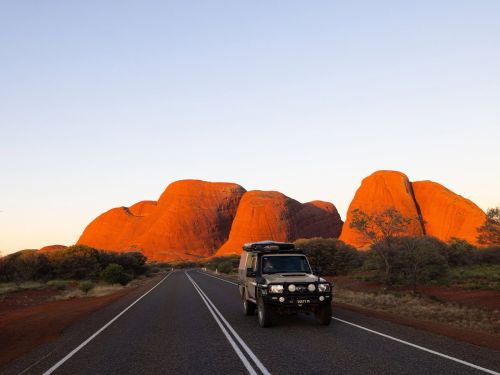
If you can squeeze it in, don’t miss the 36 large rock domes of Kata Tjuta. Located about half an hour’s drive from Uluru, they’re easy to reach on a day trip.
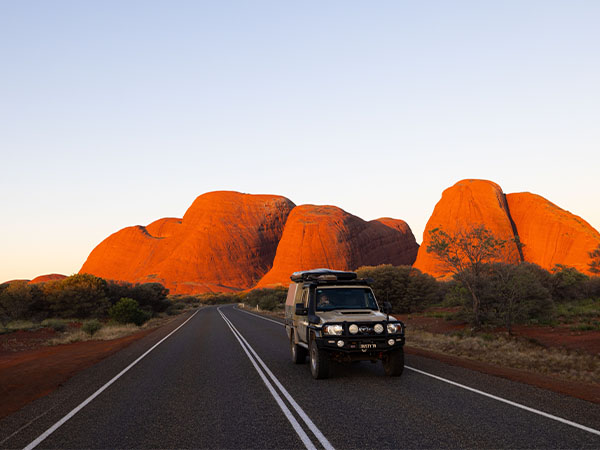
 

Kata Tjuta
The mesmerising peaks of Kata Tjuta. (Image: Tourism NT/Sean Scott)

The domes are dramatic, with the tallest one, Mt Olga, soaring 546 metres high. Explore them on foot by following the challenging Valley of the Winds trail (7.4 kilometres). It will take you about three hours, so set off early to avoid the midday heat. There is also the easier Walpa Gorge (2.6-kilometre) walk.

Where to stay

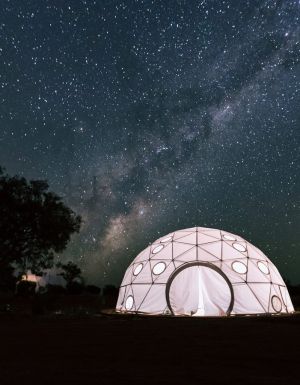
Accommodation in Uluṟu comes in all shapes and sizes, from luxury suites, to tent-style pavilions and campsites. It also runs numerous tours and workshops, some of which are free. Squeeze it all in by jumping on the resort’s complimentary shuttle, especially if you’re travelling with children or the elderly.

Need to know

Although Uluru is open to visitors year-round, in summer temperatures frequently sit at 45°C and flies are at their most persistent. Instead, visit between May and October, when daytime temperatures are comfortable.

If a one-way road trip from Alice to Uluru is enough for you, fly out of Ayers Rock Airport to many of Australia’s major cities.

Want more Red Centre travel inspo? Check out our guide on eating, playing and staying in Australia’s heart.


Jennifer Ennion
Jennifer Ennion is a freelance travel and ski journalist who loves encouraging people to spend more time outdoors. From snorkelling with belugas in sub-Arctic Canada to hiking the Himalayas, Jennifer is constantly searching for stories that inspire readers to push their boundaries.
View profile and articles
hero media

Discovering East Arnhem: Australia’s most unique and rewarding corner

    Joanne Millares Joanne Millares

    Hard to reach and harder to forget, East Arnhem offers something rare in modern travel: the chance to slow down and experience Country on its own terms.

    The sky feels bigger in East Arnhem. It stretches wide and uninterrupted above rouged earth, stringybark woodland and beaches so empty they seem to belong to another era. The coastline curves for kilometres without a footprint and the horizon runs on forever.

    For comedian Lou Wall, the scale of the place was the first thing that hit them.

    “The sheer openness,” they say. “The sky feels infinite and the land stretches out endlessly. It’s pretty breathtaking visually.”

    But the physical landscape is only part of the story. The real reward isn’t only the scenery but the shift in perspective the journey brings. Visitors stop trying to tick off the destination and a real engagement takes over.

    “It made me never want to travel again,” Wall jokes. “In that I never wanted to leave East Arnhem.”

    Getting there

    Aerial shot of East Arnhem’s coastline as cars trace the curve of the shore.
    Sail along the remote coastline on an expedition cruise.

    Reaching East Arnhem is part of the adventure. Travellers typically fly into Gove Airport near Nhulunbuy via Darwin or Cairns, or arrive by expedition cruise along the remote coastline. Others make the journey overland along rutted dirt roads that cut through East Arnhem’s small pockets of monsoon forest.

    However you arrive, there’s a distinct feeling of crossing into somewhere different. Permits are required to visit the region, reflecting the fact that this is Yolŋu land where communities and traditional owners maintain deep cultural connections to Country.

    The extra planning becomes part of the experience. By the time visitors arrive, they understand they’re entering a place not just of respect, but also patience and curiosity.

    At one with nature

    East Arnhem’s  landscapes leave a strong imprint. For Wall, one place in particular still lingers in their memory: Ngalarrkpuy, also known as Lonely Beach, near Bawaka Homeland.

    “I genuinely felt like I was living inside an Instagram filter,” they say. “One of the most stunning feats of nature I’ve ever seen. The water was so clear I swear I could see even the fish smiling.”

    Across the region, natural experiences unfold at a slower pace. Fishing, beachcombing and island hopping reveal the rhythm of the coastline. The tides shape daily life and the vastness of the landscape makes even simple moments feel downright cinematic.

    For visitors with limited time, Wall says the Bawaka Homeland experience is unmissable.

    “I just left and I’m already planning when I can get back there.”

    The sense of remoteness is part of the appeal. In a country where many beaches are crowded and well-trodden, East Arnhem’s coastline still feels wonderfully wild.

    Immersing in local culture

    A visitor spends a meaningful moment alongside Yolŋu guides, gaining insight into their deep cultural knowledge and connection to the land.
    Experience authentic moments with the locals.

    Culture is woven through every experience in East Arnhem. Visitors have the opportunity to spend time on Country with Yolŋu guides and knowledge holders who share stories and traditions that have been passed down for generations.

    For Wall, one of the most powerful moments came during a conversation with a Yolŋu elder.

    “I got to meet a traditional elder, Mayalil, in Nhulunbuy,” they say. “Listening to her talk about her home made the land feel alive in ways I couldn’t have imagined.”

    The region is also home to internationally recognised Aboriginal art centres where artists shape works deeply connected to land and family knowledge.

    Music carries the same cultural energy. East Arnhem has produced globally recognised artists such as King Stingray and Baker Boy, blending Yolŋu language, storytelling and contemporary sound.

    Wall experienced this musical spirit first-hand.

    “A jam session around the fire was it for me,” they say. “Letting the deep joy and history of their music wash over me…  and meeting a few of the King Stingray musicians was unreal.”

    These moments of human connection often become the most memorable part of a visit.

    Spotting local wildlife

    An aerial view of the beach shows tiny figures lined up across the white sand, moving as if in a rhythmic dance.
    Step into a world where nature reigns.

    The wildlife of East Arnhem adds another layer to the experience. The region is home to an extraordinary range of animals, from waterbirds and turtles to dugongs, dolphins and the formidable saltwater crocodile.

    Wall admits they didn’t actually spot a croc during their visit.

    “Devastatingly, I didn’t see one,” they laugh. “But with all the stories from the locals I definitely gained a healthy respect for caution.”

    Some of the most memorable wildlife encounters can be surprisingly small., At Banubanu Beach Retreat on Bremer Island, Wall remembers walking along the beach one morning and watching it come alive.

    “As you walk through the sand you see hundreds of crabs scurrying into their holes as you pass by,” they say. “Such a small thing, but it was completely magical.”

    Moments like this reveal the quieter rhythms of East Arnhem, where even the smallest creatures seem to play a part in the landscape.

    Visitors who make the journey soon learn the most important travel tip of all.

    “Go in open-minded with a sense of curiosity,” Wall says. “Be prepared to ditch your plans. The land and the locals will guide you on an adventure no spreadsheets could ever compete with.”

    And most importantly, they add, don’t rush.

    “The land and people deserve your time and attention. You’ll be all the better for slowing down.”

    For more information on visiting East Arnhem, head to eastarnhem.com.au.