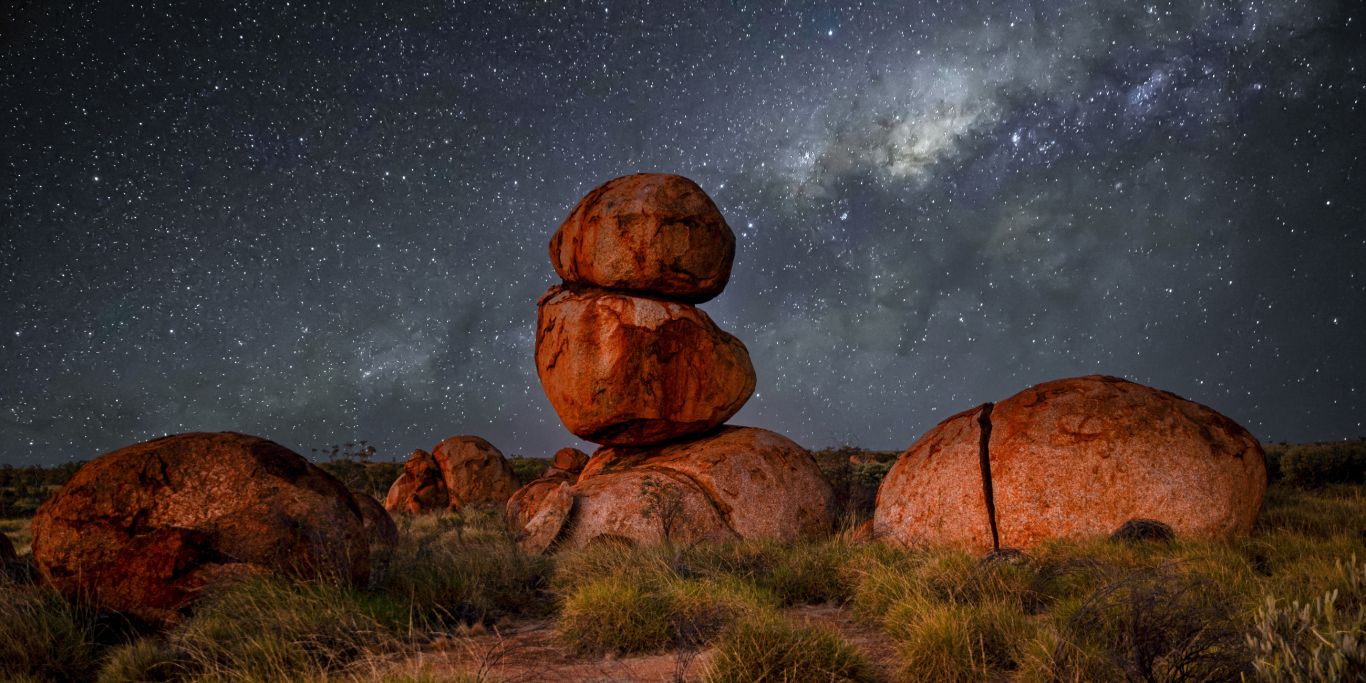

Karlu Karlu (Devils Marbles) are now home to the Northern Territory’s darkest skies.
One of the Northern Territory’s most iconic natural landmarks, Karlu Karlu, also known as the Devils Marbles, has just been given an exciting accolade: it’s officially one of the best places to stargaze in Australia. Designated as an International Dark Sky Sanctuary by DarkSky International, a nonprofit organisation that works to preserve and protect the nighttime environment, this award recognises the exceptional quality of the night skies and commits to protecting them from the impact of artificial light.
Crucially, the designation makes Karlu Karlu the first International Dark Sky Sanctuary in the NT and only the third in Australia, joining more than 270 designated Dark Sky Places around the world.
Why Karlu Karlu has been named a Dark Sky Sanctuary
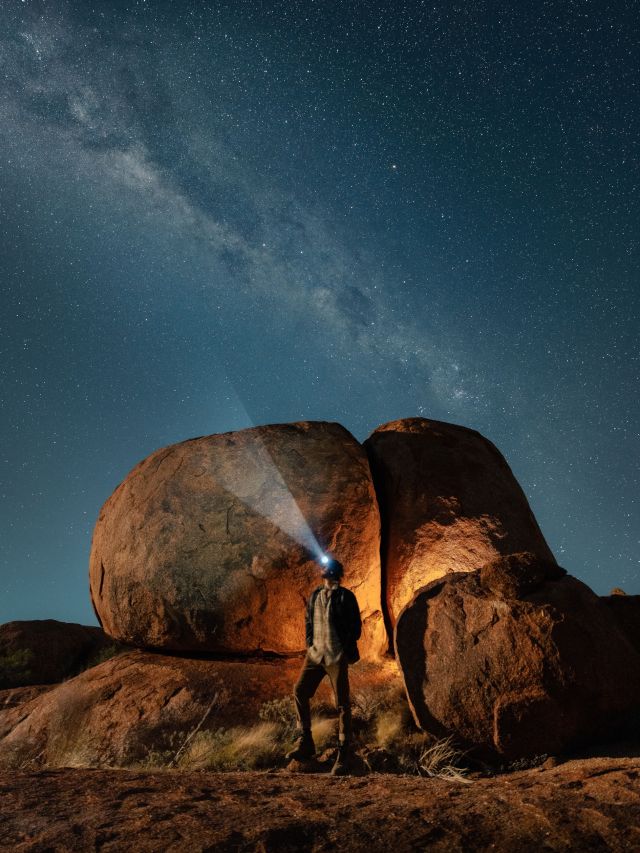
It only takes one look at the breathtaking expanse of stars over Karlu Karlu to understand the importance of protecting this view.
However, achieving the designation was no mean feat. The year-long process, led by NT Parks and Wildlife, included six months of night-sky readings to measure darkness levels, as well as an audit of artificial lighting and an assessment of potential future threats to the night sky.
The new status will also help keep it that way. Any future development at Karlu Karlu will have to adhere to strict lighting guidelines designed to preserve its dark skies for generations to come.
The 1800-hectare reserve is also a place of immense cultural significance. Almost all of Karlu Karlu is a registered sacred site, significant to the Kaytetye, Warumungu, Warlpiri and Alyawarra Traditional Owners, whose ancestors have managed the area since creation time.
As part of its Dark Sky certification, new interpretive signage will also be developed at Karlu Karlu, providing visitors with more information about night-sky viewing and the importance of preserving dark skies.
How to experience Karlu Karlu after dark
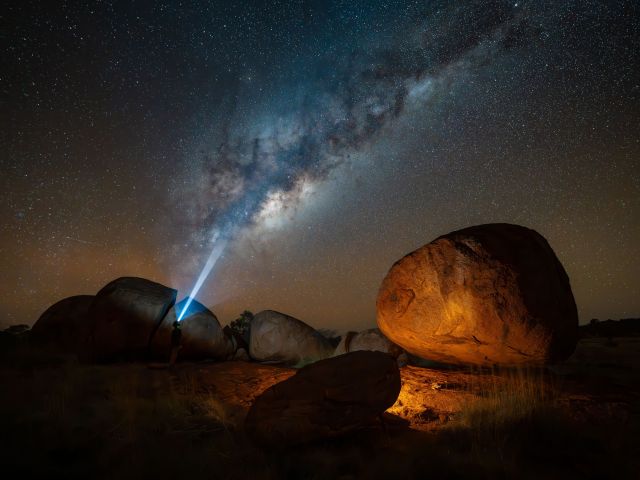
Visitors are more than welcome to camp at Karlu Karlu as long as they’ve paid the fee online and picked up an NT Parks Visitor Pass. The area isn’t just for night owls, with the surrounding landscapes offering self-guided walking trails that make it ripe for a full day-to-night adventure.
The real show begins once the sun goes down. With no light pollution to compete with, campers can experience brilliant stars and breathtaking views of the Milky Way galaxy – a sight that’s becoming increasingly difficult to experience elsewhere.
The new Dark Sky designation should make it easier for visitors to get more from the experience, too. Interpretive signage will be developed at Karlu Karlu with information specifically focused on night-sky viewing and why preserving the area’s darkness is so important.
And if you’re planning particularly far ahead, mark 22 July 2028 in your calendar. Karlu Karlu will sit within the path of totality for the total solar eclipse, when the moon will completely obscure the sun over the reserve for almost five minutes. The Northern Territory will release more information on how to experience the eclipse closer to the event.
Need tips, more detail or itinerary ideas tailored to you? Ask AT.
AI Prompt
The details
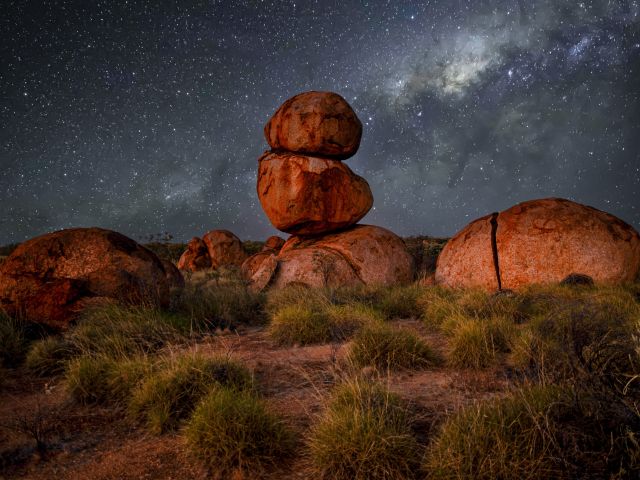
Location: An hour south of Tennant Creek or 4.5 hours north of Alice Springs, directly off the Stuart Highway in Warumungu.
Best for: Anyone looking to experience a glittering night sky free from light pollution, with views of the Milky Way galaxy that are becoming increasingly difficult to find.
Good to know: Visitors are welcome to camp at Karlu Karlu and enjoy the stars all night long. Campsites are available to book online; an NT Parks Visitor Pass is also required.
Cost: A one-day NT Parks Visitor Pass is $10 for adults, $5 for kids and $8 for concession, with more deals available for families. The camping fees are the same prices as the visitor pass, so for both it’s $20 for adults, $20 for kids and $16 for concession.
Want to see more stories from Australian Traveller in your Google search results?
- Click here to set Australian Traveller as a preferred source.
- Tick the box next to "Australian Traveller". That's it.

Jessica O'Donnell
View profile and articles