Fancy an outback, bush tucker dining experience?

hero media
A Top End dining experience takes the unknown out of native bush foods and comes to life with campfire tales.


With wide sparkling eyes gazing from under his Akubra, Geoff Mark (better known as Marksie) avidly recounts a story as though it’s the first time he’s told anyone. “My grandfather, Bill, was a professional rabbit trapper in Rainbow, Victoria, and my father, Brian, was also a keen bushman," he says as dusk falls behind him. “As a young boy, I earnt pocket money from trapping rabbits, dressing them out and selling them to my neighbours."


A vast, clear sky dotted with countless stars is spread above us, and the warm glow of several campfires flicker in the fading light; it’s an infinitely peaceful night. We’re seated at a long trestle table with three other couples; another table seats two families. Bonnie (one of four adorable rescued wallabies with a penchant for bush tucker) also competes for our attention as she potters around our table, but we’re engrossed in Marksie’s story about how he came to host camp tucker nights up here in Katherine.


Despite some initial reservations, we quickly learn this is not just a well-executed Australiana spectacle for tourists; Marksie has a genuine passion for using native herbs, spices and fruits in cooking, and his journey from rabbit-trapping youngster to a man adept at working with bush foods is a long and interesting one (and one he is remarkable at telling).

His interest in bush ingredients began when he was a young boy surrounded by ‘bush men’, but he says he didn’t have the knowledge to use them properly until a visit to the Northern Territory in the 1970s, when he was in his twenties.


“I got the chance to meet some Aboriginal people, one woman in particular who helped me." [She has passed away so her name cannot be mentioned for cultural reasons.]

Seemingly the secrets of bush food cannot be passed on to just anyone – Indigenous people are, after all, the custodians of bush food and of the knowledge associated with its use – so it took several trips over seven years before she agreed to help him. With elder Indigenous women the experts in this field, Marksie tells us, “I was white and a male. But after returning to Darwin year after year, she eventually let me spend 10 days out bush with her – this changed everything for me."


Years later in 2001, after meeting Katie Young – an Aboriginal woman who has an associate doctorate in tropical horticulture – Marksie moved to Katherine and set up the Stockman’s Camp Tucker experience, during which Katie would conduct bush food demonstrations for his guests. She has since moved to Alice Springs, but 16 years on, Marksie continues these cook-ups along with his wife, Penny, a local midwife and part-time bush tucker assistant.


Penny serves our entrée, which consists of three canapé-style dishes: crocodile and beef sausage roll with bush tomato seasoning and desert quandong sauce; wild barramundi with lemon myrtle and rainforest spice; and camel sausage with mountain pepper and sweet chilli sauce. Jugs of ‘Jungle Juice’, a homemade drink of native mint and forestberry herbs, accompanies the food.


I’ve tasted crocodile before (the sausage roll is delicious), but I hesitate with the camel sausage. After some positive feedback from my fellow diners, I take a bite, hoping it ‘tastes like chicken’ as all foreign meats do. It doesn’t.


Setting it aside, I appreciate the fruits, herbs and spices used in these dishes – desert quandong, also known as desert peach, a sweet fruit that is tart and high in Vitamin C; lemon myrtle, found on the east coast, similar to zesty lemon verbena; and the aromatic mountain pepper, made from dried berries found in Tasmania and south-east Australia. These uniquely Australian flavours are ironically more exotic to most of us than, say, the south-east Asian dragonfruit, the Central American guava, or the Mexican chipotle.

And it is this unfamiliarity with native food that sparked Marksie’s desire to teach other Australians how it can be used in everyday cooking – and to showcase a beautiful “marriage of white and Indigenous Australian culture" to his many overseas guests.


With a menu that changes to suit what’s in season, around 14 different types of herbs, spices, and fruits are used on any given night – many of which are collected by Marksie himself when he goes bush with local Indigenous ladies who he calls his close friends.


But it’s not just the foraging that’s finicky work. To prepare for every camp tucker dinner, Marksie lights the first fire around 5am and by the time the last guest leaves and clean-up is complete, it’s almost midnight. (I suddenly appreciate my camel sausage a great deal more.) There were around 120 people running similar experiences when he began, but now there are very few: “It is sad to say that many of the old-timers that used to do what I do are no longer with us. It’s a very time-consuming and slow business, so not many people want to take it on," he says.


Yet the growing appreciation for native flavours, their beauty and versatility, has taken bush foods in a whole new direction, and they are appearing increasingly in top-notch restaurants across the country. Hatted establishments such as Sydney’s Billy Kwong and Melbourne’s Vue de Monde, and Adelaide’s Orana have embraced native ingredients on their menus, with respective dishes such as red-braised caramelised wallaby tail; Davidson plum sorbet with sorrel and flowers; and riberry, native juniper, muntrie and mango.


Our main course for the evening is a little more humble, comprising roast beef with native pepper berry; roast potatoes with aniseed myrtle (which has a subtle liquorice flavour); and peas with native mint (originally used by Indigenous Australians for medicinal purposes).

A delicious hot-from-the-camp-oven damper with roasted wattle seeds is served on the side with creamy butter, and we finish the evening with homemade scones, fresh jam and cream, while watching two of the younger diners go head-to-head in a billy spinning competition.


Sure, it’s a far cry from the award-winning fare served under city lights, but the hearty and homely dishes we’ve tasted tonight perfectly complement this very Australian setting under the outback stars. And more importantly, what’s a campfire without a colourful story or two?

Marksie’s outstanding ability to tell a good yarn in between courses, if a little irreverent and exaggerated at times, has us utterly entertained. Indeed, this is a stockman’s dinner after all, where in place of a chef’s hat is a top-notch Akubra.

Getting there:

Marksie’s Stockman’s Camp Tucker is located in the grounds of Top Didj Cultural Experience on Gorge Road, seven kilometres from the Post Office in Katherine, Northern Territory. It runs five nights a week during the dry season and the cost is $80 per adult and $40 per child (two–13 years) for a three-course meal with non-alcoholic Jungle Juice. BYO alcohol. Bookings are required.

For more information on things to do in the NT, visit the official Northern Territory website at northernterritory.com

Megan Arkinstall
Megan Arkinstall is a freelance travel writer who you’ll often find at the beach, bushwalking or boating with her young family. She loves reliving travel memories through writing, whether that be sipping limoncello in a sun-drenched courtyard of Monterosso or swimming with green turtles in the aquamarine waters of Tropical North Queensland.
See all articles
hero media

8 Red Centre locations to explore after seeing the new movie, Kangaroo

Spend a few days visiting the real-life Central Australian locations that inspired the new film everyone is talking about, and discover why Alice Springs is such an important part of Australian culture.

In the credits of the new Australian film Kangaroo , the first name under ‘cast’ should read ‘The Northern Territory ’. Not only is Alice Springs (and the surrounding landscape) integral to the movie itself, but the spiritual heart of Australia and its local Indigenous owners also inform the look and feel of every frame, explains Producer Trisha Morton-Thomas of Brindle Films, who also plays Charlie’s grandmother Gwennie.

“By setting Kangaroo in Alice Springs (Mparntwe), the film embraces how visible Aboriginal people are here, and the living Aboriginal culture that is woven through this community,” she explains.

still from kangarro film
See Kangaroo, then visit the real-life filming locations.

And while shooting in such a sacred part of the Northern Territory required extra planning, it was something the cast and crew were highly invested in.

“There are incredibly significant sacred sites and places of deep cultural stories in the area, that at times are very gender-specific, which we’ve kept out of the production,” she explains. “Even if overhead drone footage captures a sacred site that isn’t meant to be seen by other people outside of that clan, we’ve made sure to omit it from the film.”

If Kangaroo piqued your interest in a Central Australian holiday, we don’t blame you. Read on to discover eight places featured in the movie that you can visit in real life – and get planning. Don’t forget to pack sunscreen and a hat.

1. Alice Springs/ Mparntwe

artist at Many Hands Art Centre
Visit the galleries of Alice Springs, like Many Hands Art Centre. (Image: Tourism NT/ Helen Orr/ Many Hands Art Centre)

The red and dusty streets of the film’s fictional town of Silvergum were filmed on the outskirts of Alice Springs. And, while the art gallery featured in the film is fictional, Alice Springs is a hub of creativity. See the work of local artists at the Araluen Art Centre , Yubu Napa Art Gallery , Iltja Ntjarra (Many Hands) Art Centre and the famous Tjanpi Desert Weavers .

2. The Kangaroo Sanctuary & Kangaroo Rescue Centre

The Kangaroo Sanctuary Alice Springs, the inspiration for the Kangaroo move
Visit the movie’s inspiration at Kangaroo Sanctuary. (Image: Tourism NT/ Kangaroo Sanctuary)

Kangaroo was inspired by the journey of Chris ‘Brolga’ Barns, who founded the now world-renowned Kangaroo Sanctuary based in Alice Springs. For lead actor, Aussie Ryan Corr, the animals were central to the movie, alongside the landscapes.

“The animals in this story were a real calling point for me,” he explains. “What this story tries to tell us about the connection between humans and animals is beautiful.”

To gain a real insight into the fauna and flora of the Red Centre, you can visit the Kangaroo Sanctuary on a sunset tour, where you might even get the chance to hold a baby kangaroo.

3. Ormiston Gorge

woman walking along the edge of Ormiston Gorge near alice springs
Take a dip in Ormiston Gorge. (Image: Tourism NT/ @domandjesso)

The film captures the raw beauty of the West MacDonnell Ranges, known in the Arrernte language as Tjoritja. This national park is rich in Indigenous culture and stark geological wonders.

Only a 15-minute drive from Alice Springs, Tjoritja offers visitors the chance to camp, hike and swim among ancient landscapes (most attractions are less than a three-hour drive away).

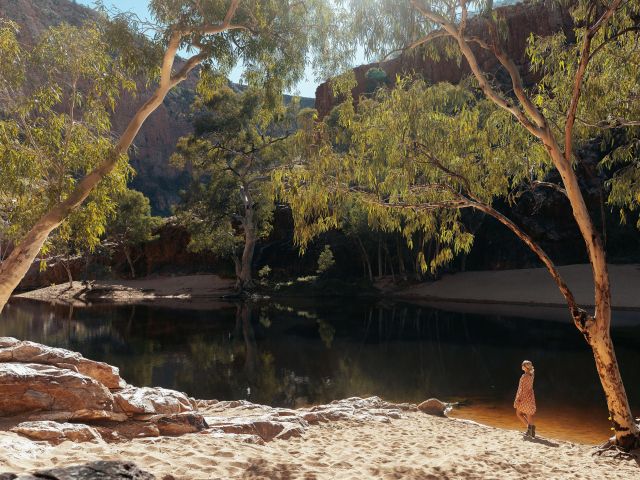
Ormiston Gorge , a cooling oasis in among the red desert sands, is one of the most popular destinations, no doubt because of the permanent swimming hole and towering red cliffs. From here, visitors can also embark on the beautiful Ormiston Pound Walk and the shorter – more accessible – Ghost Gum Walk. Bring your bathers – it’s safe for swimming.

4. Standley Chasm

woman walking through Standley Chasm near alice springs
Wander through Standley Chasm. (Image: Tourism NT)

The 1.2-kilometre walk to nearby Standley Chasm will be a highlight for any visitor as the imposing 40 metre-high chasm walls project strength and ancient wisdom.

Visit at midday to experience the path illumined by the midday sun. Not only will you fill your camera roll with vibrant red images of the gorge and its intoxicating shadows, but you can also camp nearby in a powered or unpowered site so you can watch the brilliance of the desert stars fill the night sky after dusk.

5. Simpsons Gap

three people walking on path through simpsons gap near alice springs
Walk the trails of Simpson’s Gap. (Image: Tourism NT/ Helen Orr)

Closer to Alice Springs, the photogenic Simpsons Gap is the perfect place to spot the endangered Black-footed Rock wallaby near the permanent watering hole. While swimming isn’t permitted, soaking up the sun and views certainly is.

Explore the area’s numerous walking trails, appreciate the soaring cliffs on either side of the ‘gap’ and pick out the shooting locations of Kangaroo in the area.

6. Ellery Creek Big Hole

aerial of Ellery Creek Big Hole near alice springs
Dive into Ellery Creek Big Hole. (Image: Tourism NT/ Tourism Australia)

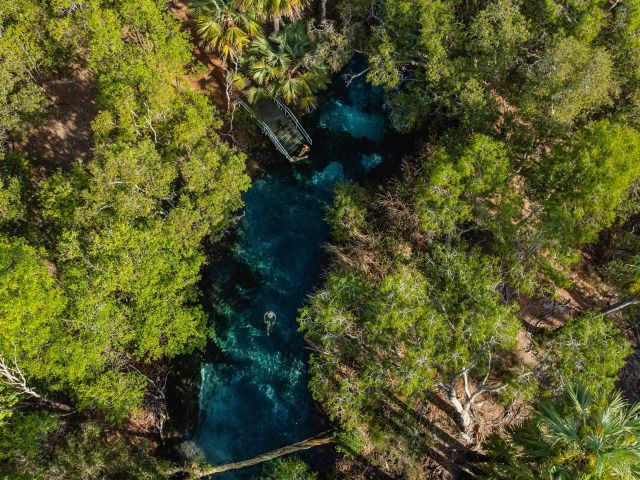
When it comes to classic Northern Territory landscapes, you can’t go past Ellery Creek Big Hole/ Udepata : tall gum trees sidling up to a refreshing watering hole (fed by the West MacDonnell Ranges and surrounded by rugged red cliffs.

Swim in the cooling waters, hike the cliff tops, watch for birds and even stargaze as you camp here overnight. It’s locations like this that attracted the film’s director Kate Woods to the project.

“It humbles you to be in this environment: it’s so beautiful, so old and so vast,” she explains. “I was thrilled to get a chance to … shoot such a beautiful story in the incredible landscape of the Northern Territory.”

7. Larapinta Drive

aerial of Larapinta Drive into alice springs
Drive along Larapinta Drive. (Image: Tourism NT)

There is no better way to get a feel for how the characters arrived at the fictional Central Australian town of Silvergum than to travel along the iconic state road, Larapinta Drive.

Connecting Alice Springs to the mighty King’s Canyon in the west, via the historic community of Hermannsburg, this road takes in the West MacDonnell National Park, Alice Springs Desert Park and artist Albert Namatjira’s house, among other attractions. Take your time, bring a camera and prepare for numerous stops along the way.

8. Todd River

competitors in Henley on Todd Regatta, alice springs
Join in the fun of the quirky Henley on Todd Regatta. (Image: Tourism NT/ TImparja Creative)

Meandering through Alice Springs like a lazy Western Brown snake, the Todd River is a central part of Alice Springs culture. Known as an ‘intermittent river’, the Todd can go from a dry dusty riverbed to a flowing waterscape in less than 15 minutes after heavy rainfall.

When it’s dry, the famous Henley on Todd Regatta fills the sandy riverbed with handmade ‘boats’ carried by sailors. This is the world’s only dry river boating event, and it’s referenced in the ‘Silvergum Boat Race’ in the movie. Inspired by the real-life event, the characters built quirky “Flintstones-style boats” and competed in teams.

See Kangaroo in cinemas now, and start planning your NT getaway at northernterritory.com.

A Top End bush tucker dining experience in Katherine