hero media

I visited the Red Centre in low season – here’s why you should too

Image: Tourism NT/@domandjesso

From icons seen in a new light to moments few experience, the Red Centre rewards travellers who visit when most don’t. Consider this your guide to the Red Centre in low season.
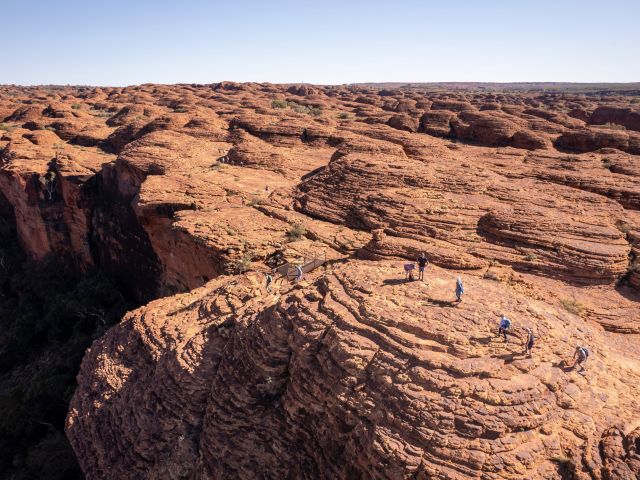
the Kings Canyon/Watarrka plateau from above
Hiking across the Kings Canyon/Watarrka plateau. (Image: Tourism NT/Mark Fitzpatrick)

Looking down on our small group of walkers from all sides are the cliff faces we just scrambled over. They form cake-like layers of deep, earthy reds and surprisingly vibrant greens, with a few splashes of black and white where the elements have had their way.

One holds a more resounding presence than the rest as we stand at the bottom of this natural amphitheatre. Another hiker has dubbed it ‘the sphinx’ and I can’t think of a better description for its rocky form. It appears to swivel its head, watching us as we continue our rocky trail along the Mpaara Loop within Finke Gorge National Park – stopping occasionally to admire colourful wildflowers and dancing birdlife. Later, we discover we didn’t imagine its presence. Traditional Owner Conrad Ratara confirms over dinner that it’s part of an important story. But he can’t tell us any more than that.

Eco-camping in Finke Gorge National Park
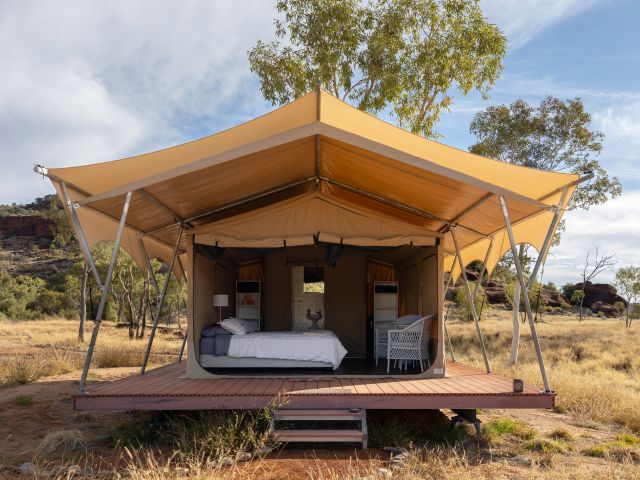
a safari-style eco tent at Yalka Ratara Eco Camp
A safari-style eco tent at Yalka Ratara Eco Camp. (Image: Sarbo Studio)

We’re staying the night at Conrad’s glamping site, Yalka Ratara Eco Camp. He’s opened it exclusively to Intrepid Travel and guests on the six-day Red Centre & Uluṟu Tour. In return, Intrepid has helped him turn this long-time dream into a reality. “I had my dream for more than 30 years," Conrad tells us that evening. “I’m proud and happy to be standing with all you people."

The camp sits within Finke Gorge National Park, on the oldest river system in the world and near Palm Valley. Eight eco-designed tents have been set up around camp, all with front-row seats to the landscape around us. The riverbed is currently dry as a bone, despite recent rain in the region. Soft buttery sand gives way to smooth light-coloured rocks, which give way to scraggly spinifex grass.
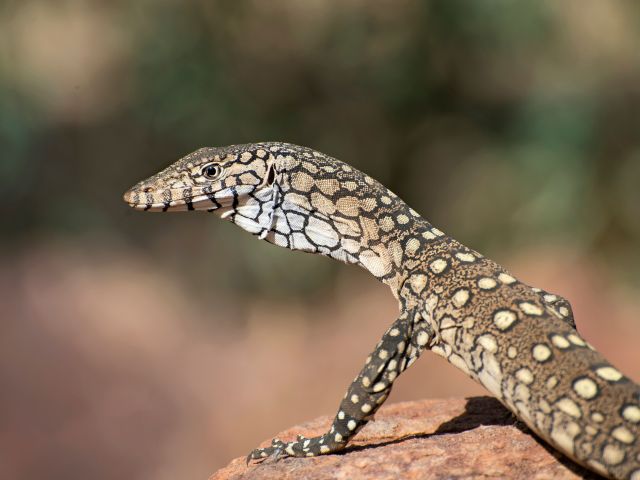
a large goanna in Red Centre
A large goanna monitors the landscape. (Image: Tourism NT/Shaana McNaught)

Ghost gums care not for where the river may choose to flow and dot themselves along the entire way. Locals make themselves known in quiet moments – like the perentie goanna that wanders slowly in front of my tent.

Hiking the Red Centre in low season
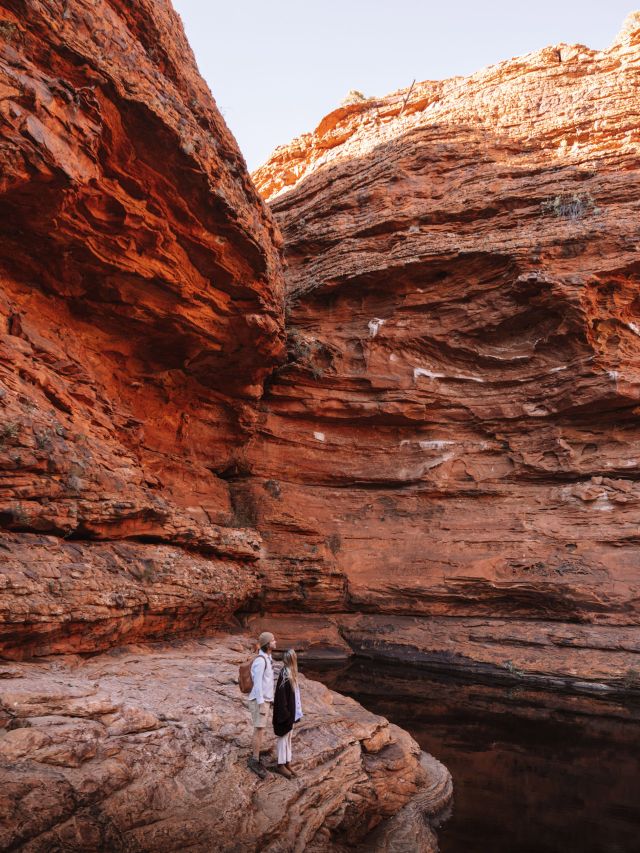
a couple at Kings Canyon
A quiet moment of stillness, looking up in awe at the walls of Kings Canyon. (Image: Tourism NT/@75vibes_)

We’re travelling in November at the start of the Red Centre’s low season, which extends through the summer months. While weather that oscillates from dramatic storms to blistering heat keeps most tourists away, there’s a special magic to this time that so few get to witness. We experience that magic in full flow at Kings Canyon/Watarrka. “Look out there," says John Stafford, our tour guide. He is pointing to the dark grey clouds rolling towards us as we stand at the base of the infamous Heartbreak Hill – a name given to the steep climb at the beginning of the Kings Canyon Rim Walk. They seem to be swallowing up the blue sky at a pace, making their way towards us.

We make it to the top before the rain breaks. Up here, it almost feels like we’ve left Australia behind and hit the craggy rock walls of Sedona, USA. Yet the almost hut-like domes of rock are so uniquely Australian. The storied beauty of this walk has not been overstated. The deep reds of the rim juxtapose with the greens and whites of the cycads, gum and witchetty trees, and bush tomatoes in the canyon below. The keen eyes of our guide spot a little rock wallaby gazing in our direction with disinterest.
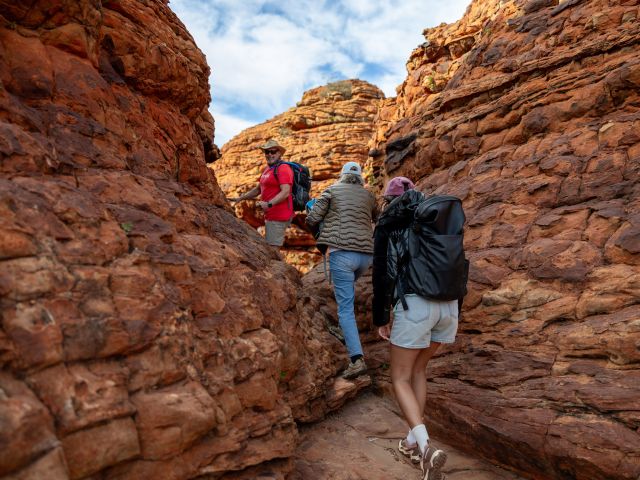
hikers walking through Priscilla’s Gap
Squeezing through ‘Priscilla’s Gap’. (Image: Sarbo Studio)

We just make it through Priscilla’s Gap (a section of the trail made famous in the 1994 film The Adventures of Priscilla, Queen of the Desert) when the heavens open again. Within minutes, what had been parched earth flows with temporary rivers that pour into the canyon below as a series of waterfalls. It turns the striking landscape into one of ethereal beauty – almost like a mermaid might pop out of the filling pools at any moment. Pools like the iconic Garden of Eden, always beautiful, are now full to the brim thanks to a thundering waterfall. It’s a natural phenomenon so rare that most hikers don’t ever set eyes on it. “I’ve been [leading tours here] for 28 years," says John, in awe, “and I’ve never seen this."

As strange as it may sound, being soaked to the bone, crossing flowing waterways that hadn’t been there moments before and seeing this desert beauty in its low-season form was an experience that would have been worth the trip on its own.

Need tips, more detail or itinerary ideas tailored to you? Ask AT.

AI Prompt

Exploring Indigenous stories and ancient landscapes
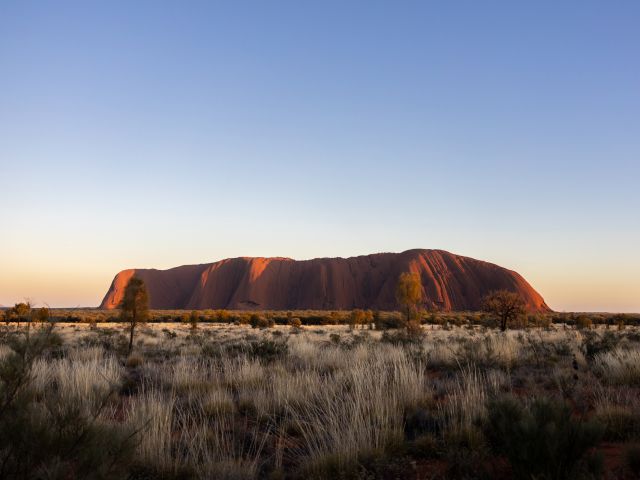
Uluru at dusk
See Uluru at dusk when every curve, crease and ancient contour catches the light. (Image: Sarbo Studio)

Kings Canyon is not the only icon we get to visit on this journey through the Red Centre, where history is quite literally written into the earth.

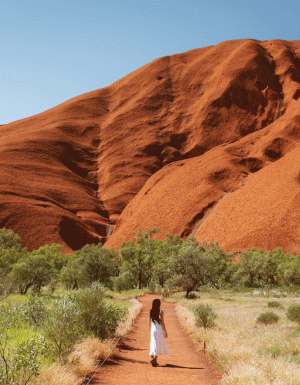
That history can be seen in the Jukurrpa stories shared by our Aṉangu guides, Sascha and her uncle Phillip, along the Kuniya Walk from one edge of Uluru into the Muṯitjulu Waterhole tucked into its jellybean-like folds. We see Uluṟu in every light, from the soft colours of sunrise to the vibrant glow of sunset. I’m not sure Uluṟu will ever be empty of tourists, or minga (ants), as Sascha calls them. But this time of year does thin out the crowds.
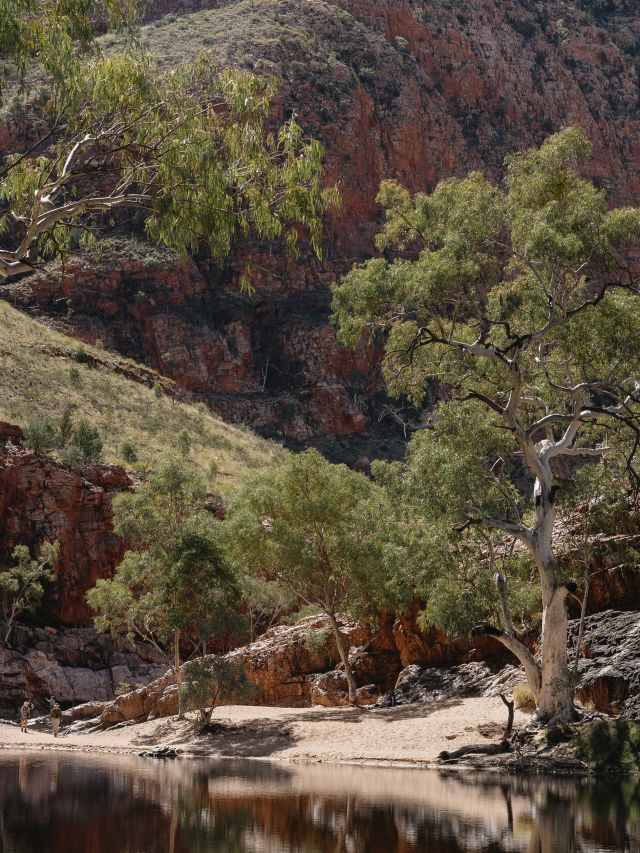
a swimming hole at Ormiston Gorge
A cool, glassy pool at the base of Ormiston Gorge offers relief from the heat. (Image: Sarbo Studio)

History can also be seen in the landscape’s scars from unearthly events. Like the 20-kilometre-wide crater of Gosse Bluff/Tnorala, left by the impact of a comet striking Earth around 150 million years ago. Or the jagged layers of sediment, pushed up from underground by tectonic plate activity and left reaching out of the earth to create the MacDonnell Ranges, which we wind our way through to reach the culturally significant Simpsons Gap/Rungutjirpa. And Ormiston Gorge, a picture-perfect swimming hole that we almost have to ourselves.

Stargazing in Alice Springs
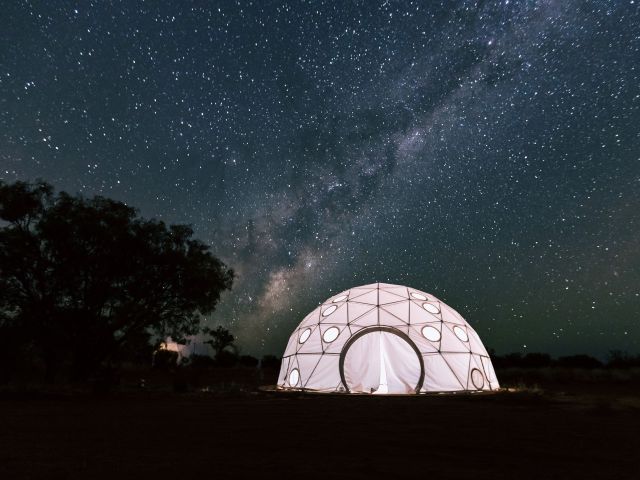
the Earth Sanctuary World Nature Centre
Enjoy dinner and a show under a dark desert sky at Earth Sanctuary. (Image: Tourism NT/Plenty of Dust)

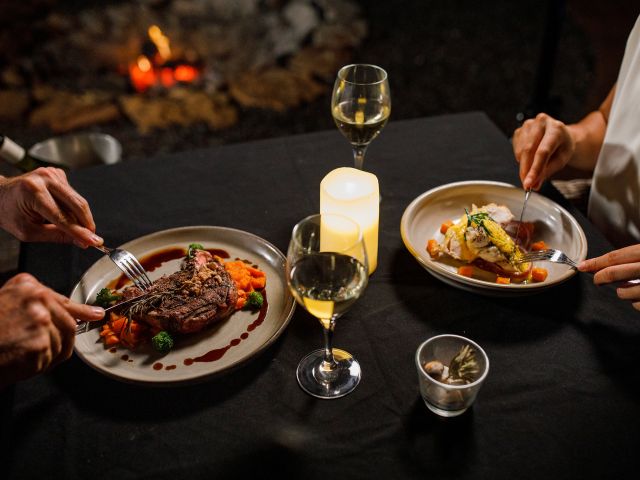
History is written in the skies above, something we get a first glance at during a stargazing experience at the Earth Sanctuary World Nature Centre in Alice Springs/Mparntwe on our final night. Looking up at this dark sky, sparkling with stars uninterrupted by human lights, it feels just as vast as the land we’ve been road tripping over.

Up there, the more scientists learn, it seems, the more there is still to learn. Down here, in the heart of this vast country, the same holds true: the more of it I witness, the more there is still to discover. Come rain or shine.

Weekly travel news, experiences
insider tips, offers, and more.

A traveller’s checklist
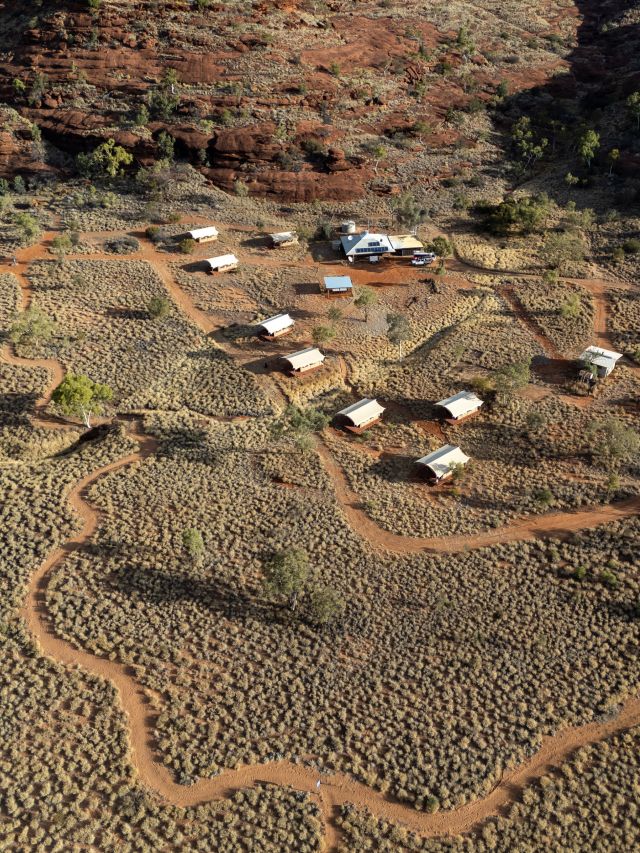
Yalka Ratara Eco Camp from above
Yalka Ratara Eco Camp sits softly on the earth. (Image: Sarbo Studio)

Getting there

Most major Australian cities have direct flights to Ayers Rock Airport, with free shuttle buses to accommodation. Alternatively, fly to Alice Springs/Mparntwe, then drive for about 4.5 hours.

Playing there
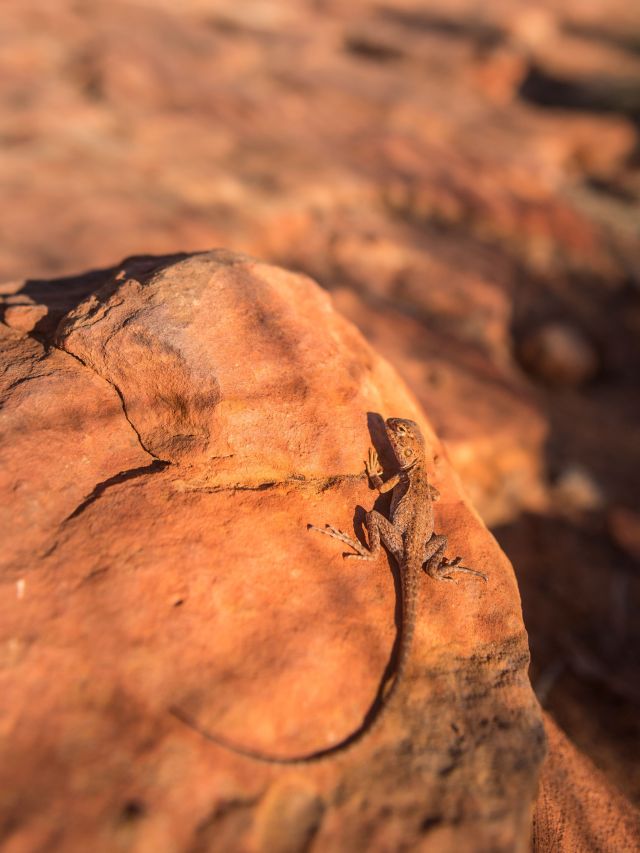
a lizard at Kings Canyon
A ring-tailed dragon. (Image: Tourism NT/Matt Glastonbury)

Intrepid Travel’s six-day Red Centre & Uluṟu Explorer runs year-round. Prices start from $2583 per person, with all accommodation, transport and some meals and activities included.

Low season is an incredible time to visit the Red Centre. Burnt landscapes are transformed by thundering waterfalls – a sight very few get to see – and there are fewer crowds than in the peak season. Walking trails are typically open, as are iconic experiences such as Bruce Munro’s Field of Light (an optional extra if you travel with Intrepid).

Kassia Byrnes
Kassia Byrnes is the Native Content Editor for Australian Traveller and International Traveller. She's come a long way since writing in her diary about family trips to Grandma's. After graduating a BA of Communication from University of Technology Sydney, she has been writing about her travels (and more) professionally for over 10 years for titles like AWOL, News.com.au, Pedestrian.TV, Body + Soul and Punkee. She's addicted to travel but has a terrible sense of direction, so you can usually find her getting lost somewhere new around the world. Luckily, she loves to explore and have new adventures – whether that’s exploring the backstreets, bungee jumping off a bridge or hiking for days. You can follow her adventures on Instagram @probably_kassia.
View profile and articles
hero media

8 Northern Territory secrets the locals don’t want you to know

    Lee Mylne Lee Mylne
    Summer transforms the Northern Territory into a lush paradise of colour and life, as a visit during the ‘low-season’ reveals secrets the locals willingly share.

    Waterlilies bloom, floodplains are alive with birdlife, waterfalls are gushing, and everywhere the green is dazzling. Summer in the Top End and the Red Centre is a kaleidoscope of unexpected wonders that delight and surprise visitors. Of course, the locals know only too well that the Northern Territory low season is often the best time to see and experience this amazing part of Australia.

    Here are some of the reasons why savvy travellers – avoiding the crowds – are discovering a new dimension to the Territory. Remember that you’ll need a Parks Pass to visit national parks.

    1. Take a dip in the Florence Falls waterhole

    Wander through savanna woodland and monsoon forest to discover the perfect place to cool off – the waterhole at the base of spectacular Florence Falls in the magnificent Litchfield National Park, just 90 minutes’ drive from Darwin. The falls flow year-round but are most spectacular during the summer. Camping is available nearby but bookings are essential and must be made online before you visit.

    Surrounded by lush forest, a woman cools off in Florence Falls, just one of many incredible things to do in the Northern Territory.
    Cool off beneath the cascading waters of Florence Falls. (Image: Joshua Griffin)

    2. Wind down at Buley Rock Hole

    Another popular local swimming spot in Litchfield National Park is Buley Rock Hole, open year-round. This is a great place to wind down after exploring everything the park has to offer, including towering termite mounds. Wade through the rock pools, soak up the scenic bush or just lie back and relax as the cool water rolls over you.

    Buley Rockhole, Litchfield National Park
    Let the cool water wash over you. (Image: Tourism Australia)

    3. Tour the Tiwi Islands

    The Tiwi Islands, a scenic 80km flight from Darwin across the narrow Clarence and Dundas Straits, reveal a different side to the Territory, with their own distinctive culture. Take a day tour with Tiwi by Design to visit Bathurst Island and learn about creation stories, the Mission days, World War II history and the islanders’ obsession with AFL!

    Take a ‘behind-the-scenes’ tour of Tiwi Design’s screen-printing workshop and pick up a great souvenir in the form of art. Choose from contemporary or traditional Tiwi designs and a wide range of work including carvings, paintings, pottery, printmaking, bark paintings and tunga (bark baskets).

    A creative moment shared inside Tiwi Design’s screen-printing space.
    Take a peek inside Tiwi Design’s screen-printing studio. (Image: Tourism NT)

    4. Dine in Darwin

    Foodies are spoilt for choice in multi-cultural Darwin. Try Sri Lankan flavours at Ella by Minoli, where Masterchef contestant Minoli De Silva creates delectable dishes, or head to Charlie’s of Darwin for gin-tasting, cocktails and more. Bowls of fragrant laksa, excellent coffee, fresh vegetables and authentic crafts are all part of a weekend visit to Darwin’s Parap Markets, Rapid Creek Markets and the Nightcliff Markets.

    Prefer to catch your own dinner? Book a Top End fishing charter to bag a barramundi – and from October register for the annual Million Dollar Fish competition. Hooking one of the tagged barra released each year in waterways across the Territory could win you up to $1 million.

    A bowl of Laksa.
    Eat your way through multicultural Darwin. (Image: Tourism NT)

    5. Up close with Uluṟu

    The magnificent monolith Uluṟu is even more magical when the summer rains fall. When it rains on The Rock, the locals come out to watch – consider yourself lucky if that happens when you visit. Waterfalls cascading off the sides of Uluṟu is a sight that relatively few tourists see.

    There’s so much to do at Uluṟu, from guided walks to learn the stories of the Aṉangu people and the ancient landscape they live in to scenic flights for a bird’s-eye view or a leisurely walk around the base of Uluṟu. Book ahead to spend the evening wandering through the Field of Light installation by Bruce Munro.

    A closer look at Uluru and uncover its ancient stories, sacred sites, and striking natural beauty – one of the most iconic things to do in the Northern Territory.
    Discover the details that make Uluṟu truly sacred. (Image: Tourism NT)

    6. Drive the Red Centre Way

    From Alice Springs, take an epic road trip along the Red Centre Way, taking in Uluru and Watarrka National Park, home to the magnificent Kings Canyon. Allow at least a week to drive through the red heart of Australia by 4WD, a little longer on the sealed road by 2WD vehicle, travelling through ochre deserts, palm-lined valleys and dramatic gorges. Stop off at waterholes for a refreshing dip along the way.

    Kings Canyon offers hiking options for all levels of fitness, from the three-hour Rim Walk atop soaring sandstone walls to the gentler Kings Creek Walk. Either way, you’ll have breathtaking views.

    SEIT Outback Australia is a small group touring specialist offering exciting, adventurous, exclusive and specialised iconic, pioneering and cultural touring in the Red Centre of Australia, giving you the time to learn, absorb and relax in the heart of Australia.<br /><br />This innovative tour company focuses on providing clients with the ultimate interpretive touring experiences with a range of products and customised touring itineraries for small groups and bespoke private charters.<br /><br />The company bases its philosophies from the key words of Spirit, Emotion, Intellect and Task (SEIT).
    Drive through Australia’s heart. (Image: Outback Australia Tours)

    7. Take a walk at Kata Tjuṯa

    Head out early to tackle the Valley of the Winds Walk at Kata Tjuṯa. This natural wonder, also known as The Olgas, is a labyrinth of soaring ochre domes that glow golden at sunrise and sunset (the walk may be closed during the middle of the day as temperatures rise).

    Walking trails range from easy to longer, more difficult tracks. At the Kata Tjuṯa dune viewing area, take in the panoramic view of the domes. The longest of the trails is the Valley of the Winds Walk, a 7.4km circuit that winds between the domes and through creek beds. It’s moderately difficult and steep in places, but offers stunning views – and occasional encounters with kangaroos.

    The Valley of the Winds Walk at Kata Tjuta is one of the most awe-inspiring things to do in the Northern Territory, especially at sunrise when the domes glow golden.
    Step into the golden light of Kata Tjuṯa. (Image: Tourism NT)

    8. Explore Tjoritja/West MacDonnell Ranges

    Tjoritja/West MacDonnell National Park lies 135km west of Alice Springs, with many fascinating natural features to beguile visitors. The ‘West Macs’ formations include chasms, gorges and waterholes – take your swimsuit for a dip at Ormiston Gorge waterhole, open year-round. The Ormiston Pound Walk is a three to four-hour circuit that leaves from the visitor centre and loops back along the gorge via the main waterhole. Other places of interest in the park include Simpsons Gap, Standley Chasm, Ellery Creek Big Hole and Glen Helen.

    Soaking in the serenity of Ormiston Gorge, these two travellers enjoy one of the most scenic things to do in the Northern Territory.
    Take the plunge at Ormiston Gorge waterhole. (Image: Joshua Griffin Litchfield)

    Start planning the NT road trip of a lifetime at northernterritory.com