isn’t what you’ve seen in the news

hero media
Alice Springs sits at the heart of the nation. Behind the headlines, you’ll find beautiful landscapes, ancient cultures and magic moments. Here’s what locals have to say.

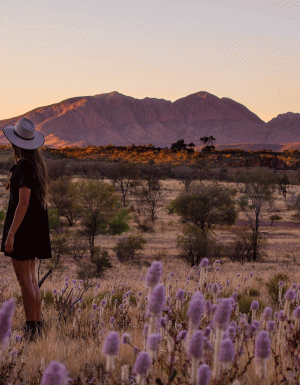
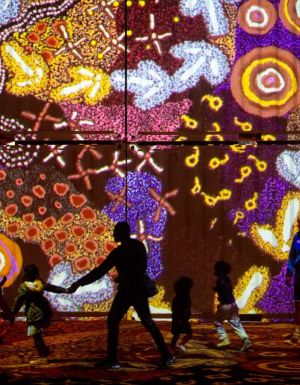
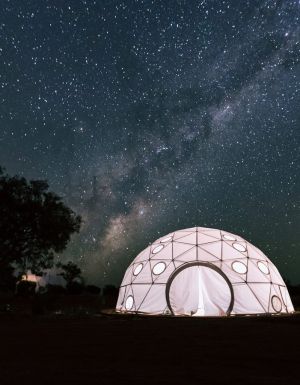
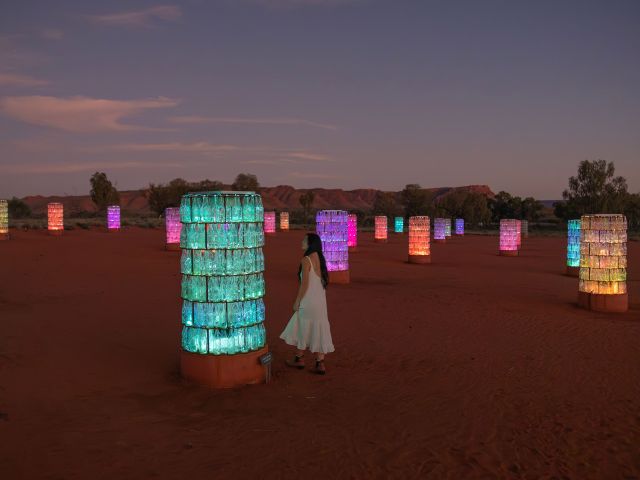
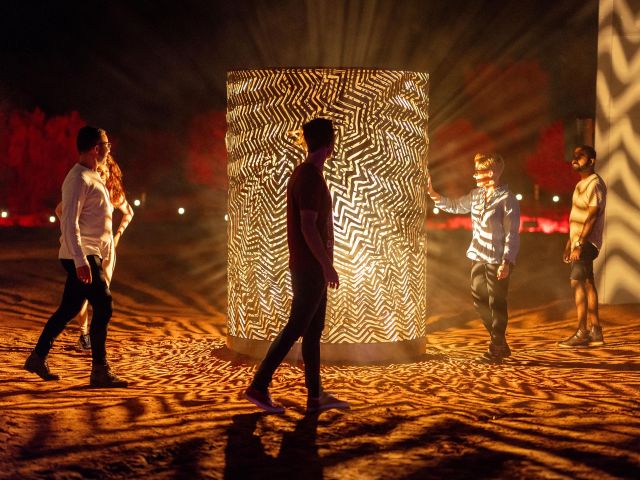
After a rainy week in April, Alice Springs/Mparntwe is ripe like a desert fruit. The air is sweet, the creeks are swollen, and the landscapes are flush with vivid green foliage. Come nightfall, the annual Parrtjima light festival competes with the glittering outback starscapes, casting brilliant images against the shadowy backdrop of the MacDonnell Ranges. Small children chase projections of Aboriginal art across the ground or stand mesmerised in front of a giant illuminated puppet roving about the festival. The experience is nothing short of magical. But it’s a far cry from the portrayal of Alice Springs that has pervaded over the last few years. We caught up with some locals to go behind the headlines and get a glimpse into a totally different side of Alice Springs.

parrtjima festival
Parrtjima lights up the night, combining traditional art forms with modern technology.

Is it safe to visit Alice Springs?

The Red Centre is a once-in-a-lifetime destination that’s a fixture on bucket lists around the world. But given the reports of unrest and a crime crisis, should you reconsider plans to travel to Australia’s unofficial outback capital?  The answer is a definitive no, according to John Stafford of Alice Springs Expeditions, “people who have booked tours have asked me if they should defer, and I’ve said to them, absolutely not. I’ve convinced them to come, and without exception, everyone in the last month has said that Alice Springs is nothing like what’s been portrayed".

John points out that the issues highlighted in the media also apply to many other towns, suburbs and regions in Australia, but Alice Springs receives a disproportionate amount of attention.
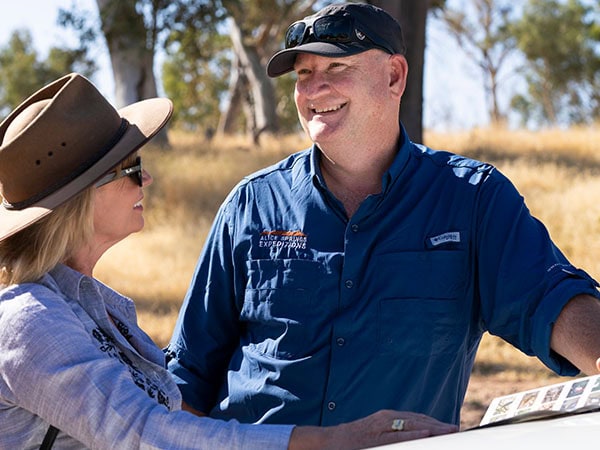
John Stafford
John Stafford runs Alice Springs Expeditions. (Image: Tourism Australia/Shaana McNaught)

“Don’t get me wrong, [the incident at Todd Tavern] isn’t great. I’m not trying to sugarcoat it. But at the same time, is it reflective of what happens here day to day? No, it isn’t. It’s sad to think that people might potentially miss out on a really awesome experience [coming here] based on what I consider to be unfair press."

As Alice Spring heads into winter, temperatures cool and the night sky becomes increasingly vivid. The town is abuzz with a roster of outback festivals, like the quaint and quirky Alice Springs Beanie Festival – a four-day celebration of hand-crafted headwear from the town and the remote communities that surround it. “The proof is in the pudding," says John, “when visitors come here, they’ve expected one thing and they see something very, very different".
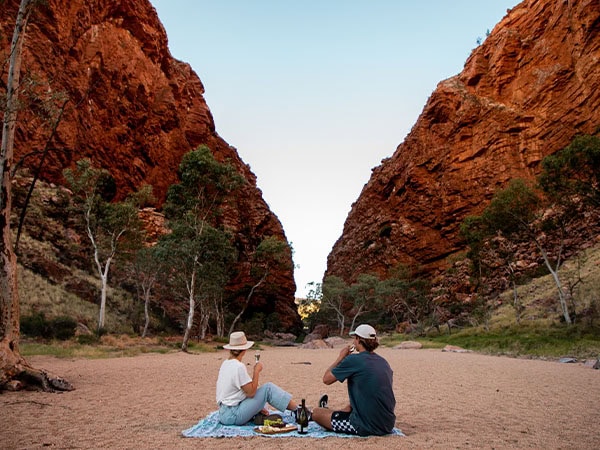
Canapes at Simpson's Gap
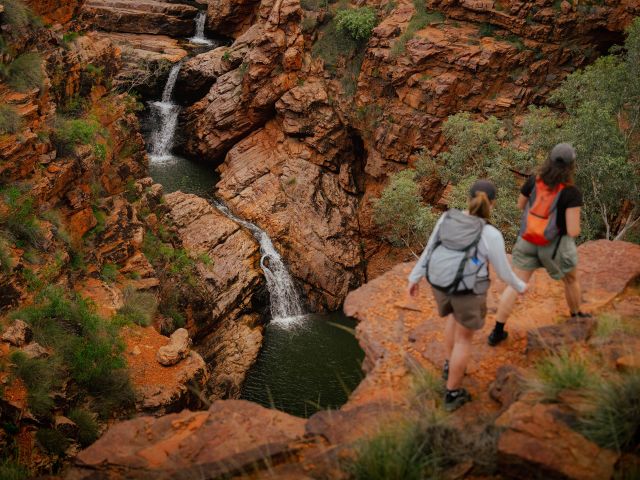
Take your time to absorb the vivid colours of Simpson’s Gap. (Image: Tourism NT/The Salty Travellers)

Need tips, more detail or itinerary ideas tailored to you? Ask AT.

AI Prompt

A place of outrageous beauty

Anna Dakin moved to Alice Springs from London six years ago. Now, she spends her days taking visitors out for painting excursions in the countryside with her tour company, Art Tours of Australia.

“[The most prevalent change] I’ve noticed in the town is the drop in visitors and a sense of frustration shared by myself and other tour operators," she says.
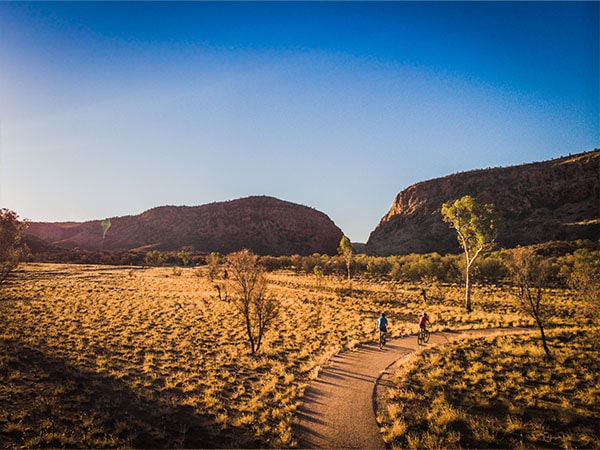
Mountain biking in the Red Centre
Mountain biking through the beautiful MacDonnell Ranges. (Image: Tourism NT/Travis Deane)

“This town is so gorgeous, it’s outrageous … there are all of these little magical moments that happen here that are a thousand times more powerful than the brief moments of unrest focused on by the media," she says. Anna recalls her most recent moment of magic, a leisurely Friday evening spent listening to a talk by a bush food expert before heading to a new cocktail bar, Crimson Chat, for a bush tucker-inspired cocktail and strolling home beneath a star-lit sky. “I could never walk from my home in London … the level of safety I [feel] walking around Alice Springs is really incomparable to what I felt in a big city," she says. “It’s easy to forget that everywhere we visit has some kind of danger. Alice Springs is no different, but the danger is actually relatively low out here.

On Anna’s last art tour, the group fell into a discussion about what makes the landscape feel so profound and magical. “It all leads back to the culture that has shaped this environment. There’s a level of frustration among people who come [on tour] with me that they don’t know more about the incredible cultures of Central Australia [such as the Arrernte and the Aṉangu cultures]… It’s a shame that when people think of Alice Springs they think of danger, when actually what is here, is vibrance and inspiration and some of the most ancient and inspiring landscapes in the world."
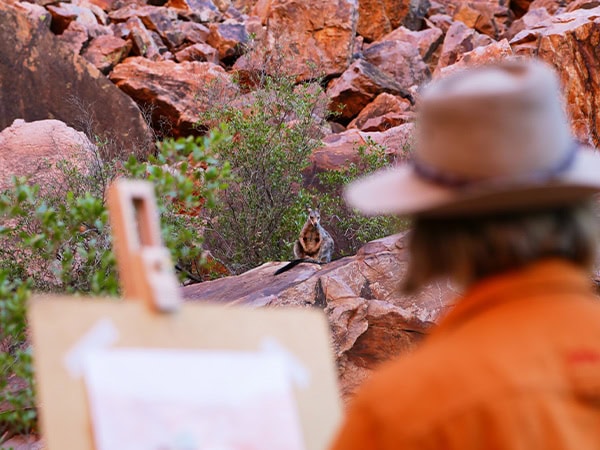
Australian Art Tours Wallaby
Anna Dakin runs Australian Art Tours, taking visitors out to paint some of the region’s beautiful landscapes.

Weekly travel news, experiences
insider tips, offers, and more.

A deeper issue

Local frustration surrounding the media’s fixation on crime is deepened by its failure to discuss the more complex and nuanced reasons for its existence. “[The situation] is the outcome of decades of systemic underinvestment, neglect and punitive measures and controls, many imposed and still remaining from the NT Intervention", wrote Australia’s Aboriginal and Torres Strait Islander Social Justice Commissioner June Oscar in a report calling for community-led solutions in Alice Springs.


Local Arrernte Elder Paul Ah Chee shares the sentiment of frustration with the media’s hyperfocus on crime in Alice Springs. “I do think that it’s somewhat blown out of all proportion, and manifests in people outside of Alice Springs believing that the town is completely chaotic and lawless," he says. Paul also cites poverty and The Gap between Aboriginal and non Aboriginal people as a contributing factor to the incidents of unrest that are often left out of media discourse on Alice Springs: “The gap is probably increasing rather than decreasing. Certain elements of closing the gap have been addressed and we can see some incremental positive change, but on the whole it’s a challenge."
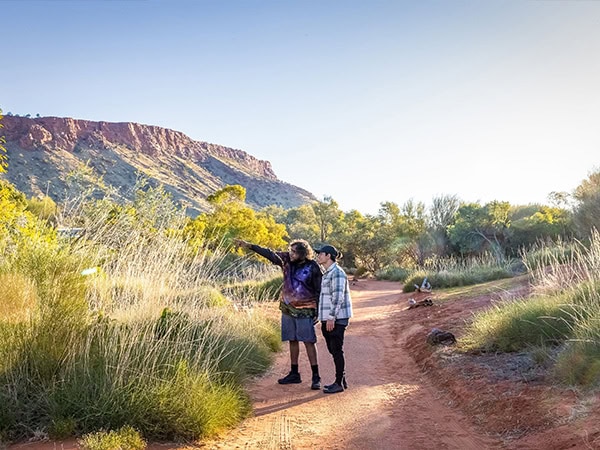
Alice Springs Desert Park
Alice Springs Desert Park is an oasis for wildlife. (Image: Tourism NT/Helen Orr)

Although systemic issues don’t have an overnight solution, it underscores the importance of visiting, learning and fostering cross-cultural understandings. “It’s a beautiful little town," says Paul. “It’s got natural beauty and some great tourism products that people can go and visit. The people here on the whole are friendly and it’s a wonderful place to visit…There’s lots of festivals, there’s lots of celebration. It’s a very creative town."


Elizabeth Whitehead
Elizabeth Whitehead is a writer obsessed with all things culture; doesn't matter if it's pop culture or cultures of the world. She graduated with a degree in History from the University of Sydney (after dropping out from Maths). Her bylines span AFAR, Lonely Planet, ELLE, Harper's BAZAAR and Refinery 29. Her work for Australian Traveller was shortlisted for single article of the year at the Mumbrella Publishing Awards 2024. She is very lucky in thrifting, very unlucky in UNO.
View profile and articles
hero media

Discovering East Arnhem: Australia’s most unique and rewarding corner

    Joanne Millares Joanne Millares

    Hard to reach and harder to forget, East Arnhem offers something rare in modern travel: the chance to slow down and experience Country on its own terms.

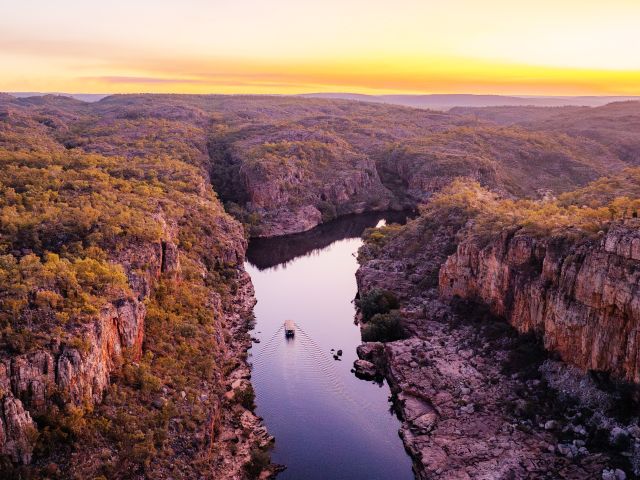
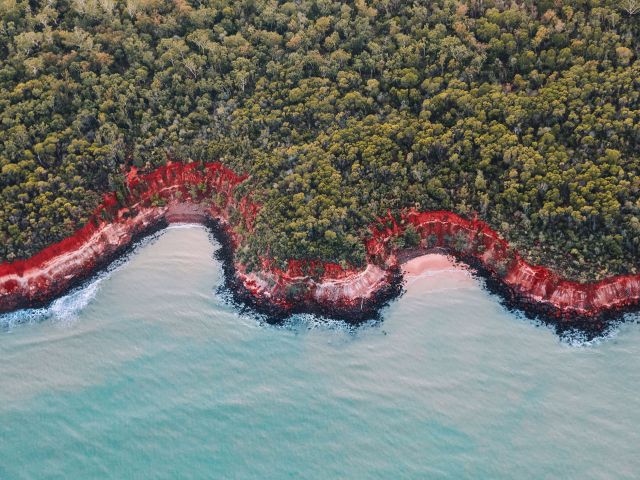
    The sky feels bigger in East Arnhem. It stretches wide and uninterrupted above rouged earth, stringybark woodland and beaches so empty they seem to belong to another era. The coastline curves for kilometres without a footprint and the horizon runs on forever.

    For comedian Lou Wall, the scale of the place was the first thing that hit them.

    “The sheer openness,” they say. “The sky feels infinite and the land stretches out endlessly. It’s pretty breathtaking visually.”

    But the physical landscape is only part of the story. The real reward isn’t only the scenery but the shift in perspective the journey brings. Visitors stop trying to tick off the destination and a real engagement takes over.

    “It made me never want to travel again,” Wall jokes. “In that I never wanted to leave East Arnhem.”

    Getting there

    Aerial shot of East Arnhem’s coastline as cars trace the curve of the shore.
    Sail along the remote coastline on an expedition cruise.

    Reaching East Arnhem is part of the adventure. Travellers typically fly into Gove Airport near Nhulunbuy via Darwin or Cairns, or arrive by expedition cruise along the remote coastline. Others make the journey overland along rutted dirt roads that cut through East Arnhem’s small pockets of monsoon forest.

    However you arrive, there’s a distinct feeling of crossing into somewhere different. Permits are required to visit the region, reflecting the fact that this is Yolŋu land where communities and traditional owners maintain deep cultural connections to Country.

    The extra planning becomes part of the experience. By the time visitors arrive, they understand they’re entering a place not just of respect, but also patience and curiosity.

    At one with nature

    East Arnhem’s  landscapes leave a strong imprint. For Wall, one place in particular still lingers in their memory: Ngalarrkpuy, also known as Lonely Beach, near Bawaka Homeland.

    “I genuinely felt like I was living inside an Instagram filter,” they say. “One of the most stunning feats of nature I’ve ever seen. The water was so clear I swear I could see even the fish smiling.”

    Across the region, natural experiences unfold at a slower pace. Fishing, beachcombing and island hopping reveal the rhythm of the coastline. The tides shape daily life and the vastness of the landscape makes even simple moments feel downright cinematic.

    For visitors with limited time, Wall says the Bawaka Homeland experience is unmissable.

    “I just left and I’m already planning when I can get back there.”

    The sense of remoteness is part of the appeal. In a country where many beaches are crowded and well-trodden, East Arnhem’s coastline still feels wonderfully wild.

    Immersing in local culture

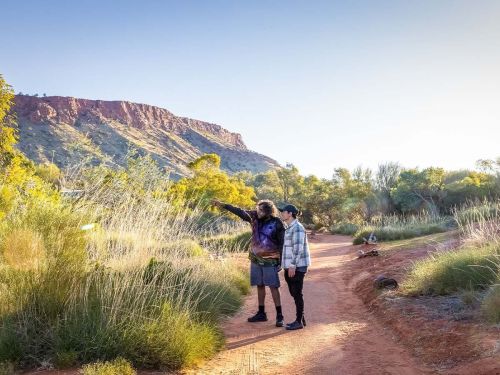
    A visitor spends a meaningful moment alongside Yolŋu guides, gaining insight into their deep cultural knowledge and connection to the land.
    Experience authentic moments with the locals.

    Culture is woven through every experience in East Arnhem. Visitors have the opportunity to spend time on Country with Yolŋu guides and knowledge holders who share stories and traditions that have been passed down for generations.

    For Wall, one of the most powerful moments came during a conversation with a Yolŋu elder.

    “I got to meet a traditional elder, Mayalil, in Nhulunbuy,” they say. “Listening to her talk about her home made the land feel alive in ways I couldn’t have imagined.”

    The region is also home to internationally recognised Aboriginal art centres where artists shape works deeply connected to land and family knowledge.

    Music carries the same cultural energy. East Arnhem has produced globally recognised artists such as King Stingray and Baker Boy, blending Yolŋu language, storytelling and contemporary sound.

    Wall experienced this musical spirit first-hand.

    “A jam session around the fire was it for me,” they say. “Letting the deep joy and history of their music wash over me…  and meeting a few of the King Stingray musicians was unreal.”

    These moments of human connection often become the most memorable part of a visit.

    Spotting local wildlife

    An aerial view of the beach shows tiny figures lined up across the white sand, moving as if in a rhythmic dance.
    Step into a world where nature reigns.

    The wildlife of East Arnhem adds another layer to the experience. The region is home to an extraordinary range of animals, from waterbirds and turtles to dugongs, dolphins and the formidable saltwater crocodile.

    Wall admits they didn’t actually spot a croc during their visit.

    “Devastatingly, I didn’t see one,” they laugh. “But with all the stories from the locals I definitely gained a healthy respect for caution.”

    Some of the most memorable wildlife encounters can be surprisingly small., At Banubanu Beach Retreat on Bremer Island, Wall remembers walking along the beach one morning and watching it come alive.

    “As you walk through the sand you see hundreds of crabs scurrying into their holes as you pass by,” they say. “Such a small thing, but it was completely magical.”

    Moments like this reveal the quieter rhythms of East Arnhem, where even the smallest creatures seem to play a part in the landscape.

    Visitors who make the journey soon learn the most important travel tip of all.

    “Go in open-minded with a sense of curiosity,” Wall says. “Be prepared to ditch your plans. The land and the locals will guide you on an adventure no spreadsheets could ever compete with.”

    And most importantly, they add, don’t rush.

    “The land and people deserve your time and attention. You’ll be all the better for slowing down.”

    For more information on visiting East Arnhem, head to eastarnhem.com.au.