hero media

The mesmerising story of Hanging Rock explained

Is the film/book Picnic at Hanging Rock real or imagined? Australian Traveller’s rock hound, Kerry van der Jagt, steps back in time to investigate this and other geological questions about the Macedon Ranges enigma.  

Short answer: A picnic spot in Victoria where schoolgirls disappeared.

Long answer: Hanging Rock is located around 80km to the north of Melbourne in the Hesket Plains near Mt Macedon. It’s 718m above sea level and 105m above the surrounding plain. It’s also one of the best examples in the world of a volcanic feature known as a mamelon (French for nipple).

It was formed six million years ago (in the Tertiary period) when a stiff type of lava formed a rounded pile of layers on the surface as it was squeezed through a narrow vent in the Earth’s surface.

The type of lava is unique in that it has an extremely high soda content. Over the years the action of rainwater has formed an unusual rock known as solvsbergite (soda trachyte).

The same rock type is also found at the nearby Camel’s Hump at Mt Macedon. The mamelon has been exposed to weathering, which has resulted in the rock formation that can be seen today. These include: Stonehenge, McDonald’s Lookout and The Eagle.

Aerial view of Hanging Rock
Aerial view of the impressive Hanging Rock formation. (Image: Visit Victoria)

Is Picnic at Hanging Rock real or imagined?

Hanging Rock is best known from Joan Lindsay’s narrative, Picnic at Hanging Rock (1967), about the mysterious disappearance of a group of local schoolgirls during an excursion to the Rock on February 14, Valentines Day 1900. And like any decent Australian mystery, the bodies were never found!

The author, in the opening to the first edition, states: “Whether Picnic at Hanging Rock is fact or fiction my readers must decide for themselves." At the time of the incident, organised searches for the three students and their teacher were carried out but only one girl was ever found.

Clearly she’s leaving the mystery open. My take is that the schoolgirls (and Miss McCraw) were crushed under a slab of rock that fell during a mini landslide, or they fell down a deep crevice or chimney. Either way, Hanging Rock is an eerie place and an extraordinary geological formation.

Today it remains a mystery shrouded in tales that flick between folklore and fact. The novel was eventually made into a movie directed by Peter Weir in 1975 and received international acclaim. A new adaption of Lindsay’s novel was turned into a six-part television series, starring Natalie Dormer aired in 2018.

A scene from Peter Weir's film adaption of Picnic at Hanging Rock. (Image: Atlantic/Allstar)
A scene from Peter Weir’s 1975 film adaption of Picnic at Hanging Rock. (Image: Atlantic/Allstar)

Need tips, more detail or itinerary ideas tailored to you? Ask AT.

AI Prompt

Fast facts about Hanging Rock

You probably know: Annual events such as art exhibitions, movie nights under the stars, car shows, concerts, craft markets and family-friendly festivals are held at Hanging Rock.

But did you know: The type of rock, solvsbergite, is extremely unusual and, outside of the Macedon region, is only found in Norway and Sweden.

And did you also know: During filming of Picnic at Hanging Rock, watches and clocks of the cast and crew behaved badly. Some stopped, others ran fast, some slow.  In Joan Lindsay’s novel, the watches of the schoolgirls stopped at noon (cue Twilight Zone music).

What else can you do at Hanging Rock Reserve?

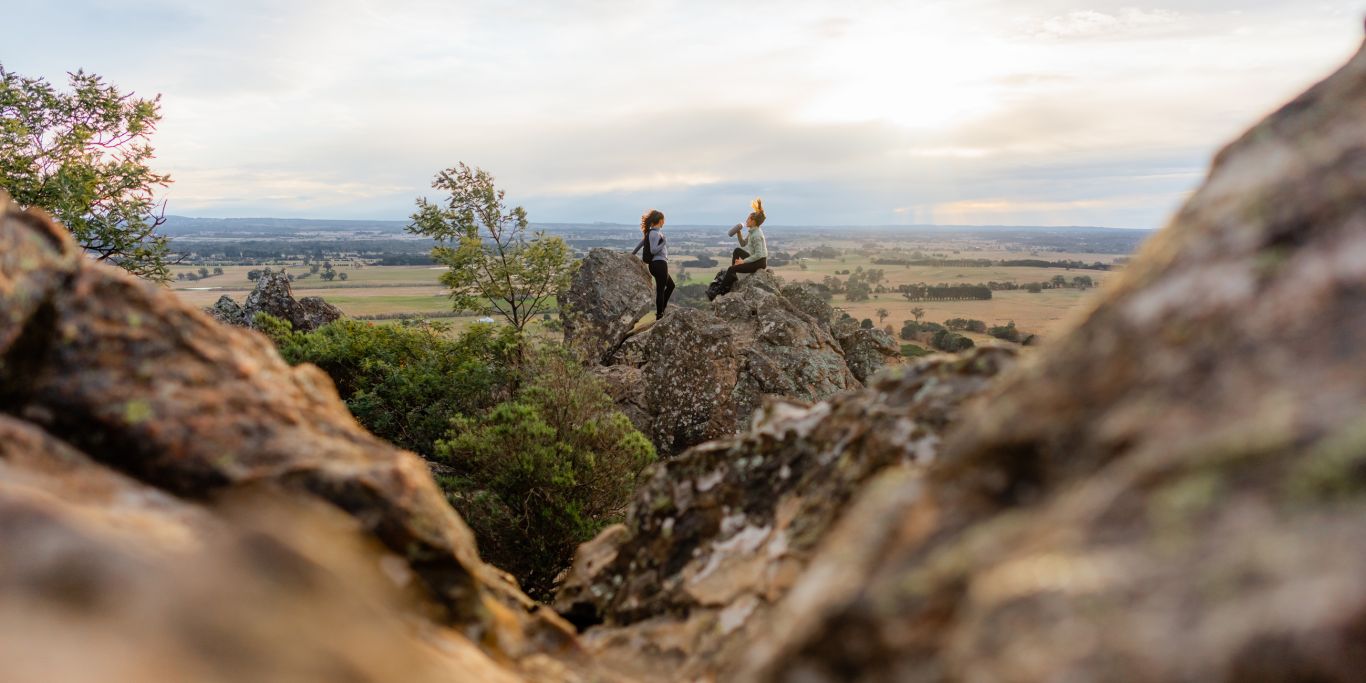
Many folks take the relaxed route and set up for the day at one of the many BBQs (they’re free to use) scattered throughout the scenic reserve and simply admire the views of the soaring monoliths. The famous Pinnacle Walk to the summit is a popular activity as is the nocturnal ranger-guided walking tour.

Two women at the Summit of Hanging Rock.
The Pinnacle Walk to the summit. (Image: Visit Victoria)

There are three dedicated walks to enjoy at Hanging Rock: The Pinnacle Trail, Base Walking Trail and the Creek Walking Trail. Each trail showcases the reserve’s distinctive beauty; expect to see granitic boulders, curious mammals, and unique volcanic rock formations. The Pinnacle Trail to the summit is quite the highlight! Note: the pathways are quite wide and people of average fitness will reach the top relatively easily in about an hour.

Kangaroos at Hanging Rock
Curious kangaroos at the base of Hanging Rock. (Image: Visit Victoria)

The ranger-guided Hanging Rock night walking tour offers the opportunity to see gliders, koalas, wallabies and more exploring their natural surroundings. So, if adventuring after dark is your thing, this tailored tour will surely appeal.

This article was originally written by Kerry van der Jagt and updated by Roxanne Williams.

Want to see more stories from Australian Traveller in your Google search results?

  1. Click here to set Australian Traveller as a preferred source.
  2. Tick the box next to "Australian Traveller". That's it.
Roxanne Andrews
Roxanne Andrews is a freelance travel writer and editor based in Yamba, Australia. Topics of expertise include; sports tourism, luxury travel, arts & culture, cuisine & dining, wellness, the adventure sector and all things marine. A professional scribe who occasionally goes gonzo to capture the moment.
View profile and articles
hero media

The best trails and natural moments around Yarra Valley & Dandenong Ranges

    Gemma Kaczerepa Gemma Kaczerepa
    The Yarra Valley and Dandenong Ranges boast some of Victoria’s most stunning natural scenery, making them a prime destination for outdoor experiences.

    There’s something very special about the Yarra Valley and Dandenong Ranges. A mix of rugged bush, mist-laden rainforest, gardens bursting with vivid blooms and a network of rivers and waterfalls, the landscapes here are layered and diverse. Late summer is a particularly good time to visit, when the days are long and the region’s outdoor offerings are ripe for sun-soaked adventures.

    The best part? Despite being only an easy one-hour drive from Melbourne, the area feels a world away from the hustle. You’ll be greeted by a slower pace with fewer travellers and more room to move – allowing you to truly switch off and take it all in.

    From rail trails to rainforest walks, this is where you’ll find nature at its most rewarding.

    1. Warburton

    Biking around Warburton is one best natural experiences in the Yarra Valley and Dandenong Ranges.
    Hit the trails at Warburton Mountain Bike Destination. (Image: Visit Victoria)

    Perched at the top of the Yarra River, surrounded by pristine national park, the town of Warburton is a haven for nature lovers. It’s known for its towering redwoods, found in the Californian Redwood Forest just 15 minutes out of town. You’ll be in utter awe of these giant trees, some of which reach heights of up to 55 metres.

    The Warburton Rail Trail is another way to experience the town’s natural beauty. This flat, 40-kilometre route goes all the way to Lilydale and is ideal for a stroll or cycle past native bushland, wineries, farmland and parts of the Yarra.

    If you want to up the pace a little, head to the Warburton Mountain Bike Destination, which encompasses 160 kilometres of purpose-built tracks amid wild bush terrain. For something a little more laid-back, the Rainforest Gallery is a standout spot for a wander. The gallery features statuesque Mountain Ash and Myrtle Beech trees, moss-covered logs and tree ferns, and a 40-metre elevated walkway that brings you right into the centre of the forest canopy.

    2. Yarra Glen

    Yarra Glen is a beloved food and drink destination, but it offers far more than excellent produce and top-notch wines.

    A highlight is Alowyn Gardens, which stretches over seven acres. Inside, you’ll find nine different gardens with vivid floral and seasonal displays, plus a nursery featuring exotic plant species. The Wisteria Arbour is a crowd favourite, a curved walkway connecting the different gardens with a display of cascading lilac blooms.

    Intersecting with the Warburton Rail Trail, the first stage of the Yarra Valley Trail runs from the gateway town of Lilydale to Yering Station. A more manageable track of just 7.5 kilometres, it takes you through rolling farmland and pockets of native bush, with ample opportunities for wildlife-spotting.

    If you’re travelling with kids, McKenzie Reserve is a non-negotiable stop. The reserve encompasses a skate park, plenty of open grass to stretch little legs, and a nature-inspired adventure playground to suit every age and every energy level.

    3. Healesville

    One of the best natural experiences in the Yarra Valley and Dandenong Ranges is seeing a Koala upclose.
    Get up close and connect with koalas. (Image: Visit Victoria)

    Healesville is the region’s best place to meet local wildlife. It’s home to Healesville Sanctuary, where you can get up close to kangaroos, koalas, emus, dingoes, reptiles and more. Beyond giving you front-row access to these gorgeous creatures, you’ll appreciate the scenic charm of the tracks and trails that meander through the wildlife park.

    To see even more birdlife, head over to Badger Weir for a picnic. Situated among soaring Mountain Ash trees and tranquil waterways, the area supports several bird species, including crimson rosellas, Australian king parrots and the elusive lyrebird. Barbecue facilities are available, and several tracks leading to Badger Weir are pram-friendly.

    Fernshaw Picnic Area, located in the Yarra Ranges National Park, is another idyllic setting for picnicking and short walks, also encircled by Mountain Ash trees. Compared to Badger Weir, though, Fernshaw provides a slightly more secluded experience, making it ideal for quieter outings.

    4. Olinda

    Cloudehill Gardens is a beautifully curated, year-round garden destination featuring nine terraced gardens filled with seasonal blooms and lush plant varieties.
    Wander through terraces of ever-changing blooms. (Image: Visit Victoria)

    Sitting more than 600 metres above sea level, the Dandenong Ranges have an enchanted feel and are shrouded in lush rainforest filled with tree ferns, mossy trunks and lingering mist.

    The town of Olinda is one of the finest places to experience this unique environment in all its verdant glory. At the Dandenong Ranges Botanic Gardens, rhododendrons reign and drape the gardens in a riot of colour every spring.

    The nearby Cloudehill Gardens are well worth visiting any time of year. In each of the garden’s nine terraces, you’ll find an array of plant varieties that bloom and transform across the seasons, including weeping Japanese maples that have been growing here for nearly a century.

    Besides being a haven for arbory enthusiasts, the nearby RJ Hamer Arboretum is a spectacular spot to enjoy panoramic views. Here, more than 150 tree species grow and overlook the neighbouring Yarra Valley and Great Dividing Range.

    5. Emerald

    A lady eating with the view of Emerald Lake Park.
    Enjoy a lakeside picnic at Emerald Lake Park. (Image: Visit Victoria)

    Set just behind the Dandenong Ranges, the foothills town of Emerald has a slightly more open feel, featuring rolling hills and open bushland. The town sits on the edge of the Dandenong Ranges National Park, with a patchwork of forested reserves and accessible bush trails on the Emerald side.

    You can also take to the water at nearby Aura Vale Lake, which is popular for sailing, canoeing, fishing for eel and perch, and picnicking on the grassy banks.

    The stand-out, though, is Emerald Lake Park, a sprawling green with multiple recreation zones. Across 52 hectares, there are walking tracks, playgrounds, paddleboats, a model railway, fishing sites and a family-friendly wading pool that comes to life every summer. The park also lies adjacent to the iconic Puffing Billy, making it a perfect stop if you’re travelling on the historic steam train.

    Start planning your next adventure at visityarravalley.com.au