Explore Victoria’s little-known Silo Art Trail

hero media
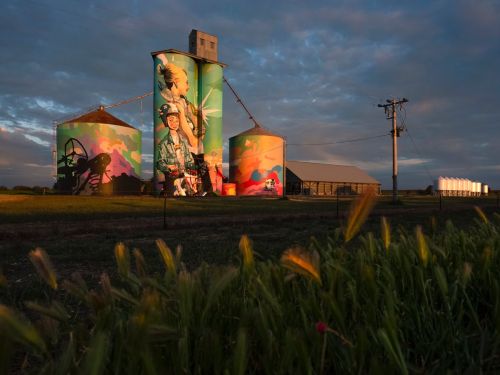
Get ready to marvel at the large-scale murals along the Silo Art Trail in Victoria.

Stretching over 200 kilometres, Victoria’s Silo Art Trail is Australia’s largest outdoor gallery (and one of 100 Amazing Road Trips).

Conceived after the success of the first silo artwork in Brim in 2016, the trail recognises and celebrates the Wimmera Mallee region through a series of large-scale mural portraits that have given new life to the 80–90-year-old grain silos.

The project saw a team of renowned artists from Australia and across the world visit the region, meet the locals and transform each grain silo into an epic work of art; each one telling a unique story about the host town.

DAY ONE: Melbourne to Rupanyup

Rupanyup

Located about three hours from Melbourne, Rupanyup is the ideal first stop for your Silo Art Trail road trip.

Rupanyup’s silo art is the work of Russian mural artist, Julia Volchkova, who turned her attention to the town’s youth and their great love of team sport. Capturing the spirit of community and providing an accurate insight into rural youth culture, the work features the faces of Rupanyup residents and local sporting team members, Ebony Baker and Jordan Weidemann, who are dressed in their sports attire (netball and AFL, respectively).
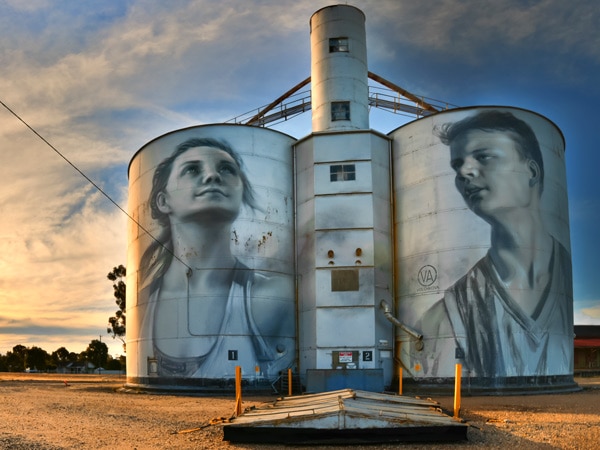
Rupanyup silo art by Julia Volchkova of Ebony Baker and Jordan Weidemann. (Image: Visit Victoria/Anne Morely)
Julia Volchkova depicted Rupanyup locals Ebony Baker and Jordan Weidemann on the silos. (Image: Visit Victoria/Anne Morely)


Must-see

Georgia Goodie artwork, Rupanyup

As a side project of the Silo Art Trail, Melbourne street artist Georgia Goodie painted two murals in Rupanyup, each one depicting firefighters. The first mural is at a house that was damaged by fire in September 2016, while the other adorns the town’s old shire office building.
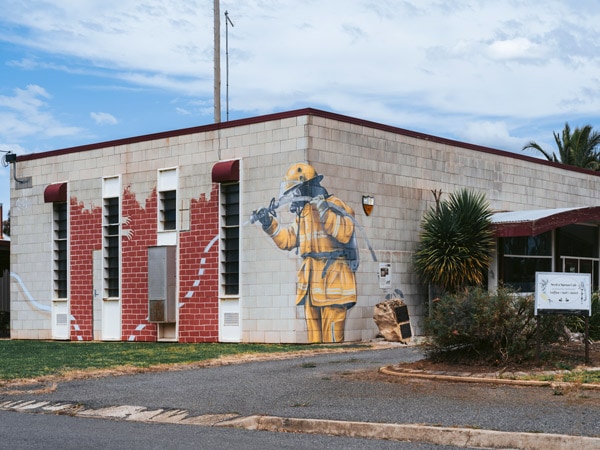
A mural of a firefighter on the Rupanyup old shire office building by Melbourne street artist Georgia Goodie. (Image: Visit Victoria/Anne Morely)
Head to the Rupanyup old shire office building to see Melbourne street artist Georgia Goodie’s firefighter murals. (Image: Visit Victoria/Anne Morely)

Stay

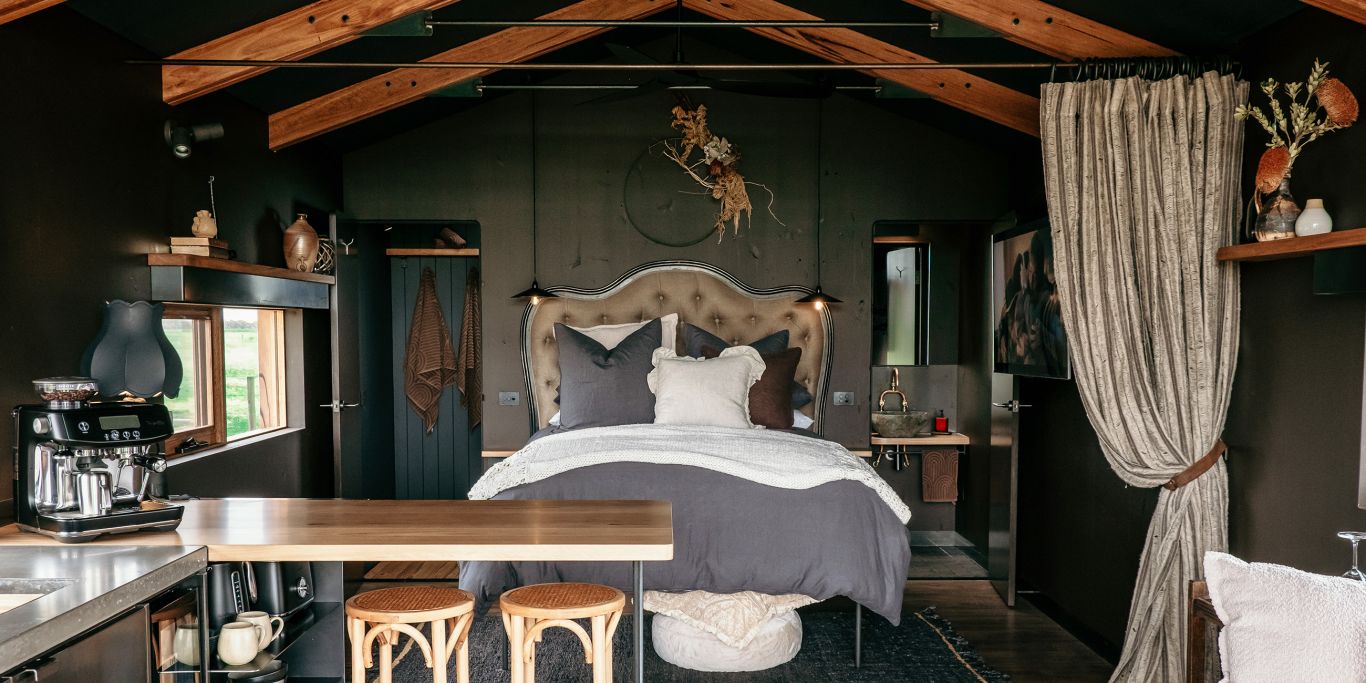
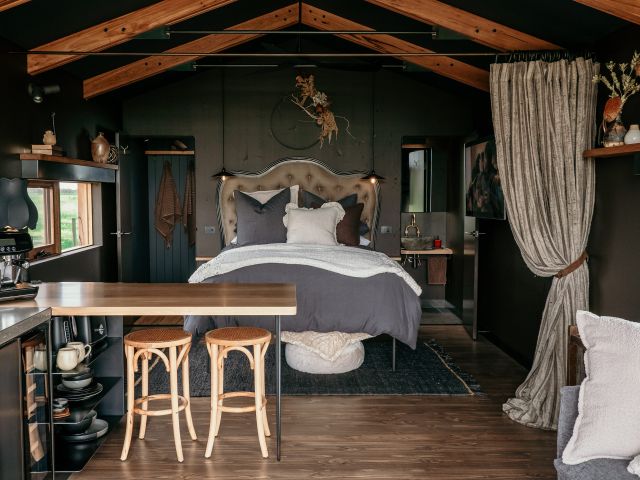
The Shack is a rustic and homely rural retreat. The two-bedroom cottage offers panoramic views of farm paddocks, dams, gum trees and the Grampians, the perfect place to rest after a day of exploring.

DAY TWO: Rupanyup to Sheep Hills, Goroke, Kaniva and Brim

Sheep Hills

Melbourne-based artist, Adnate found inspiration for his mural on the Sheep Hills silos in 2016 when he developed a friendship with the Barengi Gadjin Land Council in north-west Victoria.

Adnate depicted Wergaia Elder, Uncle Ron Marks, and Wotjobaluk Elder, Aunty Regina Hood, alongside two young children, Savannah Marks and Curtly McDonald to celebrate the richness of the area’s Indigenous culture.

The night sky represents elements of local dreaming and the overall image signifies the important exchange of wisdom, knowledge and customs from Elders to the next generation.

Spending four weeks with the community in late 2016 to conceive and complete the mural, Adnate sought to shine a spotlight on the area’s young Indigenous people and highlight the strong ancestral connection they share with their Elders.
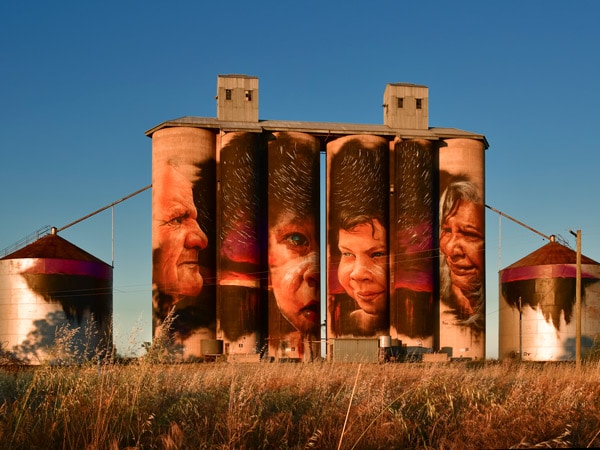
Silo Art at Sheep Hills by Adnate depicts Wergaia Elder, Uncle Ron Marks, Wotjobaluk Elder, Aunty Regina Hood, with children, Savannah Marks and Curtly McDonald. (Image: Visit Victoria/Anne Morely)
Adnate shines light on the strong ancestral connection young Indigenous people share with their Elders. (Image: Visit Victoria/Anne Morely)

Goroke

Artist Geoffrey Carran was heavily inspired by the birdlife in West Wimmera Shire when creating the Goroke silo art.  The word Goroke is the local Aboriginal word for magpie, so the native bird was a natural choice. Geoffrey then expanded the idea to include other native birds, including a kookaburra and galah.
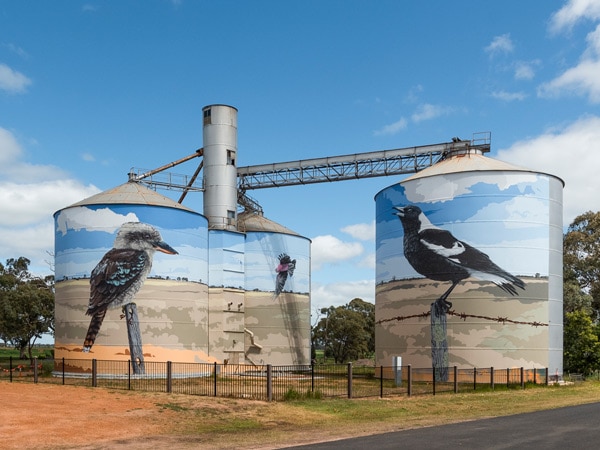
Geoffrey Carran silo art in Goroke of a magpie and kookaburra. (Image: Visit Victoria/Anne Morely)
The word Goroke is the local Aboriginal word for magpie. (Image: Visit Victoria/Anne Morely)

Kaniva

The artwork was painted by David Lee Pereira and pays tribute to the nearby Little Desert and its diverse flora and fauna. It is home to more than 600 species of native plants, 220 species of birds and 60 native mammals and reptiles.

The design features the Australian Hobby bird, which is smaller than other falcons, and is one of six Australian members of the family ‘Falconidae’. To the left of the bird is the plains sun orchid, with the salmon/pink sun orchid on the right.
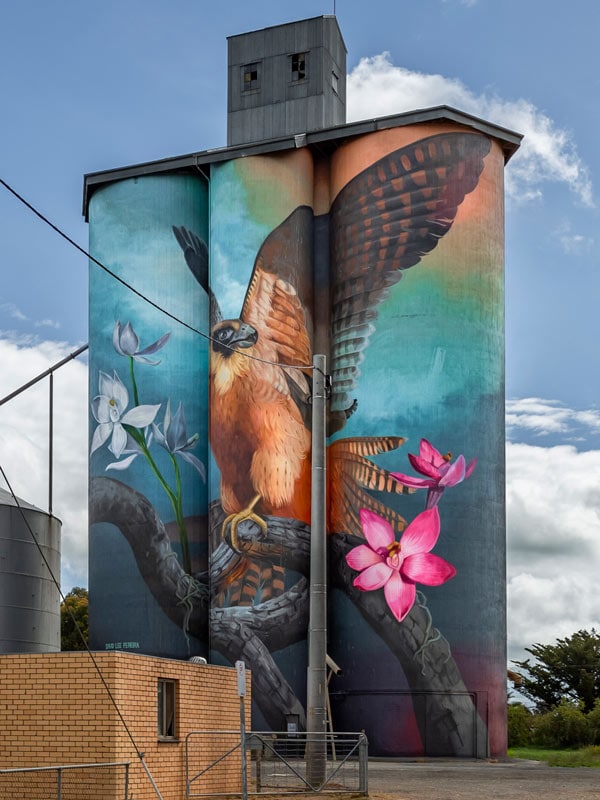
The Australian Hobby bird, and a plains sun orchid painted by David Lee Pereira on the Kaniva silos. (Image: Visit Victoria/Anne Morely)
The Australian Hobby bird is smaller than other falcons. (Image: Visit Victoria/Anne Morely)

Need tips, more detail or itinerary ideas tailored to you? Ask AT.

AI Prompt

Brim

Guido van Helten’s iconic Brim mural was the first silo artwork to appear in Victoria, and after gaining widespread local and international attention, its success shone a spotlight on the Wimmera Mallee region and inspired the establishment of the Silo Art Trail.

Completed in early 2016 van Helten’s mural depicts a multi-generational quartet of female and male farmers. Rendered across the four silos, van Helten’s subjects bear expressions that exemplify the strength and resilience of the local farming community.

The figures are both central and peripheral, present and absent, and the work explores shifting notions of community identity at a time when rural populations face both immense economic pressure and the tangible consequences of climate change.
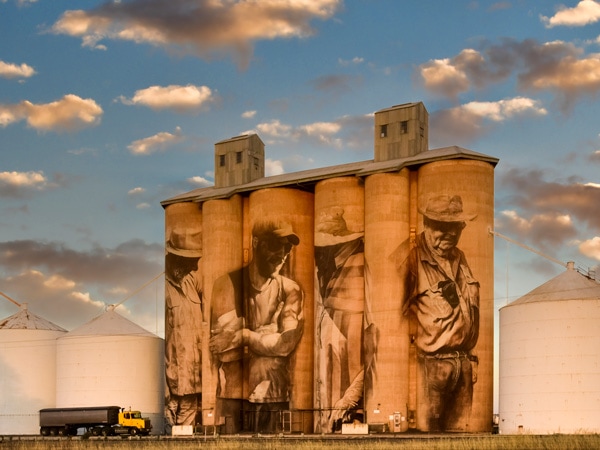
Guido van Helten's silo art in Brim depicts a multi-generational quartet of female and male farmers across four silos. (Image: Visit Victoria/Anne Morely)
Guido van Helten’s Brim mural was the first silo artwork to appear in Victoria. (Image: Visit Victoria/Anne Morely)

Must-see

Nine kilometres north of Brim on the Henty Highway is the Netting Fence, constructed in 1885 to stop rabbits invading the Mallee from the south and to keep the dingos to the north. The fence is also the division between the Wimmera and the Mallee regions.

Stay

Brim has a stunning free campsite, which can be powered (or not!) called Reddas Park Camping Area.

DAY THREE: Brim to Rosebery, Albacutya and Patchewollock

Rosebery

Before commencing work in Rosebery, Melbourne artist, Kaff-eine spent time in the Mallee assisting fellow artist Rone on his Lascelles silo project. Kaff-eine’s artwork depicts themes that she says embody the region’s past, present and future.

The silo on the left captures the grit, tenacity and character of the region’s young female farmers, who regularly face drought, fires and other hardships living and working in the Mallee.

The silo on the right portrays a quiet moment between man and horse, who are relaxed and facing downward, indicating their mutual trust, love and genuine connection.
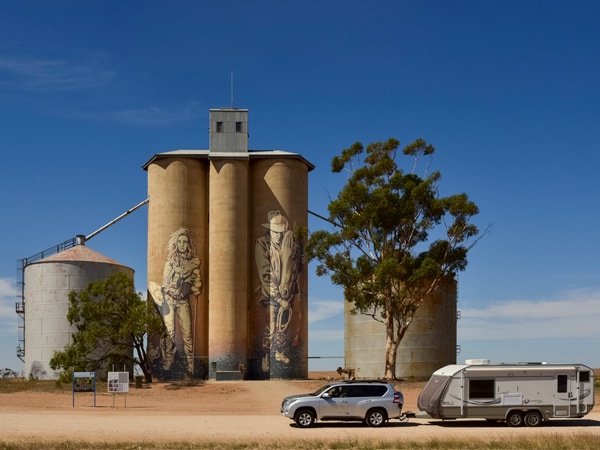
Kaff-eine's Rosebery silo on the left shows a young female farmer, and the silo on the right portrays a quiet moment between man and horse. (Image: Visit Victoria/Anne Morely)
Kaff-eine’s artwork depicts themes that embody the region’s past, present and future. (Image: Visit Victoria/Anne Morely)

Albacutya

Ten kilometres north of Rainbow lies the quirky, colourful and more modern take on Silo Art at Albacutya Silo.

Melbourne artist Kitt Bennett was inspired to, “create an artwork that tells a story of growing up in the country as a youth. I have fond memories of exploring the bush and looking for yabbies under rocks in creeks with my parents. Reflecting on this weird and wonderful time as an adult is something that brings me a lot of happiness."
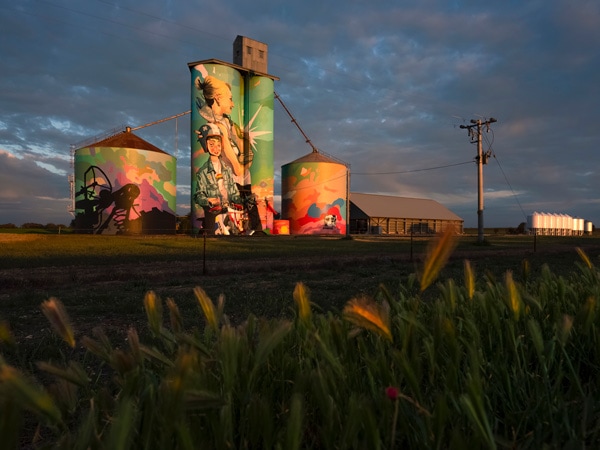
The Albacutya Silo by Kitt Bennett shows bright colours telling the story of growing up in the country. (Image: Visit Victoria/Anne Morely)
The Albacutya Silo by Kitt Bennett is a more modern take on silo art. (Image: Visit Victoria/Anne Morely)

Patchewollock

To prepare for his Patchewollock mural, Brisbane artist, Fintan Magee booked a room at the local pub to immerse himself in the community and get to know its people. When he met local sheep and grain farmer, Nick “Noodle" Hulland, Magee knew he had found his muse.

The rugged, lanky local exemplified the no-nonsense, hardworking spirit of the region. Perhaps more importantly though, Noodle had just the right height and leanness to neatly fit onto the narrow, 35-metre-high canvas of the twin silos. Hulland’s solemn expression, sun-bleached hair and squinting gaze speak to the harshness of the environment and the challenges of life in the Wimmera Mallee.
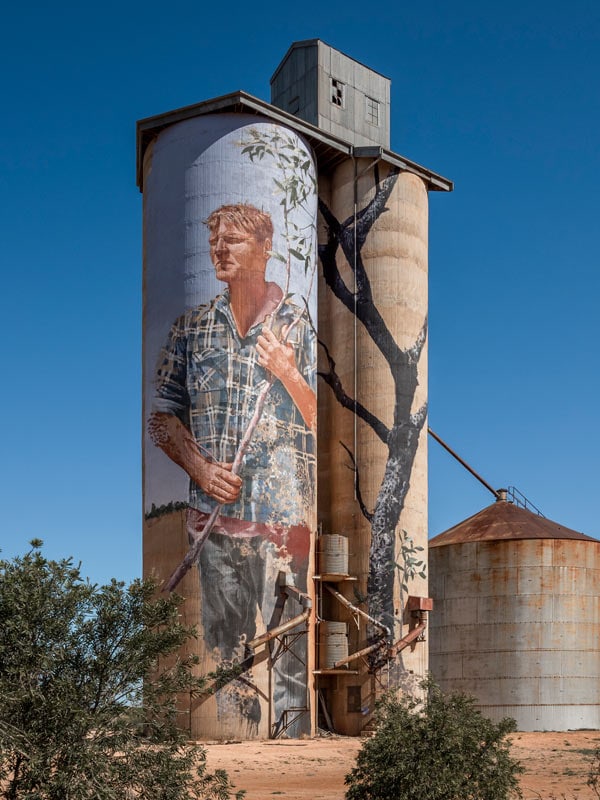
Fintan Magee painted Nick “Noodle
Brisbane artist, Fintan Magee met his silo art subject at the local pub. (Image: Visit Victoria/Anne Morely)

Must-see

Lake Albacutya

Lake Albacutya is one of a series of terminal lakes on the Wimmera River, which form the largest land-locked drainage system in Victoria.

Weekly travel news, experiences
insider tips, offers, and more.

The Big Mallee Fowl

The Big Mallee Fowl, constructed almost entirely from painted corrugated iron, is one of the most obscure of Australia’s Big Things. Make sure you stop by when you’re in Patchewollock!
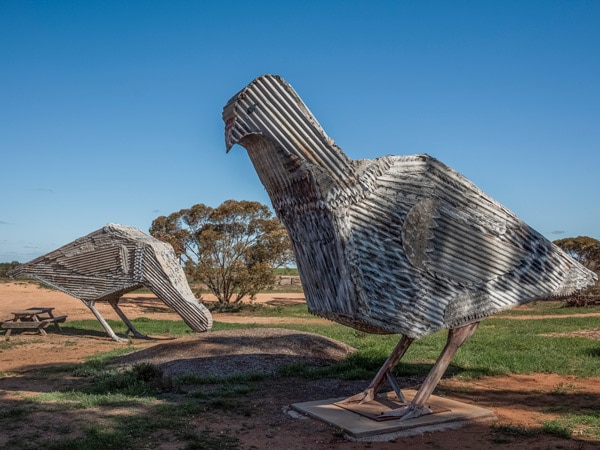
The Big Mallee Fowl in Patchewollock. (Image: Visit Victoria/Anne Morely)
The Big Mallee Fowl is a lesser-known “Big Thing" in Australia. (Image: Visit Victoria/Anne Morely)

Stay

Just 20 minutes out of Patchewollock is Pine Plains Lodge. With glorious sunrises, lingering sunsets, clear night skies and stars so close you can almost touch them, it is the perfect place to cosy up next to the fire after a big day sightseeing.

DAY FOUR: Patchewollock to Lascelles and Sea Lake

Lascelles

In order to capture the true essence of Lascelles, Melbourne-based artist, Rone knew that he had to learn about the town from those who were deeply connected to it. He depicts local farming couple Geoff and Merrilyn Horman, part of a family that has lived and farmed in the area for four generations.

Rone says that he wanted the mural to portray his subjects as wise and knowing, nurturing the town’s future with their vast farming experience and longstanding connection to the area.
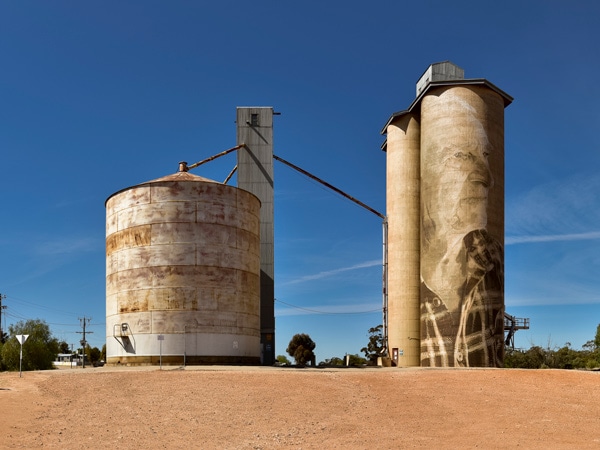
Lascelles silo art by Rone depicts local farming couple Geoff and Merrilyn Horman. (Image: Visit Victoria/Anne Morely)
The mural portrays Geoff and Merrilyn Horman as wise and knowing. (Image: Visit Victoria/Anne Morely)

Sea Lake

Joel Fergie and Travis Vinson painted the silo artwork at Sea Lake as a celebration of the still and silence found in outback Victoria, and the associated feelings of wholeness and freedom. The young girl, swinging from a Mallee Eucalyptus, looks over Lake Tyrrell and reflects on her Indigenous heritage.

The Indigenous name ‘Tyrille’ means ‘space opening to the sky’ as the colours of dusk and dawn are reflected in the shallow saline bowl. The Boorong People were known to have more knowledge of astronomy than any other tribe, and their stories are rich in culture and connection to the lake. The artwork aims to connect and bring the viewer closer to some of the relatively ordinary and overlooked elements of the outback landscape and allows viewers to see these elements from a new perspective.
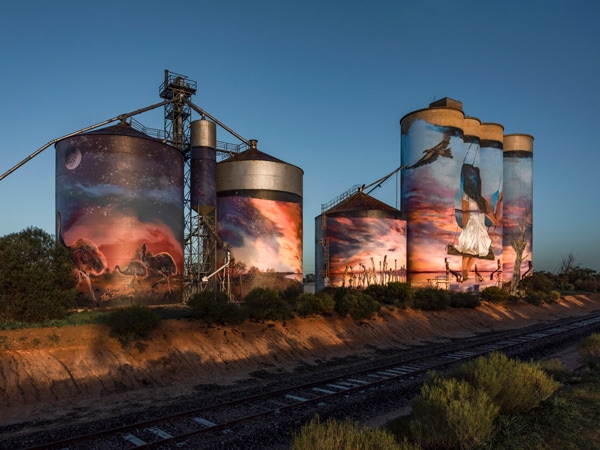
Joel Fergie and Travis Vinson painted the silo artwork at Sea Lake of a young girl, swinging from a Mallee Eucalyptus, looking over Lake Tyrrell and reflecting on her Indigenous heritage. (Image: Visit Victoria/Anne Morely)
The Boorong People were known to have more knowledge of astronomy than any other tribe, and their stories are rich in culture and connection to Lake Tyrrell. (Image: Visit Victoria/Anne Morely)

Must-see

Lake Tyrrell

A visit to Lake Tyrrell, Victoria’s largest salt lake, is a must while in Sea Lake. You’ll get a once in a lifetime insta pic, plus the 120,000-year-old lake is regarded as one of the best places in Australia for stargazing, with the dark and endless skies providing the perfect environment.
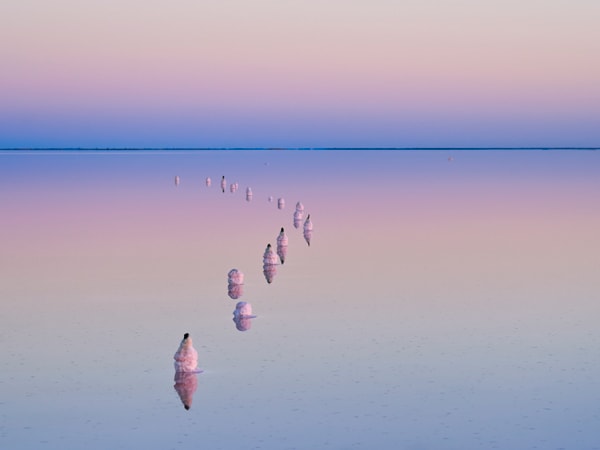
Pinks and purples reflect off Lake Tyrrell is Victoria's largest salt lake. (Image: Visit Victoria/Anne Morely)
Lake Tyrrell is the ultimate stargazing spot. (Image: Visit Victoria/Anne Morely)


Stay

Sea Lake has a range of different stays to suit your needs, whether camping is your vibe or you’d prefer to relax in a hotel.

DAY FIVE: Sea Lake to Melbourne via Nullawil

Nullawil

Artist Sam Bates (Smug) painted the Nullawil silo of a kelpie sheepdog and a farmer on the concrete canvas. The soft-coated black and tan Kelpie was depicted with a sheen on his coat, a shiny black nose, a spark in his brown toned eyes and fine grey whiskers above his semi drooped mouth.

As a “nod" to the history of Nullawil the registration disc has a “galah" and “stick" engraved on it. The name of the town is derived from two Aboriginal words, “Nulla" which means killing stick, and “Wil" derived from the term “willock" meaning Galah.

After visiting Nullawil, it’s back home to Melbourne!
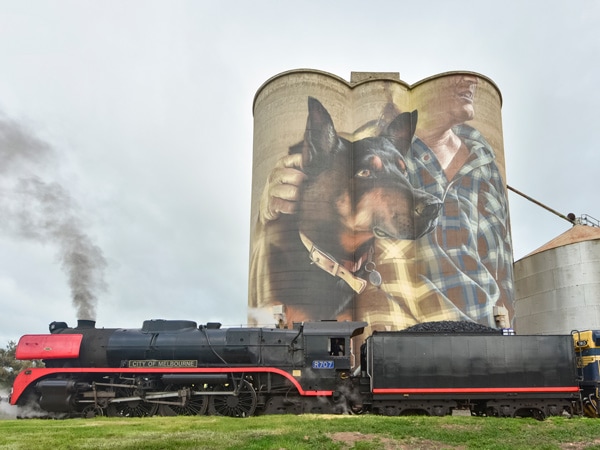
Artist Sam Bates (Smug) painted the Nullawil silo of a kelpie sheepdog and a farmer on the concrete canvas. (Image: Visit Victoria/Anne Morely)
The name of the town is derived from two Aboriginal words, “Nulla" which means killing stick, and “Wil" derived from the term “willock" meaning Galah. (Image: Visit Victoria/Anne Morely)

Want to see more stories from Australian Traveller in your Google search results?

  1. Click here to set Australian Traveller as a preferred source.
  2. Tick the box next to "Australian Traveller". That's it.
Emily Murphy
Emily Murphy is Australian Traveller's Email & Social Editor, and in her time at the company she has been instrumental in shaping its social media and email presence, and crafting compelling narratives that inspire others to explore Australia's vast landscapes. Her previous role was a journalist at Prime Creative Media and before that she was freelancing in publishing, content creation and digital marketing. When she's not creating scroll-stopping travel content, Em is a devoted 'bun mum' and enjoys spending her spare time by the sea, reading, binge-watching a good TV show and exploring Sydney's vibrant dining scene. Next on her Aussie travel wish list? Tasmania and The Kimberley.
View profile and articles
hero media

Discovering Bendigo’s unique heritage through incredible foodie experiences

    Kate Bettes Kate Bettes
    Tuck your napkin firmly in place and get ready to dive into Bendigo’s history.

    It’s an internationally recognised fact that Bendigo food experiences prove this region knows how to wine and dine. After all, its shiraz-laden landscape was named Australia’s first UNESCO Creative City and Region of Gastronomy. But what visitors lured in by this shiny label might not know is how deeply its culinary scene sits within the gold-rush town’s colourful past.

    Whether you’re eating in a grand colonial bank or nibbling through a gold miner’s garden, grab a big plate. In Bendigo, every meal is served with a huge helping of heritage.

    Take a food tour

    foodie walking tour in bendigo at Ms Batterhams restaurant Bendigo foodie experiences
    Join a Foodie Walking Tour to local highlights like Ms Batterhams.

    Start in the capable hands of Bendigo Guided Tours. Named as the 2025 Victorian Best New Tourism Business, they run two 12-person options. A Taste of Bendigo – Foodie Walking Tour will see you tasting seasonal dishes and sipping wine, craft beer and cocktails made with regional spirits over two-and-a-half hours, with stops at Ms Batterhams, Wine Bank on View, The Dispensary and Bendigo Brewing.

    You can up the ante a notch or two with the Four Hats of Bendigo – a night of fine-dine hopping with the experts across Terrae, Le Foyer, Alium Dining and The Woodhouse.

    Book a table

    Terrae restaurant in bendigo victoria
    Dine at Terrae.

    Alternatively, see Bendigo’s stars under your own steam. There’s Terrae, where produce from the owners’ own farm kitchen garden and orchard is plated up inside what was once a bank, while cocktails are poured in the underground bar below. For something special, book a private table in old bank vault. Rather less wholesome? The bullet hole in the window – a throwback to Victoria’s wild gold rush era.

    Another former bank-turned-eatery, Alium Dining, goes full art nouveau inside a 1908 building overlooking the Alexandra Fountain in the heart of Bendigo. Here, Alium’s Asian-meets-European flavours run all the way from duck leg croquettes with mandarin marmalade to raw trevally with coconut and nước chấm, to pork milanese with anchovy and stout mustard.

    Beneath an old school hall at Mackenzie Quarters, Ms Batterhams serves southern European-inspired dishes inside a 19th-century basement bar and restaurant. Beyond its sourdough crumpets (smeared with taramasalata, paprika and parsley oil, if you must know) is the origin of the restaurant’s name: Winifred Batterham, the owners’ mother’s former kindergarten teacher. Honour her properly with a ‘Winifred’ cocktail.

    Alium Dining in bendigo victoria
    Alium Dining offers a unique setting inside a 1908 building.

    Carnivores, get ready to bang your sharpest knives on the table. Bendigo’s only dedicated steakhouse, The Woodhouse, specialises in Wagyu sourced from surrounding farms. They’ve got beef every which way – from tartare topped with Giaveri Oscietra caviar and wagyu toast to porterhouse dry-aged and grilled over redgum.

    Your next bank stop on the food circuit is Bunja Thai. Housed inside the former Colonial Bank, it’s all Victorian-era Australian grandeur, from the enormous arched ceilings to the detailing overhead. Thai Singha and local craft beer jostle for attention – but both are perfect quenchers when you’re sharing barramundi baked in banana leaf beneath all that old-world opulence.

    If your trip through Australia isn’t complete without a country pub stop, make it The Bridgewater Hotel on the Loddon River. Renovated since its 1942 beginnings, but the establishment still retains its Art Deco charm. It’s the kind of place where steak burgers come stacked with bacon, egg, cheese and dripping beetroot relish, and are best handled in the riverside beer garden.

    Pour a glass

    Heathcote Wine Hub bendigo food experiences
    Find over 180 local wines at Heathcote Wine Hub.

    Your plate’s been stacked. Now it’s the glass’s turn – ideally with the famously bold shiraz and cab sav grown here. Early settlers in Bendigo and Heathcote were onto something when they first planted vines in the area’s mineral-rich soil, and their legacy still pours strong across more than 60 cellar doors today. Start big at the Heathcote Wine Hub, where more than 180 wines from nearby vineyards sit beneath the rafters of a restored former wooden church, with 16 available to taste by the glass.

    Heathcote Winery might have become one of the area’s first commercial wineries in the seventies, but its story started way before its courtyard tastings. Back in 1854, it operated as a miners’ produce store during the gold-rush years. Other cellar doors aren’t immune to reinvention under the wine wave either. At Munari Wines in Heathcote, charcuterie boards are presented in their newly renovated cellar, originally the stables of the former sheep station.

    Discover local events

    the Heritage and Hidden Spaces Wine Walk in bendigo
    Time your trip for the Heritage and Hidden Spaces Wine Walk

    Time your trip right and watch the parks, gardens and buildings fill with food and drink. Fans of the malt: mark 29 August  2026 for Bendigo On The Hop, when craft breweries take over venues throughout the CBD. Brews make way for history at the Heritage and Hidden Spaces Wine Walk (17 October 2026), where bottles are opened inside some of the city’s most interesting buildings – including rarely opened spaces. In November, the Regional Gin Gala raises spirits in Mackenzie Quarters with a boozy celebration of its homegrown distilleries, including Noble Bootleggers, Envy Distilling and In Good Spirits. Explore wine, food and live music at Heathcote on Show (6 – 8 June 2026).

    Take it all in

    bendigo tram cafe Bendigo foodie experiences
    Tram meets tasty at Bendigo Tram Cafe.

    Takeaway means something different in Bendigo. At Australia’s oldest operating Tram Depot, the Tram Cafe sits aboard an out-of-service 1916 N-Class Tram that serves tea and scones. Once you’ve polished off the last crumb, you can even pop into the driver’s cab and try the controls yourself.

    Peppergreen Farm continues Bendigo’s long connection to Chinese market gardens, first established here by immigrants in the 1850s. Today, the not-for-profit farm invites visitors to pick up organic produce, alongside jars of honey harvested from its own hives.

    Indulge in retail therapy

    Bendigo Pottery
    Elevate your at-home dining experience after a trip to Bendigo Pottery.

    If there’s still room in your bag among the clanking jars and bottles, stop by Uniquely Bendigo inside the Old Post Office. Sharing space with the Bendigo Visitor Centre, it’s a one-stop shop for favourites like Bendigo Brittle, Bridgeward Grove and Tea Associates.

    If you’d rather leave your fingerprints on your Bendigo souvenir, there’s a place for that too. At Bendigo Pottery, visitors can try their hand at shaping clay while taking part in another tradition of evolving old spaces – creating works of art within Australia’s oldest working pottery.

    Start planning your Bendigo adventure at bendigotourism.com.