A close encounter with Ningaloo‘s whale sharks

hero media
If swimming with whale sharks isn’t on your outback bucket list, well then you’re missing out, says Daniel Scott.

Just being here on this sparkling winter morning would be enough, cruising from Tandabiddy boat ramp through a break in one of the largest fringing reefs in the world. And Ningaloo Reef is right here in Australia, running for 300 kilometres along the continent’s north-western tip and enshrined on the World Heritage List since 2011 for its outstanding natural beauty and biological diversity.


After diving and snorkelling on its coral forests for the past three – unforgettable – days with Sail Ningaloo , I cannot imagine there being a healthier reef system anywhere on our planet. Nor one that draws such abundant and varied marine life. It’s impossible to count the number of tropical fish I’ve seen while snorkelling, decorated in luminous, electric colours that would outshine any neon-lit Tokyo street. While diving, I’ve loped along with a 90-year old loggerhead turtle, tried to keep up with cruising reef sharks and made awkward attempts to fly in formation alongside manta rays with five-metre wingspans.


But today, along with about 20 other passengers, I am about to realise a long-held dream: to swim with the biggest fish in the sea. Whale sharks: animals that can grow to 12 metres in length and weigh 21 tonnes and are yet among the most difficult of creatures to find on the planet. It’s another of Ningaloo Reef’s miracles that whale sharks are drawn, in significant numbers, to its plankton-enriched waters, between April and July every year.


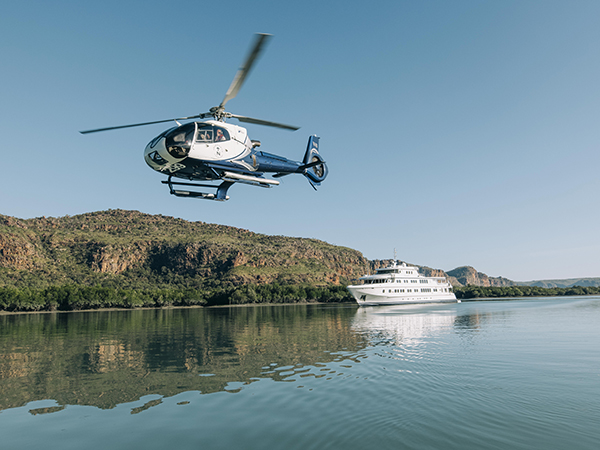
Yesterday, on a scenic flight, I saw four of these behemoths in the deeper, darker Indian Ocean outside the reef, their spotted patterns clearly visible from 300 metres above. Now, my pilot Tiffany is up in the sky again, acting as a spotter for our boat, Kings Ningaloo Reef Tour’s The Magellan.


As we are briefed by our young whale shark guides, the sense of anticipation builds.


“Once we’ve located a whale shark," my guide Nadine tells our group of eight snorkellers, “the skipper will get the boat ahead of it. Then I will jump in, find it underwater and hold my arm up to indicate which way it is travelling. Then…"


“Whale shark!"


Before she has time to finish, the cry has gone up and The Magellan is powering toward a nearby sighting.


“Get in one by one," says Nadine shuffling to the back of the boat in her fins, “and fan out on either side in two groups of four. And please remember to stay three metres away from the…"


Nadine is in and swimming like an Olympian in the open ocean. I’ve got the sinking feeling and thumping pulse I always get when my sense of adventure is about to propel me into a situation my comfort-loving self would never consider.


Nadine has stopped and pumped her arm above the swell.


“Go, go, go!"


I take a deep half-breath, step onto the tailboard and stride off the boat. There’s bubbles and white water everywhere.


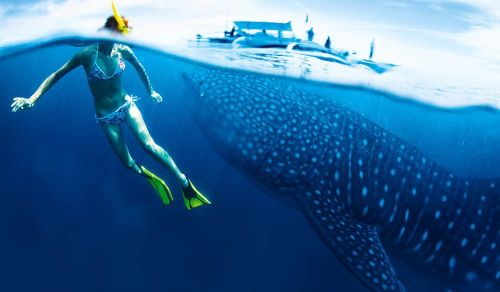
Strewth, I think, when the commotion clears, this water must be 80 metres deep. Before I can dwell on that, I catch a flash of Nadine’s yellow fins and push off towards her. Then I see it, an immense grey blur off to Nadine’s right. A second later it is a huge flat head proceeded by an outsized mouth, with natural lips that would put collagen out of business, heading straight toward me.


Getting run-down by a sub-aquatic double-decker bus wasn’t in my script. I gulp a snorkel full of ocean and fin backwards, sideways, anyways I can to get out of its road. It’s still coming toward me, the feeding whale shark’s mouth formed into an ‘O’, like one of those cool kids at school that blew perfect smoke rings.

Finally, I’m clear. I breathe easier and take in those markings that I’d seen from the air. Hundreds of off-white dots adorn its head and run in symmetrical patterns down its body. As it flashes past, I see the well-defined ridges of its back leading down to its vertical tail fin.


It takes 15 seconds for my first whale shark, an adolescent male that’s a mere four-and-a-half metres long and has the speed and grace of a marine cheetah, to be gone. As I flounder after it, it pulls away with a dismissive flap of its tail, leaving eight snorkellers gurgling like excited babies into their snorkels.


With careful manoeuvring, The Magellan drops us twice more into the path of this speedy shark. Later, we make the more relaxing acquaintance of a bigger, slower-moving female. But it is those first moments, described by shark expert Valerie Taylor as being like watching “a tanker emerging from the fog" that will remain etched in my brain as the greatest wildlife encounter of my life.

The details

Getting there


• Fly from Perth to Exmouth (Learmonth Airport) and head north to Exmouth (20 minutes) or south to Coral Bay (30 minutes). Both Coral Bay and Exmouth offer whale shark tours. You are more likely to swim with whale sharks at Exmouth (but only just – sightings at Coral Bay still happen at least 80 per cent of the time). Coral Bay is better known for its manta ray swims.

Staying there


• If you’re a luxury lodge fiend, glamping property Sal Salis in the Cape Range National Park is the only place to stay. Often there is a three-night package including a whale shark experience, for around $2660 per person, twin share.


• We stayed onboard Sail Ningaloo ; they operate three, five and nine-day Ningaloo Reef Tours between March and December. Prices begin from $1700 for a three-night tour in a deluxe cabin including all meals and non-alcoholic drinks, transfers from Coral Bay and equipment. However, you won’t see whale sharks with Sail Ningaloo – that’s a day experience offered through other operators (see ‘Playing There’).

Playing there


• We swam with Kings Ningaloo Reef Tours , but there are several operators to choose from: seven at Exmouth and one at Coral Bay. Prices range from $385–$400 per person. Most offer a return ticket for the next day if the whale sharks don’t show up.


MORE: Swim with a real shark – ‘The Great White Truth About Cage Diving With Sharks

hero media

7 Kimberley experiences that need to be on your bucket list

From thundering waterfalls to ancient Indigenous art, Kimberley’s raw beauty will take your breath away.

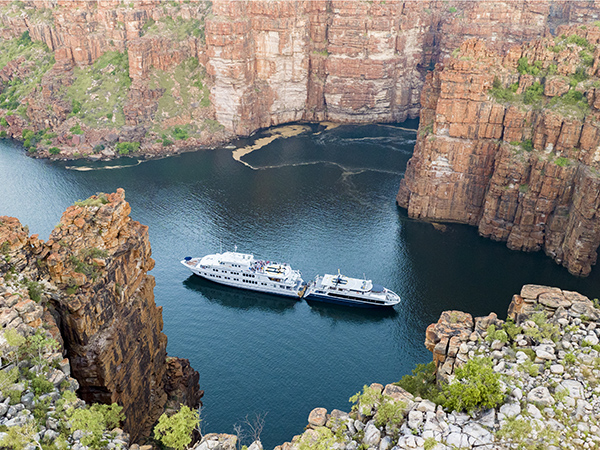
Wild, pristine, and shaped by nature, the Kimberley Coast is one of Australia’s most spectacular landscapes. A remote and rugged frontier that remains a bucket list destination for many travellers. Its most breathtaking attractions – including Montgomery Reef, King George Falls and Horizontal Falls – are accessible only by sea or air, making a guided expedition cruise aboard Silversea’s luxury expedition ship, Silver Cloud, the ideal way to explore it.

From its intricate intertidal zones to ancient rock art, extreme tides and rare wildlife found nowhere else in Australia – or the world – this journey offers an unparalleled exploration of one of Earth’s last true wildernesses.

Why Silversea?

Silversea offers a 10-day expedition departing Broome, or an extended 16-day expedition voyage from Indonesia, including landings on the hidden gems of Palopo Sulawesi and Komodo. Accompanied by expert guides and specialists in marine biology, history and geology, guests gain a deeper understanding of the Kimberley’s dramatic landscapes, rich cultural heritage and extraordinary biodiversity.

Silversea offers one of the experiential travel industry’s leading crew-to-guest ratios. Along with all-suite accommodation (80 per cent with private verandah), 24-hour butler service, a swimming pool and four dining options. Silver Cloud also has an experienced crew of multilingual expedition guides and specialists in marine biology, history and geology to enhance your Kimberley Experience.

silversea cruise ship pool deck
Take a dip in the pool deck.

1. Koolama Bay

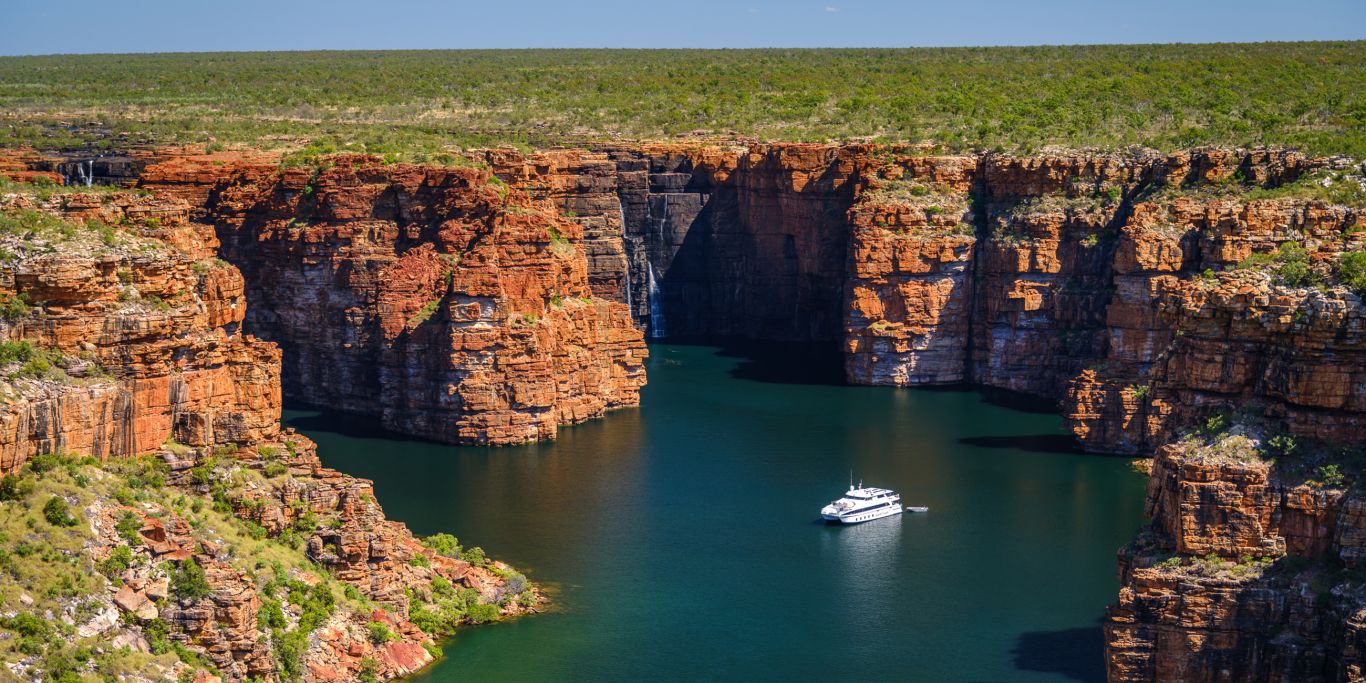
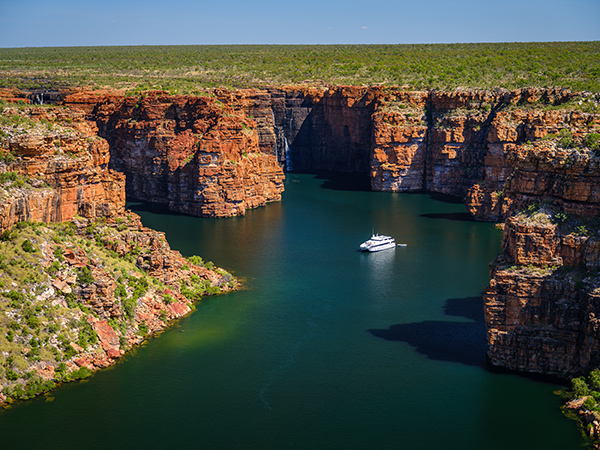
​​Before visitors see King George Falls, they hear them – a growing rumble in the distance, steady and foreboding as the Zodiac glides through the gorge, the sound echoing off sheer rock formations. At 80 meters tall, the twin cascades carve through the red cliffs, churning the waters below in a spectacular finale – but Koolama Bay holds secrets beyond its striking scenery.

Named after a ship that beached here following an aerial attack by Japanese bombers in World War II, the bay may seem desolate, yet it teems with life. With Silversea’s expert guides on their 10-day Kimberley itinerary, guests gain a sharper eye for its hidden wonders – rock wallabies darting across the cliffs, crocodiles lurking among dense green mangroves, and high above, the silhouette of a bird of prey circling the sky.

King George Falls at koolama bay excursion on Silversea Kimberley Cruise
Take a shore excursion to see King George Falls.

2. Freshwater Cove / Wijingarra Butt Butt

Connect with Country on a wet landing at Freshwater Cove, also known as Wijingarra Butt Butt. Considered one of the most special experiences on both the 16-day and 10-day Kimberley cruises, Silversea guests are welcomed by the traditional Indigenous custodians of the land, painted with traditional ochre, and invited to take part in a smoking ceremony.

Located on the mainland near Montgomery Reef, Wijingarra Butt Butt holds deep cultural significance to the local Indigenous community. Here, rock formations along the shore represent spiritual ancestors, and guests are guided to a nearby rock overhang filled with ancient art, where traditional owners share the stories and meaning behind these sacred paintings.

welcome to country on freshwater cove during silversea kimberley cruise
Take part in a smoking ceremony. (Image: Tim Faircloth)

3. Vansittart Bay (Jar Island)

Modern history, ancient culture and mystery converge in Vansittart Bay, which is also known as Jar Island. Here, the first thing to catch the eye is the dented, silver fuselage of a World War II-era C-53 plane – a striking relic of the past. Yet, the true cultural treasures lie just a short hike away where two distinct styles of Indigenous rock art – Gwion Gwion and Wandjina – can be found.

The Wandjina figures, deeply connected to Indigenous traditions, stand in stark contrast to the enigmatic Gwion Gwion (Bradshaw) paintings, which date back more than 12,000 years. Significantly different in form and style, the two different styles create a striking juxtaposition, offering a rare glimpse into the region’s rich and complex past.

aerial view of Vansittart Bay, See it in you Silversea Kimberley Cruise.
Explore ancient Gwion Gwion rock art at Vansittart Bay. (Image: Janelle Lugge)

4. Horizontal Falls

Part illusion, part natural phenomenon, the Kimberley’s much-lauded Horizontal Falls aren’t a waterfall, but a tidal and geographic spectacle that visitors have to see to comprehend. Known as Garaanngaddim, the phenomenon occurs when seawater rushes through two narrow gaps- one just twenty metres wide, and the other seven metres in width, between the escarpments of Talbot Bay.

With each tidal shift,  the force of the water creates whirlpools, furious currents and the illusion of a horizontal cascade as thousands of gallons of water are pushed and pulled in through the gap every six hours with relentless movement, making this one of the Kimberley ’s most mesmerising natural wonders.

Horizontal Falls are described as "One of the greatest wonders of the natural world". They are formed from a break in-between the McLarty Ranges reaching up to 25m in width. The natural phenomenon is created as seawater builds up faster on one side of the gaps than the other, creating a waterfall up to 5m high on a King tide.
Watch whirlpools and furious currents collide. (Image: Janelle Lugge)

5. Montgomery Reef

As the tide turns in Montgomery Reef, magic happens. With the Kimberley’s legendary tides varying up to ten metres, at low tide the submerged reef almost appears to rise from the depths: exposing up to four metres of the sandstone reef.

The impact is otherworldly: as the water drains, waterfalls cascade on either side of the channel,  turtles left exposed scramble and dive, and fish leap in search of sanctuary in shallow pools. Meanwhile, the dinner bell rings for the migratory seabirds dugongs, reef sharks and dolphins that scavenge and feast in the area.

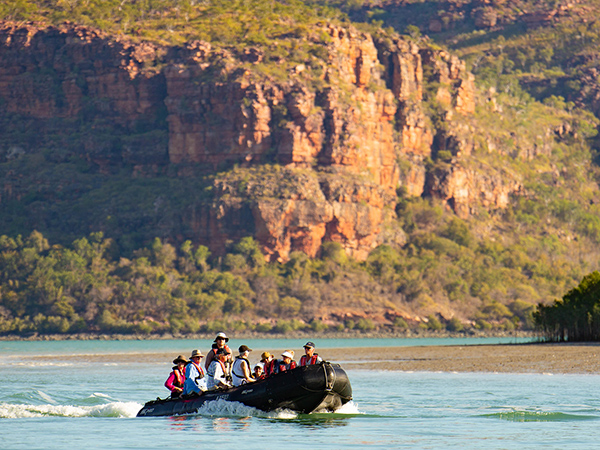
Using zodiacs, guests cruise through one of the world’s most significant inshore reef systems navigated by experienced guides, exploring the most intricate and fascinating parts of a 300-square-kilometre-wide biodiversity hotspot.

aerial view of boat going along Montgomery Reef
Witness seabirds, dolphins and reef sharks on the hunt.

6. Mitchell Falls by Helicopter

Experiencing the Kimberley by sea allows you to feel the power of the tides, but travelling by helicopter reveals the sandstone tapestry of the Kimberley, a landscape geologists believe is over 1.8 billion years old.

One of Silversea’s most popular optional excursions , guests who opt to fly into the interior from the onboard helipad soar up above the rust-coloured landscape of the Mitchell plateau, taking in one of Australia’s most scenic waterfalls: Mitchell Falls, a series of four emerald-coloured pools gently cascades into each other, before plunging down to the river below.

Seeing the landscape from above reveals a landscape weaved and shaped by the power of the freshwater wet season, juxtaposed to the constant lapping of the relentless and powerful tide on the coast.

aerial view of mitchell falls on silversea helicopter excursion
See emerald pools cascade into the river below. (Image: Tim Faircloth)

7. Indigenous Art Caves, Wandjina Art

The Kimberley Region of Western Australia is home to some of the most striking and significant

Indigenous rock art in Australia. Dotted throughout the landscape are caves, cliffs and rock overhangs depicting the striking, ethereal image of Wandjina, the rainmaker spirit and creation being central to many of the Dreamtime stories in this region.

Some of the paintings are regularly repainted by traditional custodians, while others are believed to be over 4,000 years old. Each artwork serves as both a cultural record and a living connection to the past, offering a rare opportunity to engage with the enduring traditions of the Kimberley’s Indigenous communities.

Freshwater Cover Rock Art the kimberleys
Walk among cultural records preserved in stone. (Image: Tim Faircloth)

See the best of this incredible part of the world on a Silversea Kimberley cruise. Book your 10- or extended 16-day expedition voyage at silversea.com