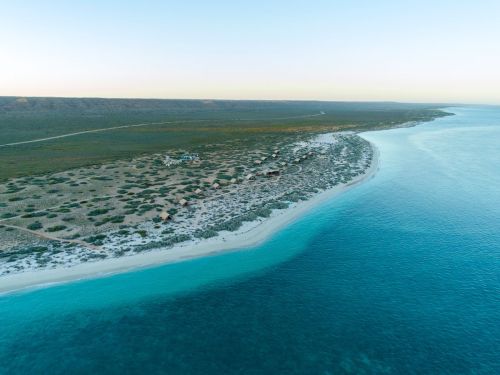
A stay at Sal Salis Ningaloo Reef redefines the off-grid experience

hero media
An off-grid stay in the sand dunes of Sal Salis Ningaloo Reef places Katie Carlin in tune with nature to rewire from everyday life.

The soft glow of first light streams through the shaded mesh covering of my nature en suite. A palm-sized shell from the nearby beach adorns the ledge and a cool ocean breeze rushes through the gap in my tent, collecting strands of my hair as I splash water on my face to start the day. I’m suddenly super aware of how precious this finite resource is after three nights sleeping by the ocean on the sand dunes of Western Australia’s Cape Range National Park where they get 200 millimetres of rain a year – if they’re lucky.

Here, cocooned in a rustic eco-wilderness tent at Sal Salis Ningaloo Reef , I wake with the sunrise and fall asleep to the sound of the ocean crashing against the reef. No devices. No bright lights. No mobile or internet coverage. It’s the antithesis of my life in Sydney and it is rewiring me from the inside out.

The luxury of experience

This deep respect for the power of nature to completely undo you is what Sal Salis defines as its ‘experiential style of luxury’. Everything about the camp is designed to connect you to the environment and wildlife around you.

From the ocean-facing placement of its tents – built to capture the coastal breeze and create a channel for airflow – to its approach to light and noise pollution, allowing you to witness uninterrupted star-speckled skies, and of course its location alongside UNESCO World Heritage-listed Ningaloo Reef with its 500-plus species of fish, coral gardens and megafauna.

It also underpins the ethos of the Eco-Certified bush camp; its guiding principles of minimal impact and sustainability are reflected in the measures Sal Salis has taken to protect its environment: construction of the camp is above ground level to protect the flora and fauna, power is generated by solar, water usage is carefully managed to avoid weed growth, no waste material escapes into the surrounding ecosystem. Every detail has been thought of, even down to the reef-safe sunscreen and toiletries.
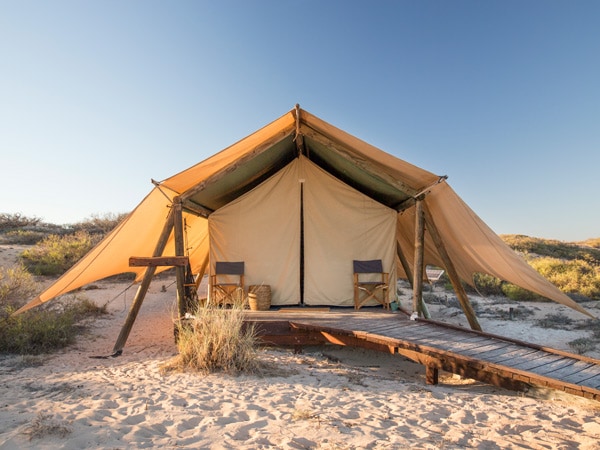
an accommodation tent at Sal Salis NingalooReef
Stay under canvas at Sal Salis Ningaloo Reef.

Turtle time on Ningaloo

Camp manager Leith Graham has spent the past 12 years managing remote lodges across the Top End. He left Seven Spirit Bay on the Cobourg Peninsula to manage Sal Salis earlier this year. Leith laughs when I comment on the camp’s remoteness. “This place isn’t remote; it has roads," he says.
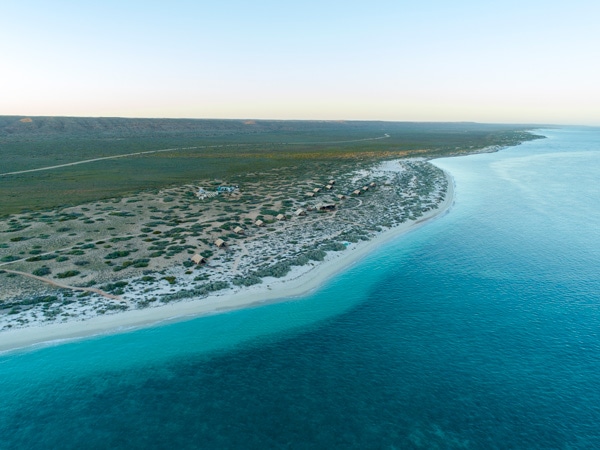
an aerial view of camp Sal Salis Ningaloo Reef
Sal Salis is in Australia’s wild, wild west.

“When we drove into town for the first time, I thought, ‘What have I done?’ because it was 50 degrees," he says, shaking his head at the memory. The summer heat is one of the reasons Sal Salis is only open from mid-March to mid-November. But by the time we pull up at Graveyards Beach, you can tell this place has gotten under Leith’s skin. We’re here to see green sea turtles from a distance; it’s late September and hundreds upon hundreds of them gather to mate just offshore at this time of year.

I follow him up the side of a sand dune and the wind blows more fiercely the higher we climb. At the top, a perfect crescent-shaped stretch of sand greets turquoise waters filled with hundreds of turtles bobbing in the waves below. I soon realise several of them are bobbing in piles of three or four. The females mounted by multiple male turtles at a time. “It’s like you’ve fallen into a David Attenborough series, isn’t it?" asks Leith over the wind.
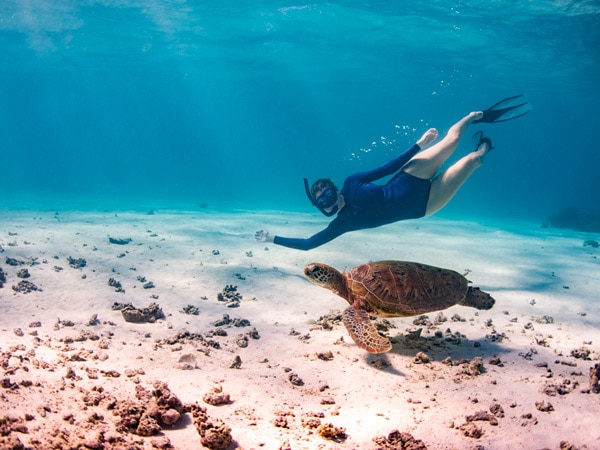
swimming with a sea turtle at Ningaloo Reef
Snorkel with turtles from Sal Salis Ningaloo Reef. (Image: Justin Bumpstead)

The beating heart of camp life

Days start and end in the communal lodge, the beating heart of camp life. It’s here I find the daily included activities scrawled across the chalkboard; normally a combination of a guided snorkelling tour or a hike to nearby Mandu Mandu Gorge or Yardie Creek Gorge.
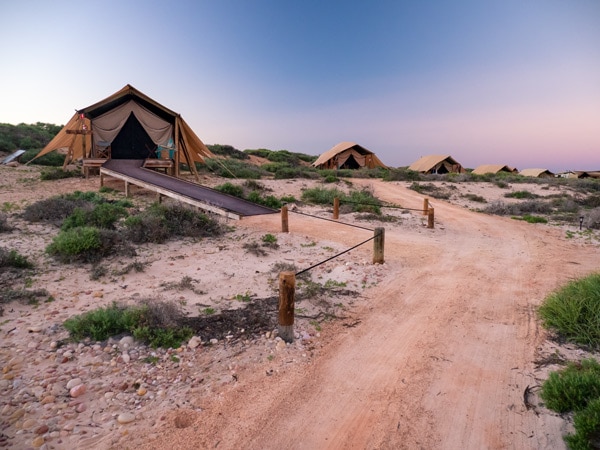
the eco-wilderness tents at Sal Salis Ningaloo Reef
The exclusive Sal Salis is on the shores of Ningaloo Reef.

There’s also a 24-hour self-serve bar stocked with wine, beer, spirits and non-alcoholic beverages of all kinds from across Western Australia, as well as a barista-style espresso coffee machine and snacks lined up in jars for the taking.

I join the other guests each evening for canapés on the deck, where we gather to watch the sun slip into the ocean and the sky erupt into fiery hues of red and orange before the colour drains into darkness.
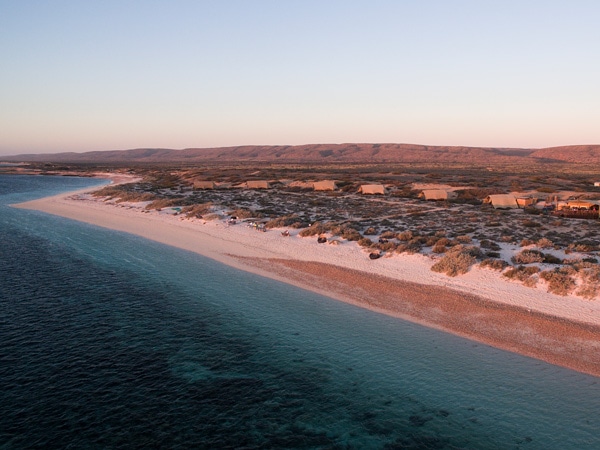
an aerial shot of Sal Salis Ningaloo Reef
An aerial shot of Sal Salis, camouflaged in the striking landscape.

It’s also where new chef Paul Seymour (also joining from Seven Spirit Bay) whips up his five-star dining creations that wouldn’t be out of place in Sydney’s finest restaurants. Dinner steals the show: a three-course set menu paired with the state’s best wines. Think crab tortellini, crispy pork belly, seared scallops and lamb rump.

It’s not long before wild tales from the day’s adventures start to spill around the communal tables. I think back to earlier that day when I joined a Live Ningaloo tour of the reef.
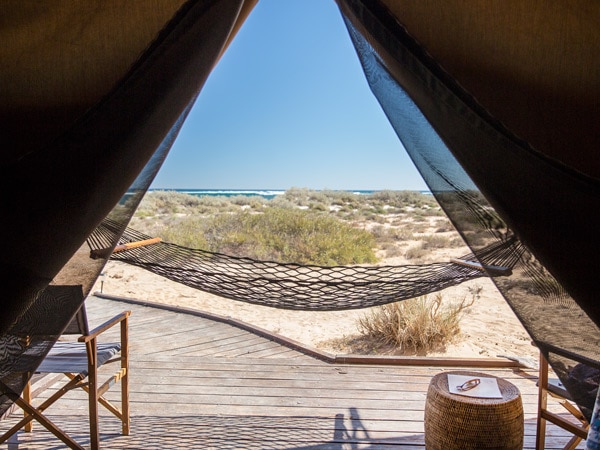
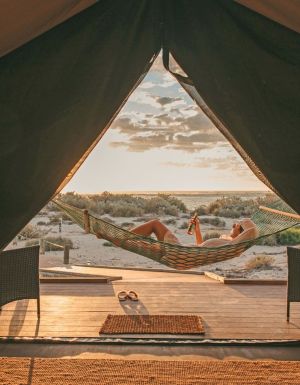
a hammock outside an eco-tent at Sal Salis Ningaloo Reef
Find enough relaxation time to switch off.

Swimming with majestic megafauna

The pilot circling the reef above radios to say she’s spotted a whale shark nearby. Whale shark season is over, so this feels like an unexpected gift. I stand, gripping onto the rail as we race towards the sighting; one hand not enough to keep me steady. An explosion of water appears ahead of us. A humpback whale breaches and a calf half her size follows her lead; spiralling into the air and flopping back down with gusto.
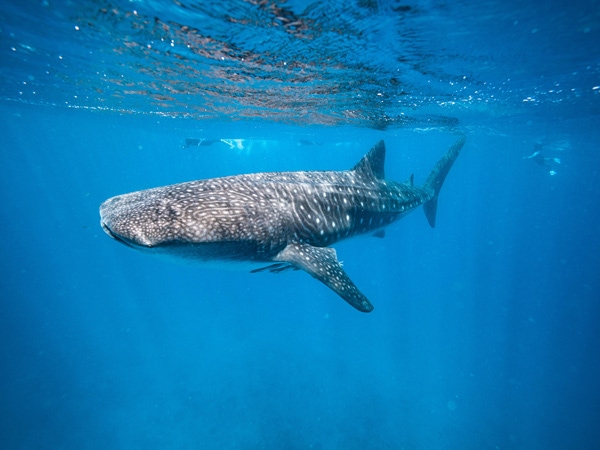
a huge whale shark under at Ningaloo Reef
Live Ningaloo offers interactions with whale sharks. (Image: Justin Bumpstead)

None of us, including the crew, can contain our excitement as unguarded squeals of delight ripple through the boat. Our skipper, Kurtis McGlennon, reluctantly pulls us away from the humpbacks at play – our turn to swim with the whale shark is fast approaching.

There are 15 operators with a licence to run swimming tours on the reef and Live Ningaloo is one of the lucky few. Now in position, four of us slip into the water after Katie Gates, our in-water guide and a marine biologist, following her lead as she directs us to kick into position.
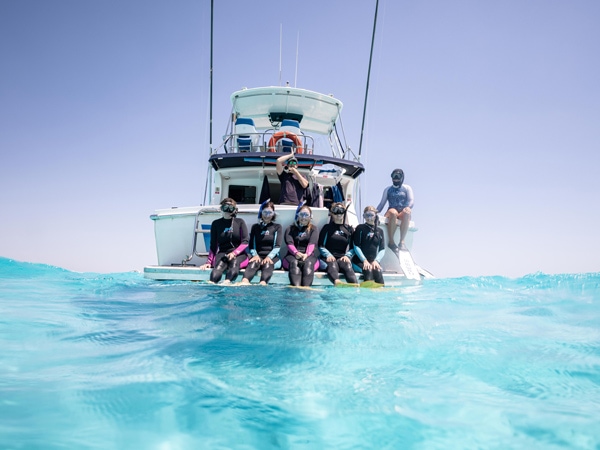
a group of tourists posing for a photo op during their Live Ningaloo tour
Join Live Ningaloo Tours. (Image: Justin Bumpstead)

I stick my head underwater at Katie’s direction and, moments later, see a grey figure start to take shape in the distance. A seven-metre whale shark is now directly in front of me. I start swimming to keep up, its tail effortlessly propelling it through the crystal-clear waters of the reef. I’m mesmerised by the white spots scattered in intricate patterns across its back; shimmering as they catch streaks of sunlight.

“Stop swimming!" Yells Katie from above. Our time is up. I reluctantly watch it swim out of view.
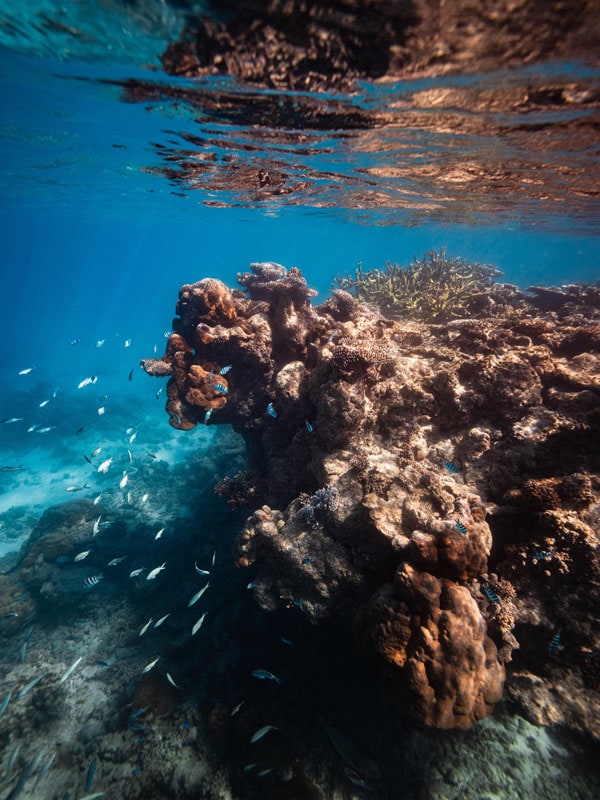
swimming deep down Ningaloo Reef
Go deep down under at Ningaloo Reef. (Image: Justin Bumpstead)

Carry it forward

I can still feel a fine coating of sand on my skin and see a light dusting of chalk-white dirt on my feet when I am waiting to collect my luggage at Sydney Airport. I’m reluctant to wash it away; it’s a welcome reminder of what we stand to lose if we keep our heads buried in the busyness of life.

As I stand watching the baggage carousel, I’m reminded of Leith Graham’s words, “The more people that know about Ningaloo, the more protected it will be." I know exactly what he means.
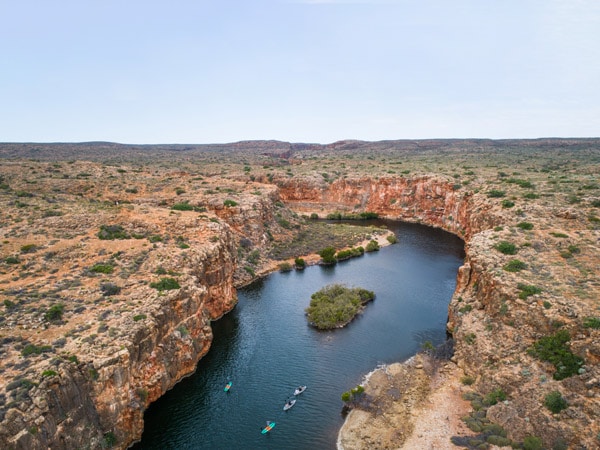
the striking landscape aerial views of Cape RangeNational Park
Explore Cape Range National Park.

A Traveller’s Checklist

Getting there

Exmouth’s Learmonth airport is the closest access point to Ningaloo Reef, located a little over an hour’s drive from Sal Salis. There are daily Qantas flights to Exmouth departing from Perth, with airport transfers available to pre-book for a fee through Sal Salis. Recently, Qantas also launched a twice-weekly direct flight from Melbourne to Exmouth during peak season.

Playing there

Live Ningaloo is the only operator that offers single-swim small-group wildlife interactions in Exmouth. The award-winning Eco-Certified tour operator accommodates 10 guests for whale shark tours and seven guests for humpback tours to ensure minimal disturbance to marine life and maximised experiences for guests.

You can also offset your trip’s carbon emissions for a small fee to support the operator’s sustainable practices and reduce your ecological footprint.  Advance bookings for all tours are essential. Whale shark season runs from March to July and humpback season from June to mid-October.     

Staying there

Eco-Certified Sal Salis Ningaloo Reef offers 15 wilderness tents and one honeymoon tent built amid the sand dunes in Cape Range National Park on the shores of Ningaloo Reef on the Coral Coast of WA. The season runs from mid-March to mid-November and the all-inclusive stay covers all food and drink, activities, snorkel gear and accommodation.
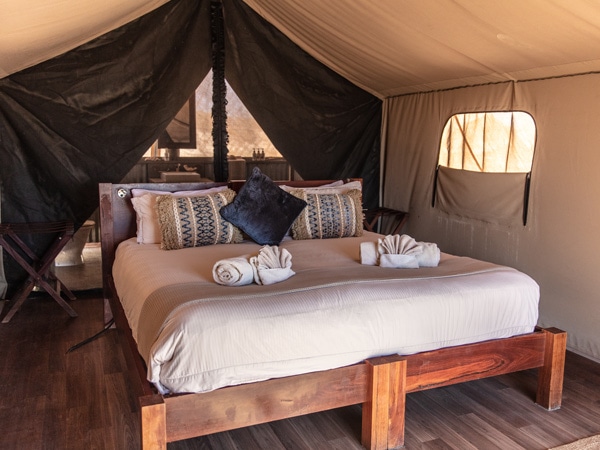
the tent interior with bed at Sal Salis Ningaloo Reef
There are just 16 off-grid luxury safari-style tents around the camp.

Eating there

Daily meals are served at The Lodge in Sal Salis with an à la carte menu for breakfast and lunch, followed by sunset canapés and a three-course set menu paired with Western Australian wines for dinner. The self-serve bar is open 24 hours a day and all dietary requirements are catered for. Expect five-star seasonal produce sourced locally.
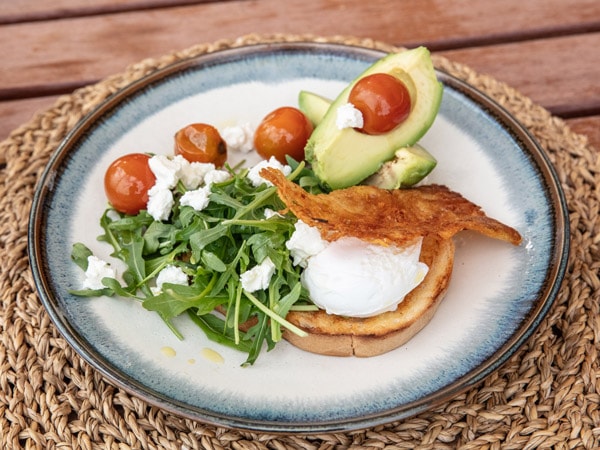
food on the plate at Sal Salis Ningaloo Reef
Expect fresh, seasonal produce.
Katie Carlin
Katie Carlin is Australian Traveller's Head of Content and when she’s not travelling or behind her computer, she’s hosting a dinner party (likely cooking an Alison Roman recipe), at brunch, working on extending her running k’s, or has her nose buried in a book. She joined Australian Traveller in 2018 and is responsible for leading the editorial team across print, digital, social, email and native content. Her job is to make sure we create content that connects readers to incredible experiences in Australia and beyond. In addition to sharing her expertise on travel through industry speaking engagements, Katie appears onToday, A Current Affair and various radio segments. With a BA in Communications majoring in Journalism and a career that has spanned roles at Fairfax Media and Are Media writing for titles such as The Sydney Morning Herald, The Age, and various lifestyle brands, she brings a wealth of experience to her role. Her most impactful trip to date has been swimming with whale sharks on Ningaloo Reef. For her next trip she is longing to experience the romance of train travel – hopefully on The Ghan or Indian Pacific.
See all articles
hero media

6 reasons the best way to experience the Kimberley is by cruise

This remote corner of Australia is one of the world’s last frontiers. This is how to see it properly.

Vast, rugged and deeply spiritual, the Kimberley coast in Australia’s North West feels a world away from everyday Australia – and there are countless ways to explore it. But if you want to reach ancient rock art, hidden gorges and lonely waterfalls, it has to be by boat. Whether you’re aboard a nimble expedition vessel or a luxury yacht with all the trimmings, exploring by the water brings exclusive experiences, shows unique views and makes travel easier than any other mode. And that’s just the beginning of Australia’s North West cruises.

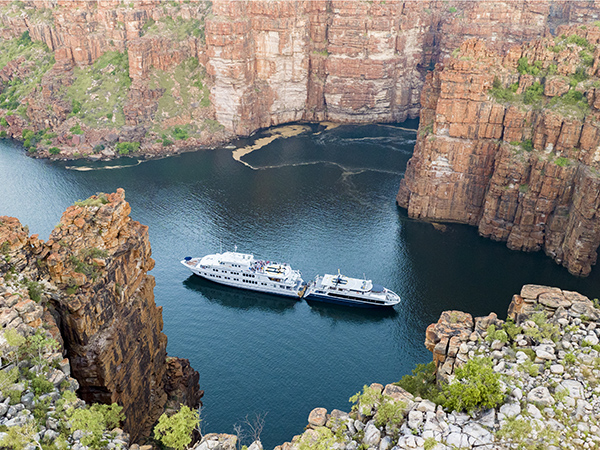
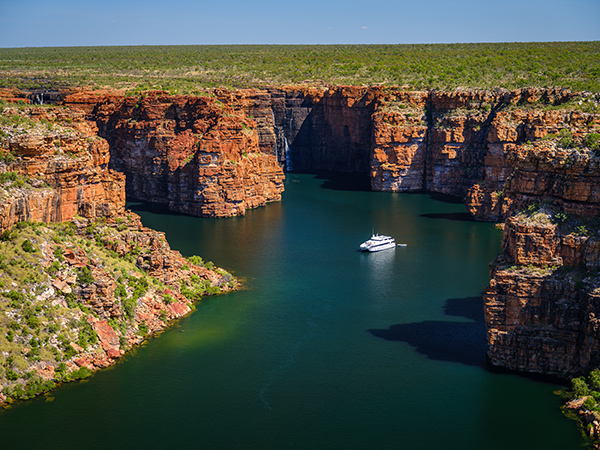
The True North Adventure Cruise in between sandstone cliffs.
Adventure starts where the road ends.

1. Discover Broome, and beyond

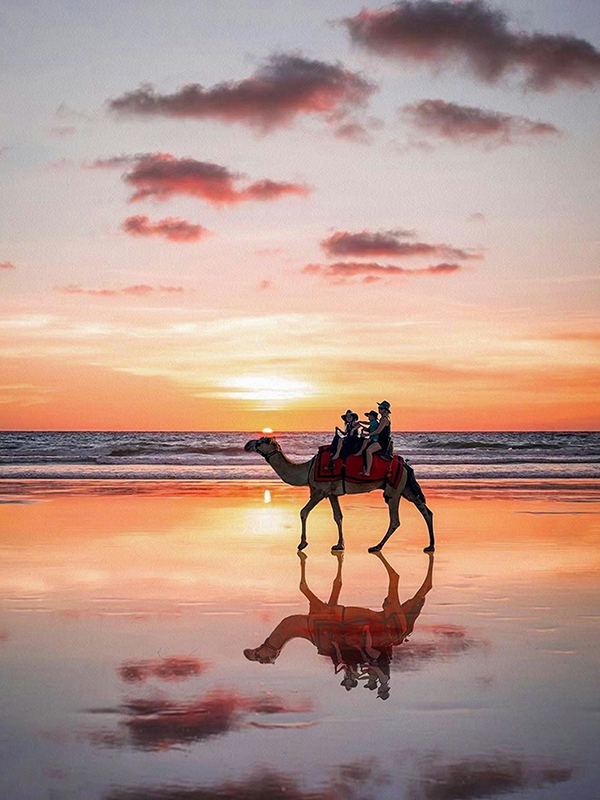
Explore your launchpad before you set sail: Broome. Here camels and their riders stride along the 22 kilometres of powdery Cable Beach at sunset. That’s just the start.

At Gantheaume Point, red pindan cliffs plunge into the turquoise sea, whose low tide uncovers fossilised dinosaur footprints. Broome’s pearling history runs deep. Japanese, Chinese, Malay and Aboriginal divers once worked these waters, and their legacy lives on in boutiques where South Sea pearls still shine.

If the moon’s right, you may catch the Staircase to the Moon over Roebuck Bay. Or simply kick back with a cold beverage and a film under the stars at Sun Pictures , screening since 1916.

Ride a camel along Cable Beach as the sun sinks into the Indian Ocean, casting golden light across the sand and sea.
Ride a camel along Cable Beach. (Image: Nick Dunn)

2. Unmatched access to The Kimberley

Once you’re onboard, expect a backstage pass to some of the most isolated places on Earth. No roads. No ports. No phone reception.

At Horizontal Falls/ Garaanngaddim, 10-metre tides surge through twin gorges like a natural waterpark ride that’ll make your palms sweat. Then there’s Montgomery Reef/ Yowjab: a giant living platform of coral and seagrass, where the sea pulls back to reveal waterfalls, sea turtles and ospreys.

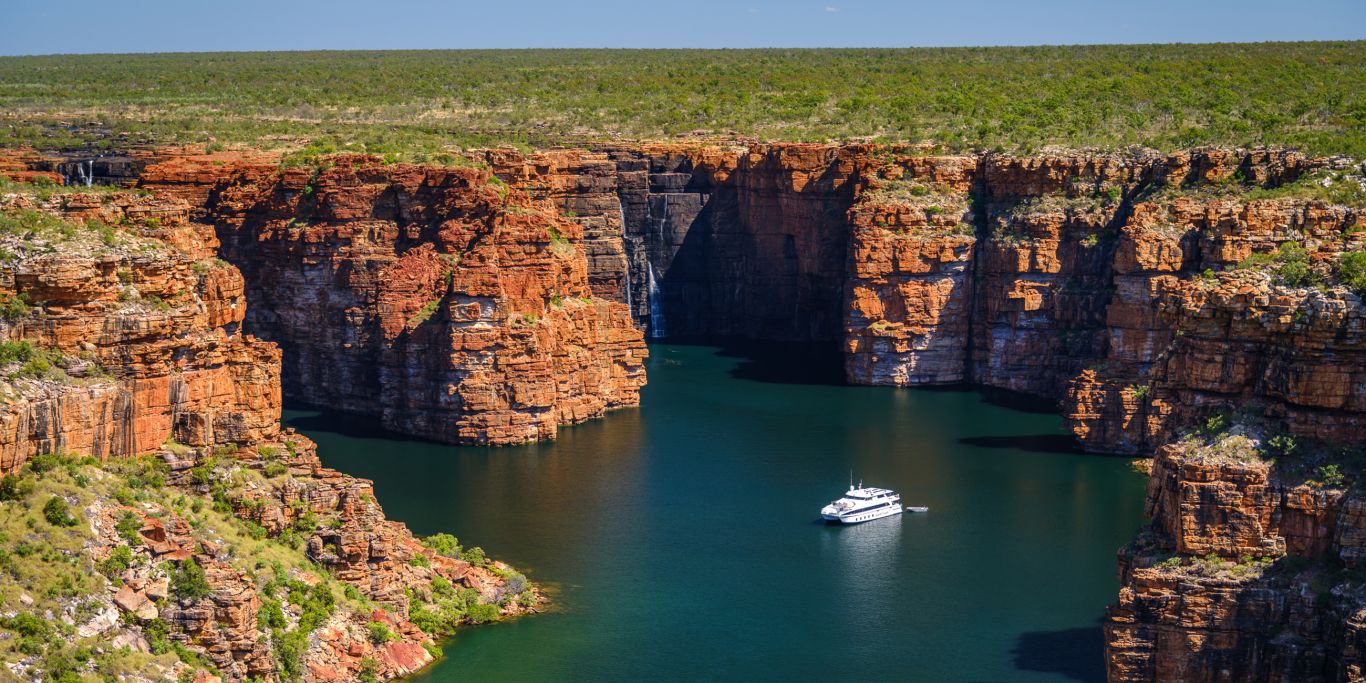
Up north, King George Falls/ Oomari rage 80 metres down red cliffs. Zodiac boats often nudge in closer so you can feel the spray on your sun-warmed cheeks. You might even fly in to reach Mitchell Falls/ Punamii-unpuu, a four-tiered cascade where you can swim in freshwater pools above the drop.

Come spring, some itineraries veer west to Rowley Shoals: an atoll chain of white sand and reef walls. Then it’s up the winding Prince Regent River to King Cascade/ Maamboolbadda, tumbling over rock terraces, and into a Zodiac to view the Gwion Gwion rock art, whose slender, ochre-painted figures are older than the pyramids.

A cruise drifts beneath King George Falls, where sheer sandstone cliffs frame the thunderous plunge into turquoise waters.
Get closer to the Kimberley than ever before.

3. Taste the Kimberley with onboard hospitality

You might spend your days clambering over slippery rocks or charging past waterfalls. But when you’re back on the water, it’s a different story. Meals are chef-prepared and regionally inspired: grilled barramundi, pearl meat sashimi, mango tarts, and bush tomato chutney. One night it’s barefoot beach barbecues with your shipmates; the next, alfresco dining on the ship.

Small expedition ships each have their own personality, but many carry just 12 to 36 guests, making being out on the water a whole other experience. You might sink into a spa on the foredeck or sip coffee in a lounge while watching crocodiles cruise by. It’s choose-your-own-relaxation, Kimberley style.

4. Expert-led excursions through the Kimberley

These voyages are led by people who know the Kimberley like the back of their sunburnt hand. Attenborough-esque naturalists might gently tap your shoulder to point out rare birds or tell the story beneath a slab of rock. Historians can explain exactly how that rusted World War II relic came to rest here.

If your ship has a helipad, you might chopper straight to a waterfall-fed swimming hole. If not, you’ll still be hopping ashore for that wet landing at a secret creek.

Then come the evenings: songlines shared by Traditional Owners under the stars, or astronomy sessions that link what’s overhead with what’s underfoot and what’s within.

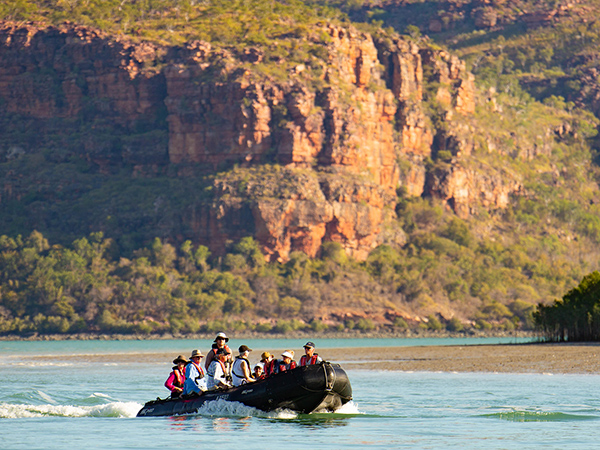
A small group glides through Kimberley’s rugged coastline by boat, passing ancient cliffs.
Explore with naturalists and historians by your side.

5. Relax in luxurious lodgings

Just because you’re off-grid doesn’t mean you have to rough it. These Kimberley vessels are small in size, but mighty in luxury. True North’s ships come with their own helicopters and a no-sea-days policy, so you’re always in the thick of it. Try the luxurious offerings from Ocean Dream Charters for exploration in style. Kimberley Quest offers a fast boat for easy, off-ship adventures. On the larger end of the scale, Coral Expeditions has open-deck bars and curated wine cellars. And then there’s Ponant’s luxury yachts sleek and incredibly stylish French sailing yachts.

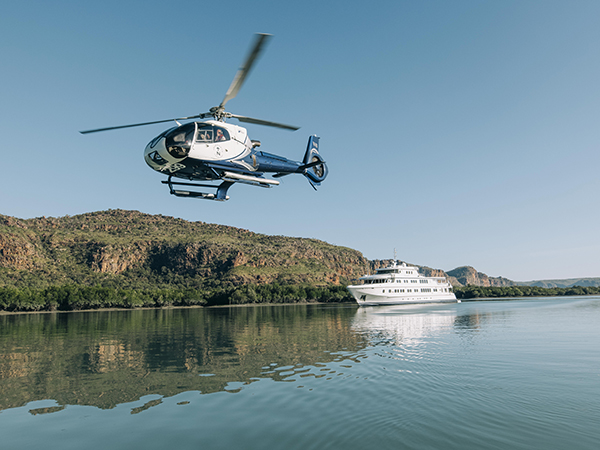
A helicopter soars above the sea, with a sleek cruise ship gliding in the distance.
See the Kimberley from sky to shore.

6. The adventure continues with pre- and post-cruise experiences

You’ve already come this far – so, why not go further? Broome makes it easy to ease in before you board, or wind down when your voyage ends, and there is no reason to stop there.

Head an hour and a half south to Eco Beach to stay off-grid and off the clock. Join a Yawuru guide for a mangrove walk or ocean forage. Dive even deeper into Broome’s pearling past at Willie Creek or Cygnet Bay, where divers and craftspeople still pull the seawater-slicked gems from the deep.

If you’re still craving adventure, it’s time to go further. Soar over the Buccaneer Archipelago, or detour inland with a 4WD trip along the Gibb River Road. Book a scenic flight over the Bungle Bungles. Or – because you never know when you’ll be back – do all three.

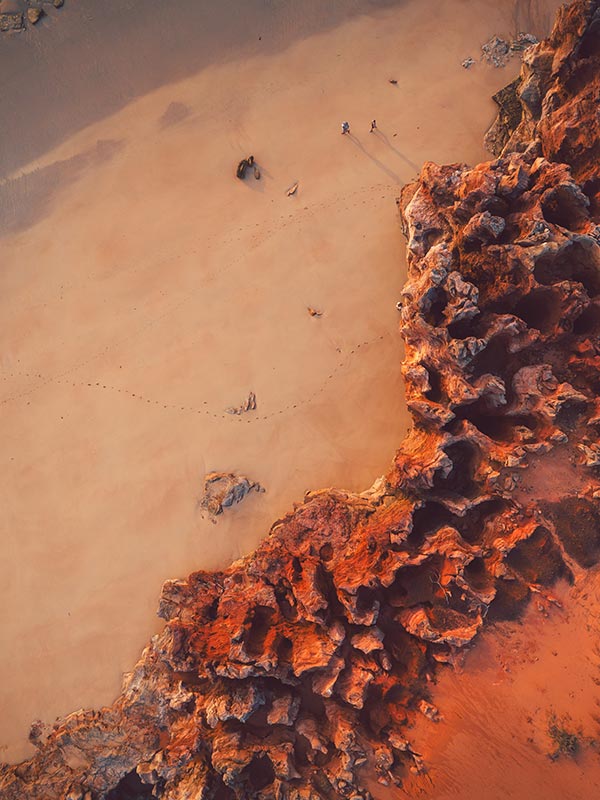
aerial of people walking on eco beach in the kimberley western australia
Stay off grid at Eco Beach. (Image: Tourism WA)

Find out more about your trip to Australia’s North West at australiasnorthwest.com .