The zoo stay with all the creature comforts

hero media
A unique hotel in Canberra, Jamala Wildlife Lodge, lets you stay alongside some of the rarest animals on the planet (By: Leigh Ann Pow)

One of the many reasons that people check in to hotels is a little solitude from the Sturm und Drang of everyday life. But lying in my luxuriously appointed hotel room in the dead of night.


I am almost willing the silence to be broken.


And then I hear it, an almighty commotion from the room next door. It’s hard to tell if it’s an argument and at any other hotel I’d be demanding that the disturbance be dealt with, but instead I just lie there in awe.


You see, the occupants of Bungalow 1 next door are not quarrelling newlyweds, they are a pride of lions. It’s the kind of experience that safari camps in Africa pride themselves on delivering.


But I’m not in Africa. My 11-year-old and I are at Jamala Wildlife Lodge, a 10-minute drive from the centre of Canberra.


Part of the privately owned National Zoo and Aquarium, Jamala Wildlife Lodge is the passion project of Richard and Maureen Tindale, who, in 1998, bought an aquarium and small native wildlife park after it went into receivership.


Almost immediately they set about expanding the property, with a mission of housing animals in as comfortable surroundings as possible, aiming for best practice when it came to animal welfare.


Many of the animals they initially brought into the zoo had spent their lives in circuses and were in desperate need of love. In the 17 years since, the zoo has continued to take in animals in dire straits, growing in size and contributing to international breeding programs, while educating visitors on the importance of wildlife conservation.


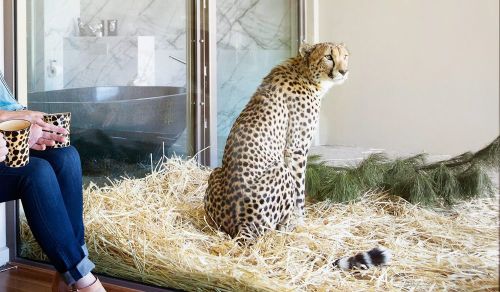
The lodge offers guests the chance to spend time with some of the most endangered animals in the world, from the comfort of five-star facilities. All of the rooms scattered around the zoo are directly adjacent to an animal enclosure, with just floor-to-ceiling walls of glass separating man from beast.


The rooms in the central uShaka Lodge overlook the likes of lemur, hyena, shark, and cheetah; six Giraffe Treehouses allow guests to feed the resident giraffe, Hummer, from their balconies; and the Jungle Bungalows look out over lions, cheetah, tiger and brown bear (conversely the animals can look in at the humans, including in the bath).


Our room, Bungalow 2, is directly adjacent to the Malayan Sun Bear enclosure, and when we enter (walking past a cute as a button red panda munching on bamboo) we find Arataki, the man of the house, sprawled outside the window determinedly working his way into a coconut with his enormous claws.


His partner Otay was rescued from Cambodia where she was being held in a cage until she was old enough to be sold to a restaurant – their paws are made into soup. It is impossible not to be totally transfixed, given that a Malayan sun bear is mere centimetres away.


Later at dinner, which is taken as a group safari-style back at uShaka Lodge, the zoo’s keepers coax a pair of white lions up into an enclosure on the verandah where pre-dinner drinks are taken.


The majestic beasts are close enough to reach out and touch (not advisable). While this kind of encounter may seem contrived and the opposite to being ‘in the wild’, many of these animals have never actually been in the wild.


It is a fact that hits home the next morning when we set out on a behind-the-scenes tour of the zoo. We stop at the Sumatran tiger enclosure and hear about their plight: deforestation in pursuit of money from palm oil harvesting is wiping out the big cat’s habitat at a sickening rate. In a mere 20 years, the only place you will be able to see these tigers is in zoos; they will be totally extinct in the wild.


And that’s where the gimmick of sleeping next to lions and tigers and bears becomes a serious attempt to stem the tragic flow of animals that are endangered. The funds raised from the room rates at Jamala go straight back into the zoo, allowing it to continue to strengthen its breeding program.


As we wrench ourselves away from Arataki and Otay to check out of our room in the late morning we glimpse the young couple who spent the previous night beside the raucous lion family. Like most of the other guests they look happy, if not just a little tired.


More information:


See JamalaWildlife Lodge


Finding the cool in Canberra


Need tips, more detail or itinerary ideas tailored to you? Ask AT.

AI Prompt

Want to see more stories from Australian Traveller in your Google search results?

  1. Click here to set Australian Traveller as a preferred source.
  2. Tick the box next to "Australian Traveller". That's it.
hero media

3 wild corners of Australia that let you reconnect with nature (in comfort)

    Kassia Byrnes Kassia Byrnes
    The country’s rawest places offer some of its most transformative, restorative experiences.

    Australia offers sublime opportunities to disappear into the ancient, untouched wilderness, worlds away from modern stress. Wild Bush Luxury offers a collection of experiences that are a portal into the continent’s wildest, most undiscovered landscapes, from wide floodplains to vast savannas, where the only distractions are birdsong, frog calls, curious wallabies and the daily drama of sunset. With a focus on conservation and Indigenous knowledge, these all-inclusive experiences allow guests to slow down and quiet their minds for intimate encounters with the natural world.

    1. Bamurru Plains

    safari tent at Bamurru Plains wild bush luxury
    Let nature take front row.

    In the remote Top End, just outside Kakadu National Park on the fringes of the spectacular Mary River floodplains, you’ll find Bamurru Plains, a peerless Australian safari camp. After a quick air transfer from Darwin to the camp’s private airstrip, you’ll be whisked away via 4WD to a vivid natural wonderland of shimmering floodplains, red earth, herds of peacefully grazing water buffalo and 236 bird species (Bamurru means magpie goose to the Gagadju people).

    Accommodations consist of 10 mesh-walled bungalows and two luxe stilted retreats where guests enjoy panoramic, up-close views that invite them into their rightful place in the landscape (and binoculars to see it even better). Being an off-grid experience designed to help guests disconnect, the only distractions are birdsongs, frog calls, curious wallabies, the occasional crocodile sighting and the daily drama of the spectacular golden sunset.

    It’s a place where nature’s vastness rises to the level of the spiritual, and Bamurru’s understated, stylish,  largely solar-powered lodgings are designed to minimise human impact and let nature take front row.  Guests relax in comfort with plush linens, an open bar, communal tables that allow for spontaneous connections and curated dining experiences from the in-house chef using local ingredients and bush-inspired cooking methods.

    Bamurru Plains airboat tour
    Zoom across the floodplains. (Image: Adam Gibson)

    It’s a restorative backdrop for days spent zooming across the mist-covered floodplains in an airboat, birding with expert guides, taking an open-sided safari drive or river cruise through croc country. Spend time at the Hide, a treehouse-like platform that’s perfect for wildlife spotting.

    In fact, nature is so powerful here that Bamurru Plains closes entirely during the peak monsoon season (October to April), when the floodplains reclaim the land and life teems unseen beneath the water. Yet Wild Bush Luxury’s ethos continues year-round through its other experiences around Australia – each designed to immerse travellers in a distinct Australian wilderness at its most alive and untouched.

    2. Maria Island Walk

    woman on a headland of Maria Island Walk
    Maria Island Walk offers sweeping coastal scenes.

    Off Tasmania’s rugged east coast, the iconic Maria Island Walk is an intimate four-day journey through one of the country’s most hauntingly beautiful and unpopulated national parks, encompassing pristine beaches, convict-era ruins, and wildlife sightings galore. Accessible only by a small ferry, Maria Island feels like a place reclaimed by nature, which is exactly what it is: a penal settlement later used for farms and industry that finally became a national park in 1972.

    These days, the island is known as ‘Tasmania’s Noah’s Ark’ and its only human inhabitants are park rangers. It’s a place where wombats amble through grassy meadows, wallabies graze beside empty beaches, dolphins splash in clear water just offshore and Tasmanian devils – successfully reintroduced in 2012 after near-extinction on the mainland – roam free and healthy.

    Each day unfolds in an unhurried rhythm: trails through coastal eucalyptus forests or along white-sand bays, plateaus with sweeping ocean views, quiet coves perfect for swimming. Midway through the journey, you’ll explore Darlington, a remarkably preserved 19th-century convict settlement whose ruins tell stories of human ambition at the edge of the known world.

    At night, sleep beneath a canopy of stars in eco-wilderness camps – after relaxing with Tasmanian wine and locally-sourced meals, and swapping stories with your fellow trekkers by candlelight.

    3. Arkaba

    two people standing next to a 4wd in Arkaba
    Explore Arkaba on foot or on four wheels.

    For a bush immersion with more of an outback flavour, Arkaba offers a completely different type of experience. A former sheep station and historic homestead in South Australia’s striking Flinders Ranges that has been reimagined as a 63,000-acre private wildlife conservancy. It’s now patrolled mainly by kangaroos and emus.

    Small-scale tourism (the homestead has just five ensuite guestrooms) helps support rewilding projects, and guests become an essential part of the conservation journey. Days begin with sunrise hikes through ancient sandstone ridges or guided drives into the ranges to spot yellow-footed rock-wallabies. And end with sundowners on a private ridgetop watching the Elder Range glow vibrant shades of gold, crimson and violet as the air cools and time stands still.

    Here, you can join conservation activities like tracking native species or learning about Arkaba’s pioneering feral-animal eradication projects, then unwind with chef-prepared dinners served alfresco on the veranda of the homestead, which is both rustic and refined. The highlight? Following Arkaba Walk, a thriving outback wilderness where emus wander and fields of wildflowers grow.

    It’s an unforgettable immersion in Australia’s vast inland beauty, a place where the land’s deep and complicated history – and astounding resilience – leave their quiet imprint long after you return home. In a world where genuine awe is rare, Wild Bush Luxury offers a return to what matters most in the untamed beauty of Australia’s wilderness.

    Disconnect from the grind and reconnect with nature when you book with at wildbushluxury.com