Passengers questioning directives to turn phones to aeroplane mode mid-flight are on the rise, but it turns out there really is a very good reason for it.
We all know someone who’s forgotten to put their phone on aeroplane mode while flying, and they proclaim nothing happened. In fact, claims there is no need for aeroplane mode on flights have been on the rise for years.
But now, a slightly fed-up U.S. pilot has taken to social media to explain why switching your phones to aeroplane mode is actually extremely important for the crew flying your plane.
Pilots really need you to turn on aeroplane mode. (Image: Getty/ Maravic)
“This is just a friendly PSA that the aeroplane mode button on your phone is not a conspiracy," began the pilot, known online as PerchPoint.
“If you have an aircraft with 70, 80, 150 people on board and even three or four people’s phones start to try making a connection to a radio tower or for an incoming phone call, it sends out radio waves," he explained.
“There’s a potential that those radio waves can interfere with the radio waves of the headset that the pilots are using."
Take photos, don’t send messages. (Image: Getty/ Hakinmhan)
He then gave a very real example, for anyone who wants to brush off the problem.
“Last night in San Francisco, we had pushed off the gate," he recalled. “We were talking to the rappers, we disconnected from the tug, started the engines and then once we got the plane turned around we started to head towards the taxiways."
“I called up ground to get our clearance as to which direction we had to go. And as soon as we start getting directions, there’s this really annoying buzz going through the headset and it kind of sounds like there’s a mosquito in my ear."
So no, the result won’t necessarily be disastrous. The pilot even said, “The plane won’t fall out of the sky, and it won’t even mess with the systems on board." But how would you like to do your work with a bug in your ear?
“It’s not the end of the world, but it’s definitely pretty annoying when you’re trying to copy down instructions and it sounds like there’s a wasp or something flying around you."
I don’t know about you, but I’d rather the pilot of my next flight be able to concentrate fully on the task at hand. So let’s keep the phones in aeroplane mode.
Need tips, more detail or itinerary ideas tailored to you? Ask AT.
AI Prompt
Kassia Byrnes is the Native Content Editor for Australian Traveller and International Traveller. She's come a long way since writing in her diary about family trips to Grandma's. After graduating a BA of Communication from University of Technology Sydney, she has been writing about her travels (and more) professionally for over 10 years for titles like AWOL, News.com.au, Pedestrian.TV, Body + Soul and Punkee. She's addicted to travel but has a terrible sense of direction, so you can usually find her getting lost somewhere new around the world. Luckily, she loves to explore and have new adventures – whether that’s exploring the backstreets, bungee jumping off a bridge or hiking for days. You can follow her adventures on Instagram @probably_kassia.
Exploring the world’s largest sand island starts with the perfect K’gari homebase.
The morning light is still soft, but it’s already a perfect sunny day. We left our K’gari homebase at Kingfisher Bay Resort with our guide, Peter Meyer, at 9 am to make the most of our time to explore all that the world’s largest sand island holds. The size of K’gari is hard to grasp until you arrive here. This is no sandbar. Stretching 120 kilometres, unique lakes, mangrove systems, rainforest, 75 Miles of beach, historic shipwrecks, small townships and even one of Queensland’s best bakeries are all hidden within its bounds.
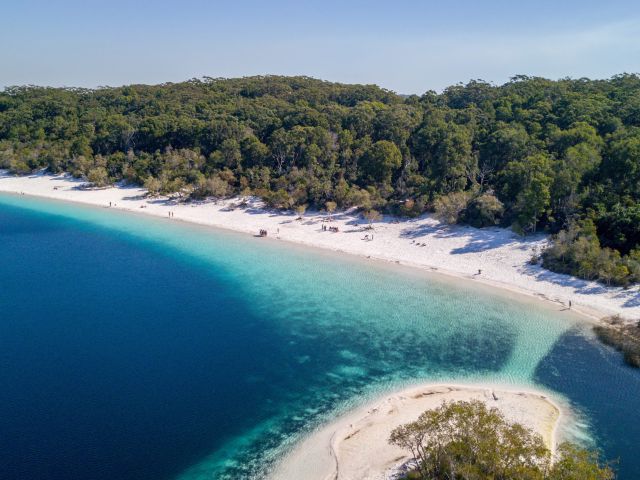
Laying eyes on it for the first time, I’m finally able to confirm that the photos don’t lie. The sand is pure white, without the merest hint of yellow. The water fades from a light halo of aqua around the edges to a deeper, royal blue, the deeper it gets (not that it’s particularly deep, six metres at most). The surface remains surprisingly undisturbed, like a mirror.
Arriving with our guide before 10 am means that no one else is around when we get here. Which means we have the pleasure of breaking the smooth surface with our own ripples as we enter. As a self-confessed wimp with chilly water temperatures, my fears are quickly assuaged. Even in the morning, the water stays around 23 degrees – perfect for lazing about all day. But we have more sights to see.
Exploring K’gari
Relax in the warm waters of Lake McKenzie. (Image: Ayeisha Sheldon)
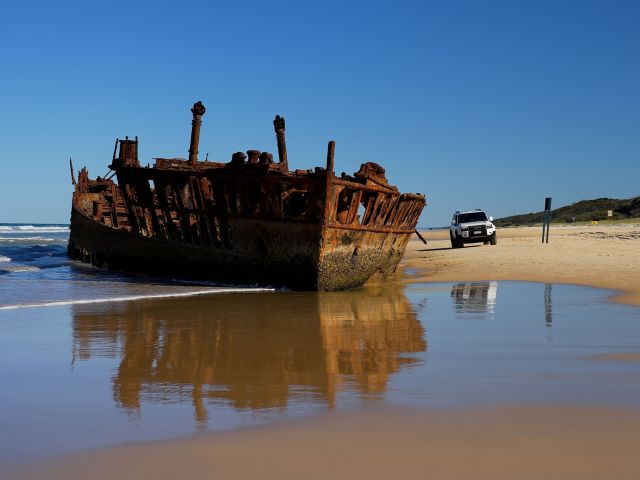
This was the Personalised 4WD tour offered by Kingfisher Bay Resort, and my absolute top pick of experiences. Over the course of the day, we had the freedom to create our own bespoke itinerary (plus a provided picnic lunch along the way), with an expert guide who had plenty of stories and local expertise to give context to what we were looking at. From the history of the SS Maheno shipwreck, which survived the First World War only to be washed ashore by a cyclone in 1935, to a detailed description of how an island made of sand could sustain such diverse flora.
If it’s your first time to K’gari, the Beauty Spots Tour is another great option. Departing daily from Kingfisher Bay Resort (you’ll start to notice a trend, as many of the tours do start and end here), an air-conditioned, 4WD bus takes guests to the island’s most iconic locations, including the best places to swim, like Lake McKenzie and Eli Creek. The latter offers a gentle current, perfect for riding with a blow-up tyre out towards the ocean.
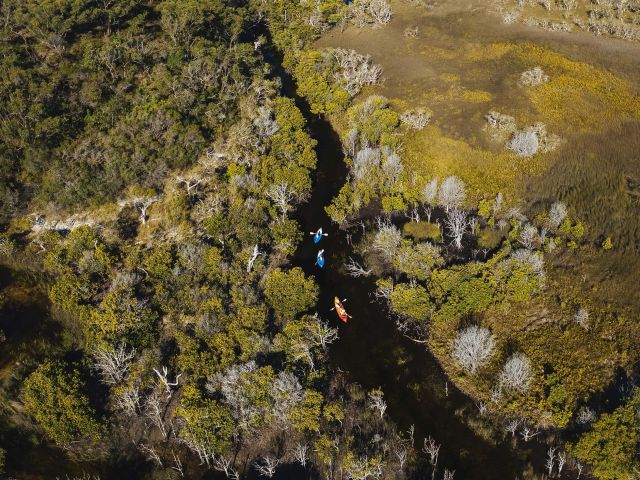
The next day, for a look at a completely different side of K’gari, I joined one of Kingfisher Bay Resort’s Immersive Ranger-guided tours to kayak through the mangroves of Dundonga Creek. This long, snake-like stretch of creek winds its way inland from the ocean outlet we entered by, at times too narrow for three kayaks to be side-by-side. Small insects buzz from leaf to leaf, while birds call overhead. Occasional bubbles indicate we’ve passed some fish that call this place home.
Learn about the island’s mangroves from your Ranger. (Image: Reuben Nutt/ TEQ)
If kayaking isn’t for you – or if, like me, you simply want more – other ranger-led experiences include nature walks and a dedicated Junior Eco Ranger Program for kids ages five to 12 (these run every weekend, and daily over the peak December holidays). Just ask for a timetable of upcoming tours when you check in.
While during whale season, Hervey Bay Whale Watch & Charters operates tours from the hotel’s jetty to get up close to the famous Humpback Highway of Hervey Bay, from 7 November to 31 May, attention turns to the Aqua Oasis Cruise . Departing from the resort every Tuesday, Thursday, Saturday and Sunday for resort guests, adventure along the island’s remote western coast, pointing out wildlife like dolphins, turtles, flying fish and eagles along the way.
The cruise drops anchor so guests can jump into the water using the boat’s equipment – from SUP boards to inflatable slides and jumping platforms. Then refuel with a provided lunch, of course.
Unwind at sunset
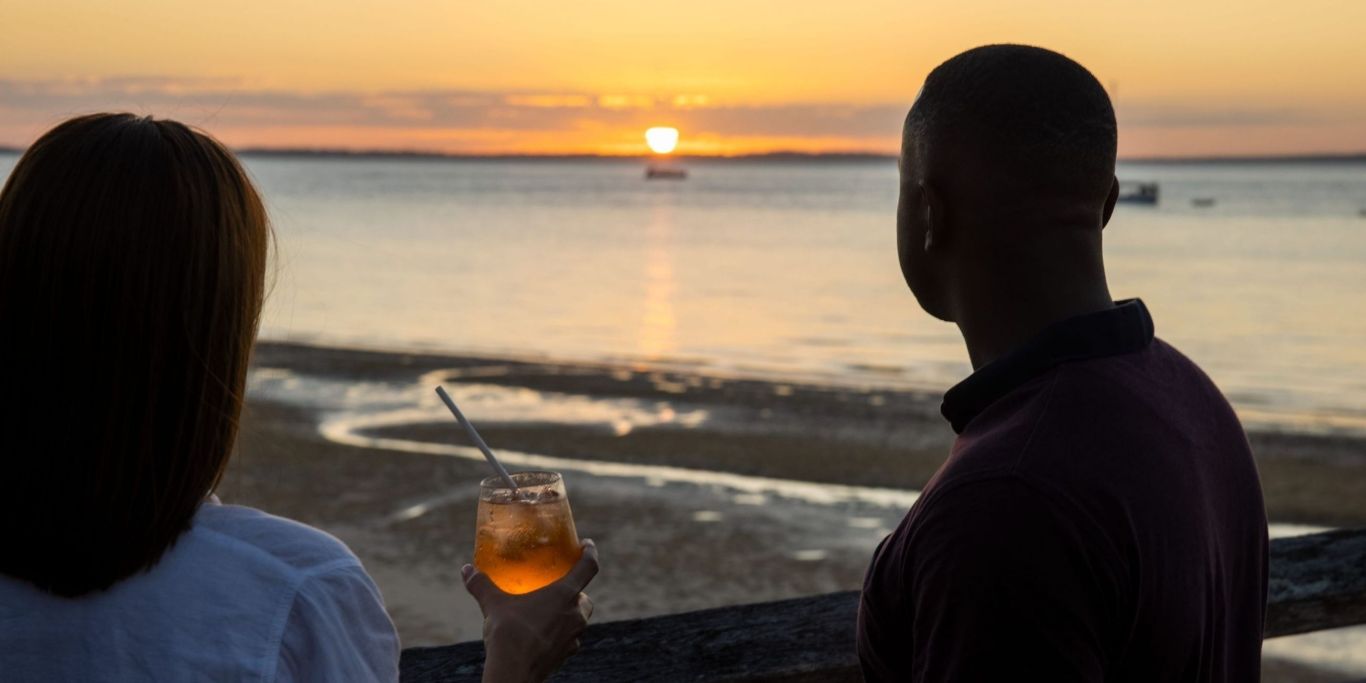
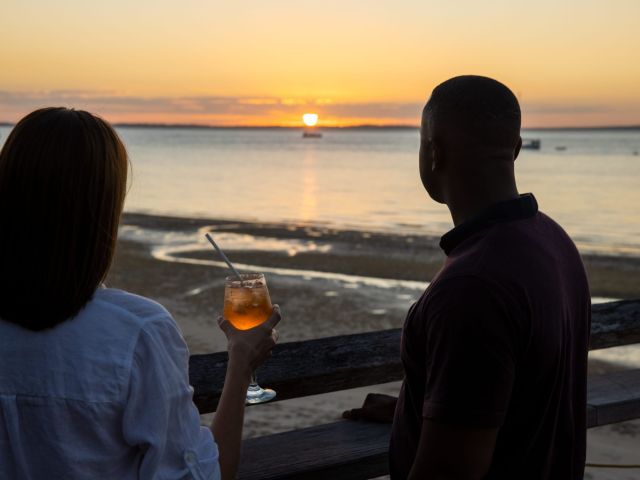
Unwind at the Sunset Bar. (Image: Sean Scott)
As much as days on K’gari can be filled with adventure, to me, the afternoons and evenings there are for unwinding. Sunsets on K’gari are absolutely unbelievable, with Kingfisher Bay on the west side being the best spot to catch the colours.
The Sunset Bar , located at the start of the resort’s jetty and overlooking the beach, is the ultimate location for sundowners. Let chill beats wash over you as you sip on cool wines, beers and cocktails in a relaxed, friendly vibe. Personally, a cheese board was also absolutely called for. As the sun sinks, the sand, sea and horizon turn a vibrant shade of orange, with the jetty casting a dramatic shadow across the water.
When the show is over, head back to the hotel for dinner at the Asian-fusion Dune restaurant, or the pub-style Sand + Wood. But if your appetite is still whetted for more lights and colours, the evening isn’t over yet.
Settle into the Illumina stage for Return to Sky, an immersive light and sound show leading viewers on a captivating journey through K’gari’s stories and landscapes.
Indulge and disconnect
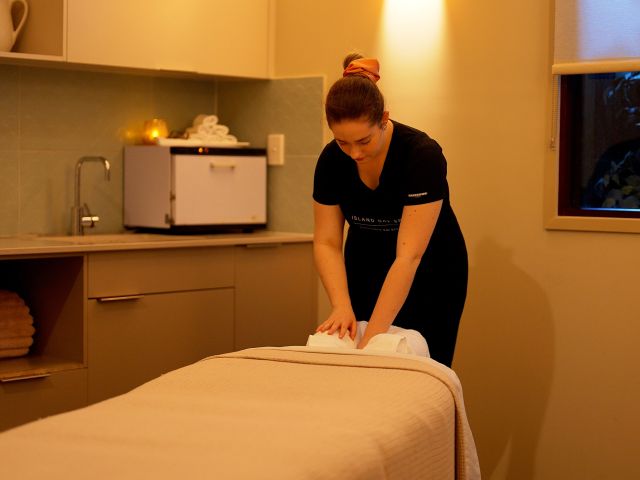
Find bliss at Island Day Spa. (Image: Jessica Miocevich)
Of course, there is a type of traveller who knows that balance is important, day or night. While Kingfisher Bay Resort offers more than one pool for guests to spend all day lounging by (they’ll even serve you food and drinks while you do it), you’ll find me at the Island Day Spa.
The masseuses could match the magic hands of any big city spa, and I felt the warm welcome as I walked into the light, breezy reception. Choose from a range of botanical facials, beauty treatments and soothing massages using traditional techniques (obviously, I couldn’t go past a relaxing massage). All products used contain organic, native botanical ingredients with nutrient-rich plant extracts to soothe skin and mind. To really indulge, try out one of the packages, couples treatment or even a pre-wedding day offering.
Getting there
The world of K’gari awaits. (Image: Jessica Miocevich)
Getting to K’gari is shockingly easy. Find daily flights into Hervey Bay from Brisbane, Melbourne and Sydney. Kingfisher Bay Resort offers a shuttle bus between the airport, their headquarters in Hervey Bay and the ferry to take you to K’gari.