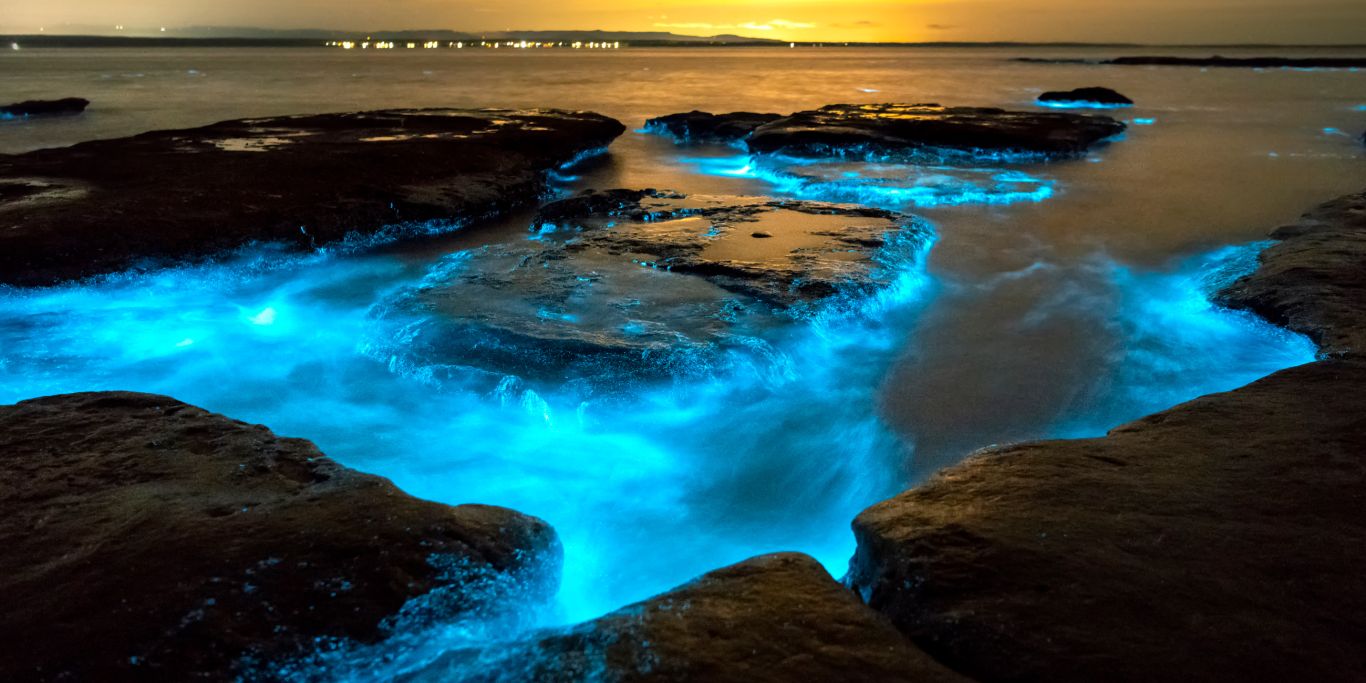

A dazzling underwater world reveals itself after dark – and we know where to find it.
There are chemical reactions that bake your bread, rust your bike, and turn your water from still to sparkling. But perhaps one of the most magical chemical reactions on Planet Earth is that which lights up living things from the inside out: bioluminescence.
What is bioluminescence caused by?
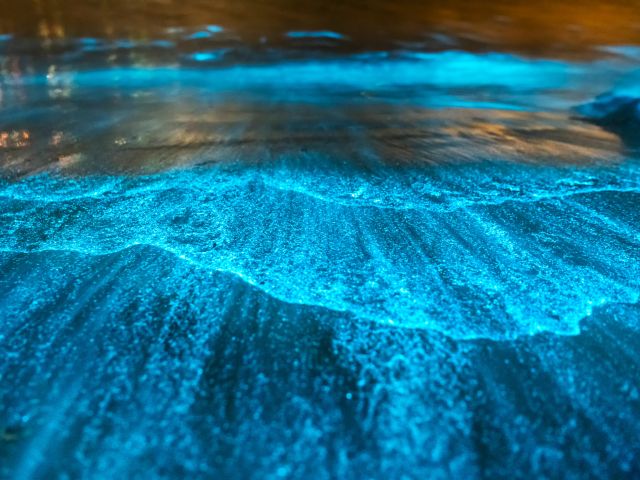
Bioluminescence is a primarily marine phenomenon, occurring in certain types of fish, plankton, jellyfish and other deep-sea invertebrates. It can take place on land, but this is much rarer, with fireflies, foxfire mushrooms and glow worms being amongst the most famous examples. In order to be bioluminescent, all these species share an important chemical duo: the molecule luciferin and the enzyme luciferase. When luciferin reacts with oxygen, catalysed by the luciferase as a spark might ignite a match, the reaction releases energy in the form of cold light from inside the organism. The colour of this light depends on the arrangement of luciferin molecules, although the colour you can most expect to see is a bright, brilliant blue.
Where in Australia can you see bioluminescence?
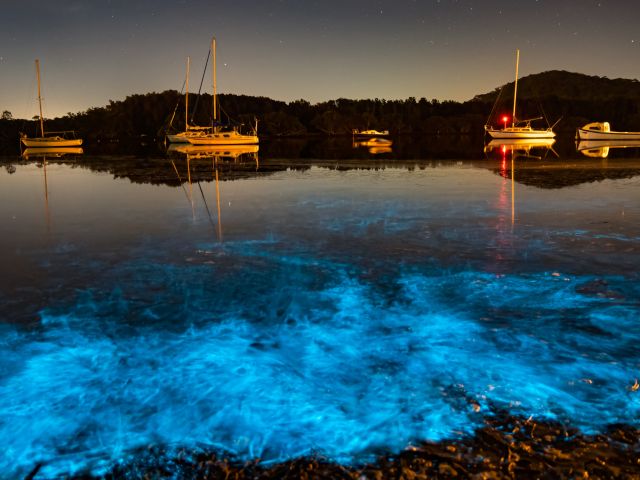
Thanks to nutrient-rich currents and greedy plankton, this sparkly show tends to hug the country’s south-eastern states, making Tasmania, Victoria and New South Wales the leading hotspots for seeing bioluminescence in Australia. Sightings in South Australia and Western Australia aren’t impossible (Port Lincoln on the Eyre Peninsula and Marina Mindarie near Perth have had documented flares), but it’s far, far rarer. Meanwhile, instead of glowing waves, the Northern Territory and Queensland are two of your best bets for spotting fireflies. Taking previous displays and recent sightings of bioluminescence into account, here’s a run-down of where to try first…
Tasmania
Noctiluca scintillans – an algae species that shows up red in daylight but transforms into a glittering blue after dark – seem especially fond of Australia’s island state. Best of all, you really don’t have to go far from Hobart to catch a glimpse. Seven Mile Beach, Montagu Bay, Howrah Beach and Ralphs Bay have all lit up on calm summer nights. Meanwhile, just off the eastern coast of Bruny Island, Storm Bay has even had recent sightings of the dazzling moon jellyfish. On the state’s eastern edge, brilliant pictures of both the red and blue blooms have been taken around Eaglehawk Neck, Pirates Bay and Port Arthur. If you’d rather be taken to the action, Tassie local and bioluminescent expert Dr Lisa Gershwin – who holds a literal PHD in ‘Jellyfish’ – runs a guided Glow Tour from Hobart , with dates throughout the year.
Need tips, more detail or itinerary ideas tailored to you? Ask AT.
AI Prompt
Victoria
A four-hour drive from Melbourne, the Gippsland Lakes region is a reliable spot for our electric-blue Noctiluca scintillans, particularly around the Lakes National Park. That said, inner-city spots like St Kilda and Port Melbourne have been seeing increasing flares of bioluminescence in Port Phillip Bay, making the glow surprisingly accessible without leaving the city. See also: the Mornington Peninsula, spots along the Surf Coast (particularly around Lorne and Wye River) and the Otways, whose dark, damp forests make them prime catch for glow worms, too.
New South Wales
New South Wales is home to perhaps Australia’s most famous bioluminescence hotspot: Jervis Bay, an almost three-hour drive south from Sydney. A perfect cocktail of shallow waters, sheltered beaches, minimal light pollution and an abundance of microscopic algae makes it a bio-spotter’s best chance at seeing the phenomenon up close. From Jervis Bay, the Noctiluca scintillans can appear all along the coast as far north as Lake Macquarie, propelling spots around Palm Beach and Wollongong into the spotlight. Closer to Sydney, Manly Beach and Shelley Beach are becoming increasingly blue come nightfall.
And if you want to get really serious, there’s a Bioluminescence Australia Facebook group you can join for live updates of activity around the country.
What time of year can I see bioluminescence in Australia?
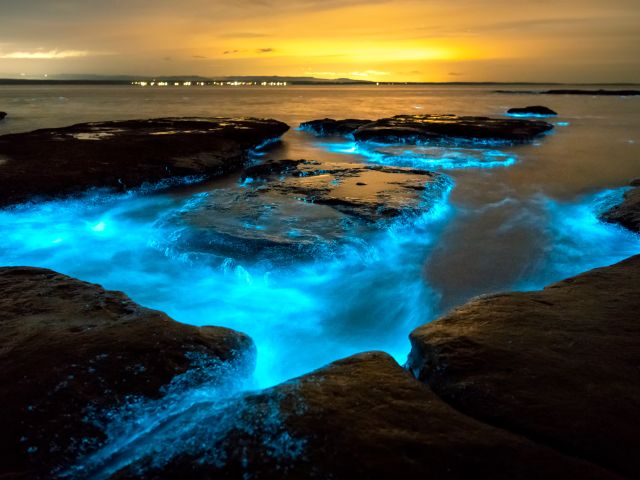
While the phenomena can strike at any time of year, warm water makes for the best bioluminescent bedfellow, since heat stimulates the growth, reproduction and activity of our glow-in-the-dark microorganisms. In Australia, this means the late summer months heading into autumn (February to April) generally produce more frequent sightings. For ultimate sparkle-spotting conditions, bioluminescence is more active after a period of rainfall (rain washes nutrients from the land into the water, helping to trigger algae blooms), and is best viewed on a moonless light, with minimal light pollution.
Is it safe to touch bioluminescent water?
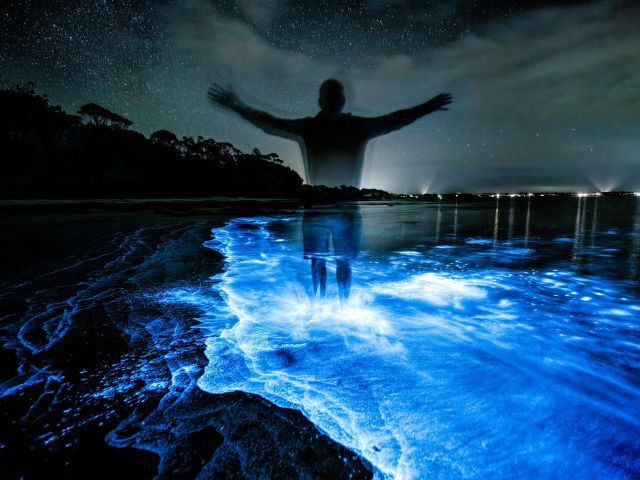
On the whole, it’s not recommended – bioluminescent organisms and the ecosystems they inhabit tend to be extremely delicate and vulnerable. Plus, by touching bioluminescent organisms in order to encourage the light, you are by default having to stress and disturb them – akin to poking a lion to make it roar. Some species are even toxic, and can cause skin irritation. Having said this, many glow-in-the-dark tours around the world do permit gentle touching, so long as no sunscreen, lotions or perfume is worn. Many will see you glide through bioluminescent waters on kayaks. The best advice? Exercise your own judgement and practice responsible tourism.