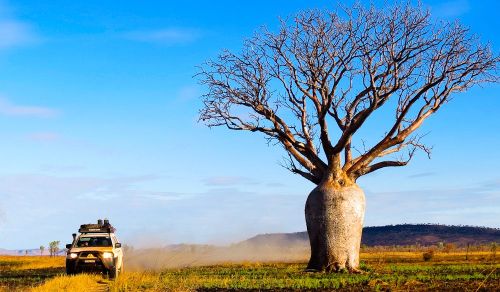
Dreaming about driving off into the sunset and doing a big lap of Australia?
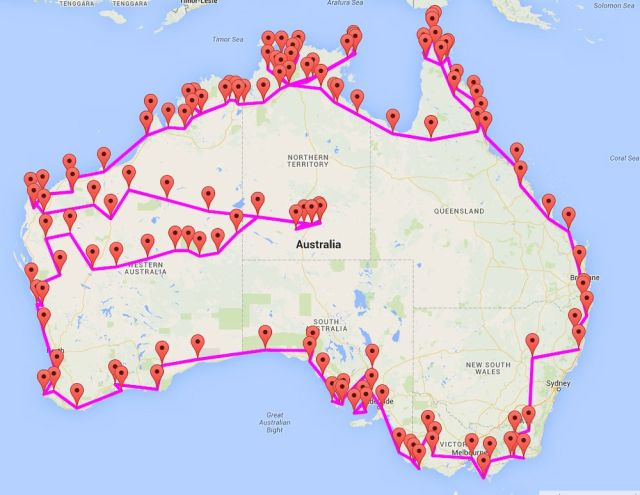
Travel writer and photographer Lee Atkinson has just returned from an epic 10-month, 40,000km road trip around the country, and written a book about it (see below). Here are her top 12 road trip travel hacks you need to know before you hit the road.
1. What to drive
You don’t need a 4WD to drive around Australia, but you do need low range gearing to reach some of the most beautiful bits, because the really wild, wondrous places are almost always in out of the way places. If you are towing a van or camper trailer opt for a turbodiesel, because this type of engine works more efficiently than a petrol for towing and diesel is more readily available in remote areas. And go for an automatic, because autos allow you to just stick it in drive and concentrate on other things.

2. To tow or not to tow?
The number one mistake most people make when choosing whether to buy a caravan, motorhome or camper trailer is to think in terms of what it will be like to live in, rather than where they can take it. If you’re planning to spend most of your time on main roads and want to stay in towns or caravan parks, a caravan or motorhome is a great option. But if your idea of a good time is taking the roads less travelled and getting out into national parks and wild places a camper trailer or a roof-top tent is a better choice. Bigger is not always better. There’s an exponential relationship between the size of your caravan or trailer and the extent to which you can get off the beaten track.
3. Before you go…
If you’ve never been outback or off-road before sign up for a 4WD training course. It will teach you how to use the vehicle to its full potential, how to get yourself out of tight spots and, most importantly, how to use recovery gear. Google ‘4WD driver training’. Same goes for towing: not only do you get plenty of time, and traffic-free space, to learn how to manoeuvre and reverse park your vehicle with a caravan or trailer in tow, you’ll also pick up lots of technical and safety information and handy tips. Tow-ed operates courses in most capital cities and regional centres and will lend you a van if you want to learn before you buy.

4. What tools do you need?
A basic tool kit should include a jack, jacking plate and wheel replacement tools, spare tyre, fire extinguisher, emergency fuel supplies (if heading off the beaten track), engine oil, coolant, jumper leads and spare radiator hoses and fan belts and the tools you’ll need to replace them – check out YouTube for DIY tips and bush mechanic lessons. Don’t even think about leaving home without ultimate get-out-of-jail repair kit: cable ties, gaffa tape and fencing wire – with these you can fix just about anything.
Need tips, more detail or itinerary ideas tailored to you? Ask AT.
AI Prompt
5. Getting out of trouble
Getting stuck is inevitable when you’re travelling off the beaten track. You can spend a fortune on fancy recovery gear but there are five things you really can’t do without: we took a pair of Maxx Trax ramps, which you put under the wheels when you’re bogged in sand or mud. They give the tyres something to grip and, as a rule, will launch you out of trouble easily. We also had a long-handled shovel for digging and a snatch strap for those moments when all else failed – all we needed then was somebody else to come along to pull us out, but it was never used. The best way to not get bogged in the first place is to drop tyre pressures to 20psi or less, so we also carried a quality air compressor and an accurate pressure gauge.
6. Essential kit
Never travel without a first aid kit and always carry extra drinking water. Mobile phone coverage can be non-existent in the outback. Hire (or buy) a satellite phone so you can call for help if needed. Some tourist information centres in remote areas have sat phones you can hire, or visit Satellite Hire or Rent a Sat Phone.
7. Map it out
Fighting over which is the right way to go is a major cause of holiday (and marital) breakdown. Don’t rely on the mapping app on your phone – invest in a good GPS. We used Hema Navigator, which features off-road tracks as well as major highways.
8. Keep in touch
These days you can get most of your bills, banks statements etc electronically, which means you can keep the home fires burning relatively easily. Skype is the best thing ever for keeping in touch with friends and family for next to nix. We carried laptops and a 4G mobile wi-fi modem which connects up to 10 devices. Telstra’s the only network that consistently works outside of capital cities.
9. Where to go when
Clockwise or anti-clockwise, that’s the million-dollar question when you’re about to head off on the Big Lap. Whether you turn left or right out of your driveway depends on when you go – if it’s summer, head south, if it’s winter, head north or aim for the red centre. The wet season, which cuts roads and closes national parks anywhere north of the Tropic of Capricorn, can be anytime from November through to May, although it (usually) really only starts to rain in mid to late December and can be all over by April.

Weekly travel news, experiences
insider tips, offers, and more.
10. How long will it take?
How long have you got? Know that however long you go for, it won’t be enough – Australia’s a big place and you could spend a lifetime and still not see it all. On the other hand, you’d be amazed at how far you can go in just four weeks. We spent 42 weeks on the road, and didn’t go where most do go, but did go where many people don’t.
11. How much will it cost?
Everyone’s trip is different, depending on what you drive, where you go, where you stay and what you eat and drink. We were in a 4WD and towing an off-road camper trailer. In terms of day-to-day expenses we averaged just under $150 a day, including fuel, camping fees and the occasional night in a pub if the weather was foul, food and alcohol – we probably could have got that down a little if my partner was a better fisherman, and if I’d chosen cheaper wine, but hey, life’s too short!
12. Can I take my dog?
Many caravan parks will accept well-behaved pets on a leash, but always check before you book rather than on arrival. Pets are not allowed in national parks, even for day visits or picnics. If you want to bush camp with pets, choose state forests instead.
You can read all about Lee’s epic road trip in her book, The Big Lap.

The Big Lap by Lee Atkinson.
“We took the road less travelled whenever we could, camping in national parks and other wild places where few other travellers go," says Atkinson. “We found some truly amazing places and saw some fantastic things, and this book is the result, a showcase of some of the most scenic spots in Australia." Featuring hundreds of beautiful images, the book is the pictorial diary of her journey with detailed captions telling the stories behind the images. The Big Lap costs $35, (including postage), from ozyroadtripper.com.au
Want to see more stories from Australian Traveller in your Google search results?
- Click here to set Australian Traveller as a preferred source.
- Tick the box next to "Australian Traveller". That's it.

Editor
View profile and articles