Never has gut instinct played such a literal role when it comes to our travel choices, but growing interest in gut health is leading to more Australians making travel choices with their wellbeing in mind. Jennifer Ennion joins a fermentation workshop to find out what it’s all about.
“This is not rotten food," assures Cornersmith Picklery teacher Jaimee Edwards. Laughter erupts in the tiny store in Sydney’s Marrickville.
“When food perishes, it’s the breakdown of protein," Jaimee continues. “When food is fermented, it’s the breakdown of carbohydrates."
It’s a small but important difference and the roomful of beginner fermenters takes note. Most of us have travelled here to learn about gut health and how we can manage our own. I’ve been wanting to learn how to make fermented foods for years and the growing gut-health catchcry from nutritionists has spurred my interest. My biggest concern, however, is knowing when not to eat something. Jaimee assures me that making fermented food at home is safe. She simplifies the process: “It’s the yeast and bacteria on the surface of our produce [that, when] deprived of oxygen, turn the carbohydrates of the produce into lactic acid and the lactobacillus that we want."
It’s this lactic acid that preserves food and makes it safe for consumption. It’s basic enough, until I learn that all the food we jar today will ferment on our watches. I snap into student mode.
The fermentation process
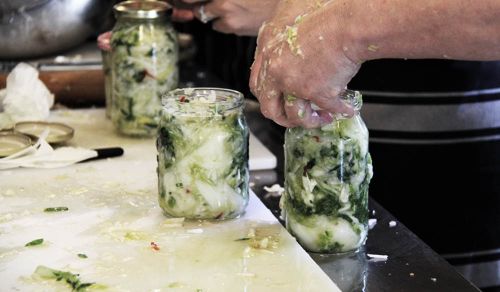
We start with likely the most well-known of fermented foods – sauerkraut. It’s surprisingly simple: four kilograms of green cabbage, finely shredded, with two tablespoons of salt, plus seasoning. I opt for the classic Eastern European additions of caraway and juniper. We bash the cabbage with the end of a rolling pin until we can squeeze water out of it, add the seasoning and pack it tightly into a jar, ensuring we leave a layer of brine on top. It’s a lot of fun and we sip on a fermented tonic and chit-chat as we label our batches.
Next is kimchi, a Korean staple. Again, it’s easy but this time we use daikon (a winter radish), wombok (a Chinese cabbage), leek, ginger and garlic. We also add a touch of salt, sugar and chilli. It’s messy business as we pound, crush and stuff the vegetables. By now, chopping boards are covered with juice and vegies off-cuts. The picklery is buzzing with talk and laughter, and I can see the workshop is just as much about a great morning out as it is about learning a new culinary skill. It’s also about putting in place some long-lasting habits to improve our health, as opposed to adopting a green-smoothie-like fad.
“I want to avoid fermented foods going down that path," says Jaimee. “There is no one thing that you can consume, and it’s certainly not kombucha, that is going to deliver you optimum health," she says.
It’s this desire to improve our health that has seen fermentation workshops bloom across the country. Food continues to play a big role in our travel choices and, just as many of us travel to explore food markets and eat at award-winning restaurants, we’re also now holidaying for our health.
Need tips, more detail or itinerary ideas tailored to you? Ask AT.
AI Prompt
What’s the attraction of a fermentation workshop?
There is a mix of men and women attending Cornersmith’s two-and-a-half-hour Fermenting Vegetables workshop and an array of ages. I join a trio of women in their early fifties, one of whom has travelled from the New South Wales South Coast. The ladies met at university 30-odd years earlier and are starting a new tradition of catching up during culinary classes. So far, they’ve ticked off three. Chris Anthony, 34, from Sydney is attending solo and rounds out our group. He’s signed up because he is tired of seeing cabbage “left looking sad at the back of the fridge" after his regular vegie delivery.
“I’m trying to be healthy and not to be wasteful," he says, as we start making brines.
Although Jaimee may have discovered fermentation a decade ago, thanks to her Russian heritage, she says more people are spending their leisure time learning about the benefits – and travelling to do so. The frequently sold-out fermentation class is the second most popular at Cornersmith, after “preserving for the season", and there has been strong growth over the four years the picklery has been running. Most attendees are Sydneysiders but many are visiting from Newcastle and the Blue Mountains and making a weekend of it.
The class I’m attending goes all too quickly, but I leave smiling, a jar of fermented green tomatoes in my hands. I’m inspired to continue my journey with fermentation, and the feeling doesn’t dissipate weeks later, as my tomatoes thrive in their little jar taking pride of place in my kitchen.
5 places to try fermentation workshop
– The Fermentary , in Victoria, is the place to go to make kvass (a fermented drink), learn about SCOBYs and try pickling.
– Green Living Australia runs half-day workshops in Queensland that focus on vegetables, kimchi, kefir and yoghurt.
– Buchi Kombucha , also in Queensland, doesn’t just centre on making the popular drink, but also offers workshops on cultured desserts, kimchi and miso.
– Foley’s Frothing Fermentations, in WA, offers a beginner’s guide to fermenting vegetables at home.
– Get Fermented is for people living in and travelling to the tropics, with classes about water and milk kefir, in the Northern Territory.
Fermenting: the facts you need to know
1. Put the fermenting food in a spot you’ll remember out of direct sunlight, not forgotten in the pantry
2. Summer ferments will happen much faster than in winter
3. If attending a workshop, take extra glass jars
4. To avoid air pockets in jars, slide a knife down the inside edge of the jar
5. Check your ferments every couple of days
6. The higher the sugar content in produce, the faster it ferments
7. The fridge slows the fermenting process down but doesn’t stop it
Weekly travel news, experiences
insider tips, offers, and more.