hero media

How to survive a group trip wage gap

Travelling with a group of people who all make vastly different amounts of money? This is how to stay friends afterwards.

A strange thing happens when you’re lucky enough to have good friends who have been in your life for decades. When you met, in my case in high school – and for many others in university – there was no group trip wage gap because none of you had any money. You’re all squeezing in shifts at a cafe, dodgy clothing store or underground bar between exams just to afford a tiny bedroom in a sharehouse that smells and looks like mould.

At this stage of life, if you plan a holiday, everyone is on the same page: the cheapest hostel bed possible, and obviously, we load up on the free continental breakfast before sneaking some more out in napkins so we can have it for lunch as well.

four friends with arms around each other at a lookout
Budgets change in long friendships. (Image: Helena Lopes)

But now, decades later, we don’t have jobs, we have professions. And like any good rom-com featuring a group of friends, those professions are vastly different: from travel journalist to archaeologist to lawyer to digital commerce. That also means the salary glass ceiling is vastly different, sometimes by as much as $100k or more.

This is an issue that is so delicate in some circles that it can literally end friendships, especially when planning a holiday. Happily, it’s something my friends and I are able to navigate really well, so I thought I’d share our top learnings.

1. Everyone is different, and that’s ok

Money has absolutely nothing to do with personality. It’s not an indication of how hard anyone works, or how smart anyone is, or anything else. In fact, all my friends are hard workers who have hustled in their industries to gain success. But the bottom line is that different industries simply have more or less money to play with.

Society has weird hangups around money, and a shame around not being able to afford something, but that’s silly. Whether you’re the group’s high-earner or low-earner, forget the shame and comparison before you even think about planning a group trip.
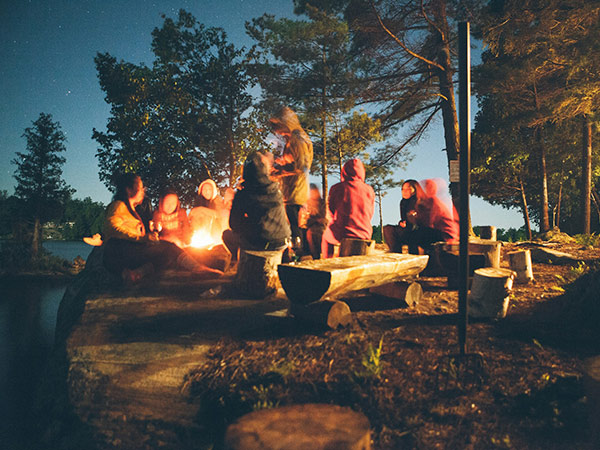
group of friends around a campfire at night
People are one fo two types: campers, and not campers. (Image: Tegan Mierle)

Need tips, more detail or itinerary ideas tailored to you? Ask AT.

AI Prompt

2. Set budgets before you go, and share them

Now that you’ve done step one, work out your budget. Once you have, share it with the group before any planning happens. And don’t assume anyone else’s budget, you may not know what other savings goals or payments their salary is being allocated to besides travel.

Aerial view of yellow kayaks in blue sea at sunset in summer
Set your budget and expectations, then stick to them. (Image: Getty/ Den Belitsky)

3. Decide the aim of the trip

This might sound silly, but a group trip can be about many things. Maybe it’s a group reunion or quality time to make new memories with old friends. Or maybe it’s a bucket list trip you’ve all been talking about for years. These trips are going to have vastly different outcomes in how they’re put together.

If the point is simply to spend time together, book a holiday rental that everyone can afford to split, and cook your meals at home. Throw in a few board games and a good hike or beach trip, and you’re sorted.

However, if it’s a bucket list trip, then it gets a bit more complicated.
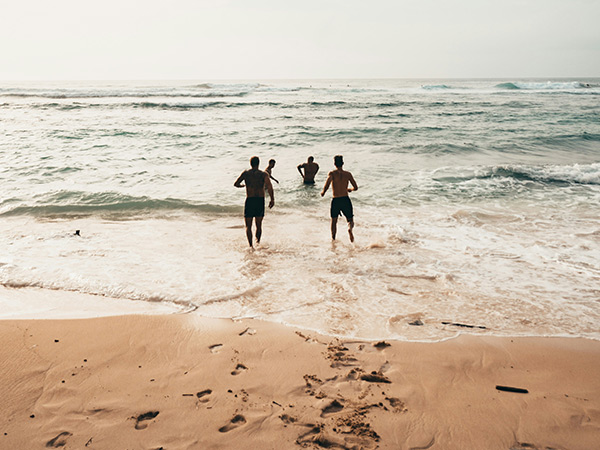
a group of people running into the ocean from a beach
The beach is free. (Image: Oliver Sjostrom)

4. Be prepared to split up

Whether there’s a wage gap in the group or not, this is my number one group travel rule. Everyone places importance on different aspects of travel. Some would spend their final pennies on an incredible meal, while others would eat buttered bread just to afford a high-end experience of their dreams. Add children to the mix, and it all gets even more complicated.

Talk about this before you go, share your non-negotiables, and be ready to plan that time apart as well as when you’ll all come back together to share your experiences. If this is a bucket list trip, everyone deserves to do it their way. And if your non-negotiables happen to overlap, even better.
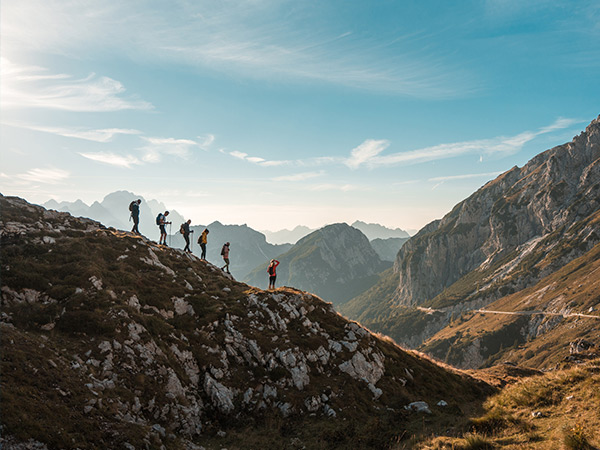
With backpacks and hiking poles, diverse friends trek together on a sunny day
Hiking isn’t for everyone. (Image: Getty/ Azman L)

Weekly travel news, experiences
insider tips, offers, and more.

5. Use a money tracking app

Even friends with the best intentions sometimes forget how much they owe someone. Save yourself the stress and make everyone download an app like Splitwise . If you put everything in there, the app will do the hard work for you at the end of the trip, and let you know who owes what.

a group of people sitting around a table with food
Whether it’s groceries or fine dining, keep track in an app. (Image: Spencer Davis)

6. Get the money up front

coffee and breakfast at Greenhouse on Flora, Sydney
Be kind, pay your share and help organise. (Image: Greenhouse on Flora)

Having said that, big purchases that are made ahead of time, like accommodation or that splurge dinner on your final night, make everyone transfer their portion of the payment to the booker before it’s booked.

And, for goodness’ sake, be kind and don’t leave all the hard work to the organised friend. Everyone is going on the trip, so everyone should help plan and book.


Group trips can be rowdy. Here’s how to keep everyone in check and get the most from you hotel staff.

Kassia Byrnes
Kassia Byrnes is the Native Content Editor for Australian Traveller and International Traveller. She's come a long way since writing in her diary about family trips to Grandma's. After graduating a BA of Communication from University of Technology Sydney, she has been writing about her travels (and more) professionally for over 10 years for titles like AWOL, News.com.au, Pedestrian.TV, Body + Soul and Punkee. She's addicted to travel but has a terrible sense of direction, so you can usually find her getting lost somewhere new around the world. Luckily, she loves to explore and have new adventures – whether that’s exploring the backstreets, bungee jumping off a bridge or hiking for days. You can follow her adventures on Instagram @probably_kassia.
View profile and articles
hero media

Discovering East Arnhem: Australia’s most unique and rewarding corner

    Joanne Millares Joanne Millares

    Hard to reach and harder to forget, East Arnhem offers something rare in modern travel: the chance to slow down and experience Country on its own terms.

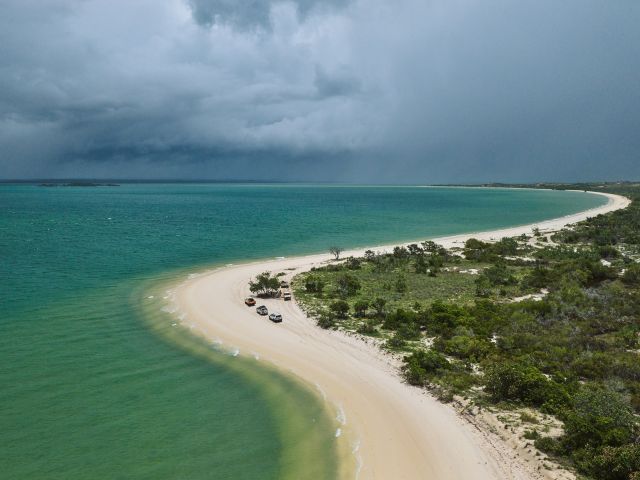
    The sky feels bigger in East Arnhem . It stretches wide and uninterrupted above rouged earth, stringybark woodland and beaches so empty they seem to belong to another era. The coastline curves for kilometres without a footprint and the horizon runs on forever.

    For comedian Lou Wall, the scale of the place was the first thing that hit them.

    “The sheer openness,” they say. “The sky feels infinite and the land stretches out endlessly. It’s pretty breathtaking visually.”

    But the physical landscape is only part of the story. The real reward isn’t only the scenery but the shift in perspective the journey brings. Visitors stop trying to tick off the destination and a real engagement takes over.

    “It made me never want to travel again,” Wall jokes. “In that I never wanted to leave East Arnhem.”

    Getting there

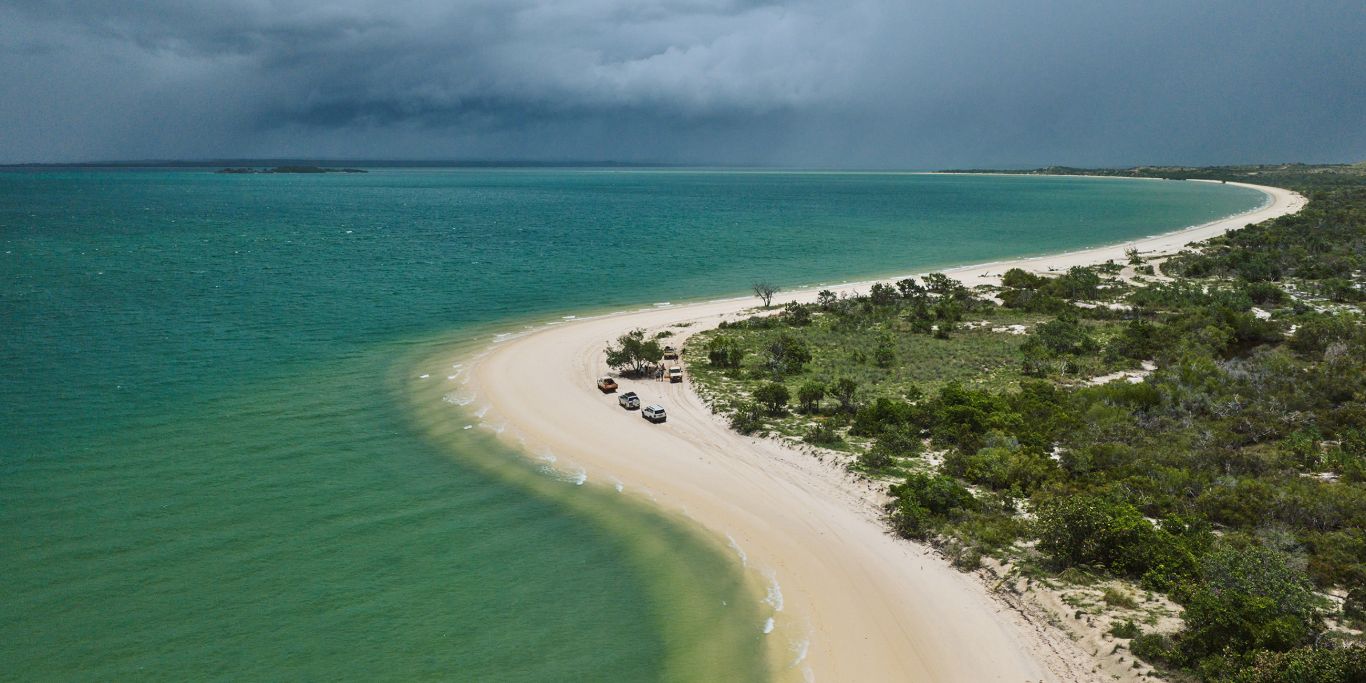
    Aerial shot of East Arnhem’s coastline as cars trace the curve of the shore.
    Sail along the remote coastline on an expedition cruise.

    Reaching East Arnhem is part of the adventure. Travellers typically fly into Gove Airport near Nhulunbuy via Darwin or Cairns, or arrive by expedition cruise along the remote coastline. Others make the journey overland along rutted dirt roads that cut through East Arnhem’s small pockets of monsoon forest.

    However you arrive, there’s a distinct feeling of crossing into somewhere different. Permits are required to visit the region, reflecting the fact that this is Yolŋu land where communities and traditional owners maintain deep cultural connections to Country.

    The extra planning becomes part of the experience. By the time visitors arrive, they understand they’re entering a place not just of respect, but also patience and curiosity.

    At one with nature

    East Arnhem’s  landscapes leave a strong imprint. For Wall, one place in particular still lingers in their memory: Ngalarrkpuy , also known as Lonely Beach, near Bawaka Homeland.

    “I genuinely felt like I was living inside an Instagram filter,” they say. “One of the most stunning feats of nature I’ve ever seen. The water was so clear I swear I could see even the fish smiling.”

    Across the region, natural experiences unfold at a slower pace. Fishing, beachcombing and island hopping reveal the rhythm of the coastline. The tides shape daily life and the vastness of the landscape makes even simple moments feel downright cinematic.

    For visitors with limited time, Wall says the Bawaka Homeland experience is unmissable.

    “I just left and I’m already planning when I can get back there.”

    The sense of remoteness is part of the appeal. In a country where many beaches are crowded and well-trodden, East Arnhem’s coastline still feels wonderfully wild.

    Immersing in local culture

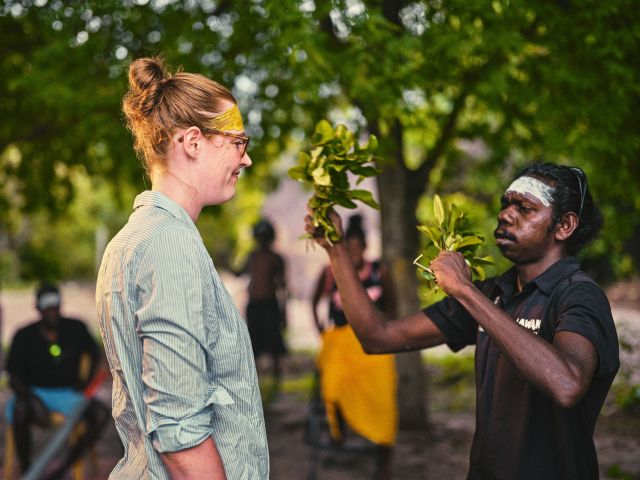
    A visitor spends a meaningful moment alongside Yolŋu guides, gaining insight into their deep cultural knowledge and connection to the land.
    Experience authentic moments with the locals.

    Culture is woven through every experience in East Arnhem. Visitors have the opportunity to spend time on Country with Yolŋu guides and knowledge holders who share stories and traditions that have been passed down for generations.

    For Wall, one of the most powerful moments came during a conversation with a Yolŋu elder.

    “I got to meet a traditional elder, Mayalil, in Nhulunbuy,” they say. “Listening to her talk about her home made the land feel alive in ways I couldn’t have imagined.”

    The region is also home to internationally recognised Aboriginal art centres where artists shape works deeply connected to land and family knowledge.

    Music carries the same cultural energy. East Arnhem has produced globally recognised artists such as King Stingray and Baker Boy, blending Yolŋu language, storytelling and contemporary sound.

    Wall experienced this musical spirit first-hand.

    “A jam session around the fire was it for me,” they say. “Letting the deep joy and history of their music wash over me…  and meeting a few of the King Stingray musicians was unreal.”

    These moments of human connection often become the most memorable part of a visit.

    Spotting local wildlife

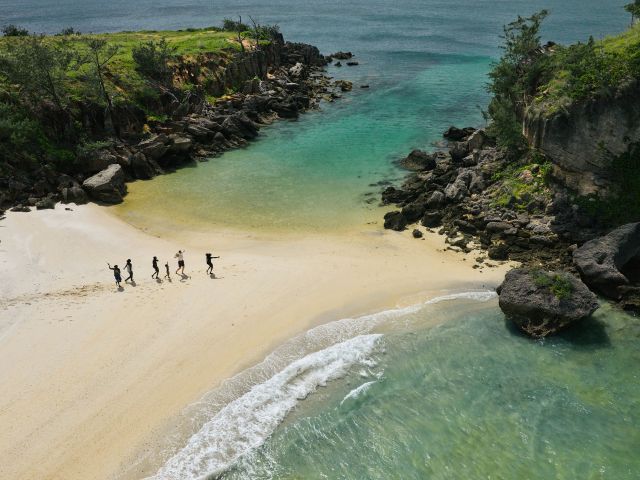
    An aerial view of the beach shows tiny figures lined up across the white sand, moving as if in a rhythmic dance.
    Step into a world where nature reigns.

    The wildlife of East Arnhem adds another layer to the experience. The region is home to an extraordinary range of animals, from waterbirds and turtles to dugongs, dolphins and the formidable saltwater crocodile.

    Wall admits they didn’t actually spot a croc during their visit.

    “Devastatingly, I didn’t see one,” they laugh. “But with all the stories from the locals I definitely gained a healthy respect for caution.”

    Some of the most memorable wildlife encounters can be surprisingly small., At Banubanu Beach Retreat on Bremer Island, Wall remembers walking along the beach one morning and watching it come alive.

    “As you walk through the sand you see hundreds of crabs scurrying into their holes as you pass by,” they say. “Such a small thing, but it was completely magical.”

    Moments like this reveal the quieter rhythms of East Arnhem, where even the smallest creatures seem to play a part in the landscape.

    Visitors who make the journey soon learn the most important travel tip of all.

    “Go in open-minded with a sense of curiosity,” Wall says. “Be prepared to ditch your plans. The land and the locals will guide you on an adventure no spreadsheets could ever compete with.”

    And most importantly, they add, don’t rush.

    “The land and people deserve your time and attention. You’ll be all the better for slowing down.”

    For more information on visiting East Arnhem, head to eastarnhem.com.au .