I am not the brightest of the three bears sometimes, but I think this is a new low for me.
Becoming a dad is a life-changing moment. The clue I seemed to have missed is life-changing. Not life-changing, except for holidays.
After our first family holiday I had a ‘what the hell did you expect’ moment. And so just in case anyone else missed the ‘kids change everything including holidays’ memo, here are some lessons.
Lesson 1: Age Matters
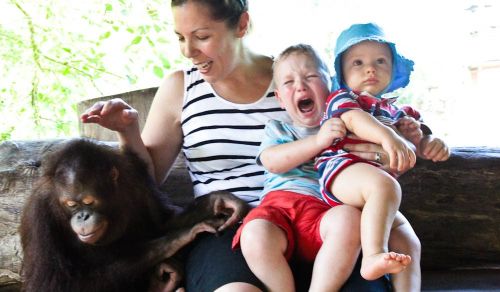
Two kids, aged two years and 10 months, are not at the ideal ages for a holiday. Life at this stage is a repetitious pattern of juggling two distinct feed-play-sleep cycles. Repeat it three to four times a day and break it up with a bath and that is your day.
Taking a holiday at this stage simply takes this mind-numbing and exhausting cycle to a new destination.
There is only a small window of opportunity – about one hour – when both kids are not sleeping or feeding or crying because they needed to sleep or be fed. This doesn’t lend itself to a day of sightseeing.
Worse, you make the process harder as all the tools, toys and facilities that make the cycle of sleep, eat and play easy are left at home so you are just trying to make do. Trying is the key word there.
So at this age, I wouldn’t bother with a big expensive holiday. The only caveat is if a nanny (AKA the Granny/Nanna/Grandma/Nona or whatever) is invited along to be the trusted babysitter.
But, as I found out, that doesn’t necessarily guarantee a restful holiday.
Need tips, more detail or itinerary ideas tailored to you? Ask AT.
AI Prompt
Lesson 2: Mum’s Headspace Matters
Yes, you can have the babysitter along for the ride, a fantastic holiday location, but if Mum can’t tear herself away from the bundles of joy for more than half a day, again maybe wait until the kids are older and Mum is ready to do things for herself.
Lesson 3: Rooms Can Become a Gaol
So if the child needs to sleep, then you can’t simply leave them and walk away. So the room can quickly become a gaol, where one parent is locked in watching a sleeping child while the other takes the non-sleeping child out for playtime.
Lesson 4: First-World problems are far better than Third-World ones for parents
Full declaration here is that we went to Bali. So I took a two-year-old and a 10-month-old to eat in Third World restaurants where Bali Belly is a real threat.
Add the Dengue Fever mosquitoes, rabid dogs and insanely tedious traffic and it’s not the most stress-less travel for protective parents.
The real conundrum is that families need holidays. The benefits, as I can certainly testify, are real and important. Mums get a rest and out of their Groundhog-Day life with loads more support from a present dad and maybe granny.
Dads get to spend real, extended quality time with the kids. And maybe, just maybe, Mum and Dad can have some quality time to remind themselves they are actually in a relationship with that strange person who seems to be in their house a lot. In fact, they are quite fond of them.
This did all happen for us, but it was not easy and certainly didn’t feel like a holiday but a strange week where we were together a lot, just in a different living room. Is that the way it is from now on? I hope not.
I hope in three years the family holiday will become a thing of greater joy, more quality time with the kids, where we create cherished family moments and less tedium.
But just in case can someone send me the memo?
Weekly travel news, experiences insider tips, offers, and more.
Quentin Long is the Co-Founder and Managing Director of Australian Traveller Media. Quentin is a sought-after travel media commentator. He is Australia’s most trusted source for travel news and insights, having held weekly radio segments across the country since 2006, and regularly appearing on Channel 9’s Today and A Current Affair programs from 2010. Don't ask him his favourite travel experience as that's like asking him to choose a favourite child. However he does say that Garma Festival is the one travel experience that changed him the most.
From coast to mountains, hiking in Gippsland offers a stunning array of landscapes, with trails that take you deep into the region’s heritage.
I step out onto the sand and it cries out underfoot. Kweek! I take another step and there’s another little yelp. Screet! Picking up the pace, the sounds follow me like my shadow, all the way down to the water. It’s obvious how this spot got its name – Squeaky Beach – from the rounded grains of quartz that make the distinctive sounds under pressure.
For many, Wilsons Promontory National Park is the gateway to Gippsland , and the best way to explore it is by walking its network of hiking trails, from coastal gems such as Squeaky Beach through to the bushland, among the wildlife. But it’s still just a taste of what you’ll find on foot in the region.
Venture a bit further into Gippsland and you’ll discover the lakes, the rainforest, and the alpine peaks, each changing with the season and offering summer strolls or winter walks. Just like that squeaky sand, each step along these trails has something to tell you: perhaps a story about an ancient spirit or a pioneering search for fortune.
The best coastal hikes in Gippsland
Wilsons Promontory National Park is a sprawling wilderness with many coastal bushland trails. (Image: Mark Watson)
Wilsons Promontory National Park (or ‘The Prom’, as you’ll end up calling it) is an easy three-hour drive from Melbourne, but you might ditch the car when you arrive, with much of the park’s 50,000 hectares accessible only by foot. From the inky water of Tidal River (dyed dark purple by abundant tea trees), I like the easy walks along the coast, among lichen-laden granite boulders, to golden beaches and bays.
Panoramic views from the summit of Mount Oberon. (Image: Everyday Nicky)
The trail to the panoramic views at the summit of Mount Oberon is a bit harder, up steep timber and granite steps, but it’s a popular 6.8-kilometre return. The more remote hikes are found through the open banksia and stringybark woodland of the park’s north, or along the multi-day Southern Circuit , which ranges from about 35 to 52 kilometres, with sunrises and sunsets, kangaroos and cockatoos, and maybe even whales.
Walk ‘The Prom’s’ golden sand beaches. (Image: Tourism Australia/Time Out Australia)
You might also see whales on the George Bass Coastal Walk , even closer to Melbourne on the western edge of Gippsland. This dramatic seven-kilometre trail along the clifftops takes in sweeping views of the wild ocean, occasionally dipping down from grassy green hills to coastal gullies and a secluded beach. It also now links into the Bass Coast Rail Trail for an extra 14 kilometres.
George Bass Coastal Walk trails for seven kilometres along clifftops. (Image: Visit Victoria/Time Out Australia)
Over at the eastern edge of Gippsland, in Croajingolong National Park, you can wander along the lakeshores beneath koalas and around goannas (I keep my distance since one chased me here!). For those who are even more adventurous, the park is also the starting point for the 100-kilometre Wilderness Coast Walk , usually done over seven days.
Wander along the lakeshores in Croajingolong National Park. (Image: Tourism Australia)
The best bush hikes in Gippsland
The alpine heath of Baw Baw National Park. (Image: Everyday Nicky)
Deep in the Long Tunnel Extended Gold Mine at Walhalla, mining guide Richard tells me how this small town in the mountains east of Melbourne boomed when prospectors found gold here in 1862. These days, you’ll find most of the town’s treasure – its heritage – above ground, with the Walhalla Tramline Walk a wonderful way to explore it.
Just seven kilometres long, the walk takes you through decades of Gold Rush history, following the original rail trail from lush bushland to the mining sites, and through the charming village of just 20 residents with its wooden cottages and old shopfronts adorned with turn-of-the-century advertising posters. Blazing a trail where trailblazers once opened up the region, this is also the starting point for the 650-kilometre Australian Alps Walking Track.
Nearby, Baw Baw National Park has walks through gnarled snow gums and alpine heaths that show off the colourful wildflowers in summer and the pristine carpet of white in winter. Several trails are perfect for snowshoes, including a 45-minute route from St Gwinear up to vast views across the Latrobe Valley.
Further up into the mountains, the Toorongo and Amphitheatre Falls Loop Walk is an easy 2.2-kilometre path that serenades you with the sound of flowing water as you pass mossy rocks and tree ferns en route to two sets of waterfalls cascading over boulders in the remote wilderness.
The best cultural hikes in Gippsland
Hike the Mitchell River National Park. (Image: Parks Victoria/Grace Lewis)
Across a pool in a natural sandstone amphitheatre, deep within a cave behind a waterfall, it’s said the Nargun has its lair. A fierce creature, half human and half stone, that abducts children and can’t be harmed by boomerangs or spears, the story of the Nargun has been told around the campfires of the local Gunaikurnai people for generations.
As a culturally significant place for women, hikers are asked not to go into the Den of Nargun, but a 3.4-kilometre loop walk leads you through a rainforest gully to the entrance where you can feel the powerful atmosphere here in Mitchell River National Park , along Victoria’s largest remaining wild and free-flowing waterway.
Bee-eaters at Mitchell River National Park. (Image: Parks Victoria/Grace Lewis)
The Den of Nargun is part of the Bataluk Cultural Trail , a series of important traditional Gunaikurnai sites through central Gippsland. Another location is Victoria’s largest cave system, Buchan Caves Reserve, with trails to important archaeological sites of human artefacts up to 18,000 years old. The FJ Wilson Interpreted Walk includes the naturally sculpted white limestone steps of the 400-metre-long Federal Cave, while the Granite Pools Walk goes among tall timber and moss-covered gullies.
The ancient rainforest of Tarra-Bulga National Park. (Image: Josie Withers)
Also important to the Gunaikurnai people is Tarra-Bulga National Park , known for its ancient myrtle beeches and enormous mountain ash trees. Just 40 minutes return, the Tarra Valley Rainforest Walk offers a taste of this verdant landscape, while the Grand Strzelecki Track takes you deep into the lost world of forest giants on an epic 100-kilometre trail rich with tradition.
A traveller’s checklist
Staying there
Wilderness Retreats in The Prom. (Image: Christian Pearson)
Wilderness Retreats in Wilsons Promontory offers glamping-style tents with luxurious queen beds. Star Hotel is a reconstruction of a Gold Rush-era hotel from 1863 in the heart of heritage Walhalla. Caves House is a historic three-bedroom house with views over the Buchan River.
Eating there
Enjoy a post-hike lunch at Carrajung Estate. (Image: Everyday Nicky)
Kilcunda General Store serves great coffee and meals of local produce at the George Bass Coastal Walk. Alpine Trout Farm is located near Toorongo Falls in Noojee. Fish for your own lunch and barbecue it with the provided cookware.
Carrajung Estate is a short drive from Tarra-Bulga National Park. The winery’s restaurant offers a seasonal menu of regional ingredients and you can stay at The Lodge.
The table is set for a seafood feast at the estate.