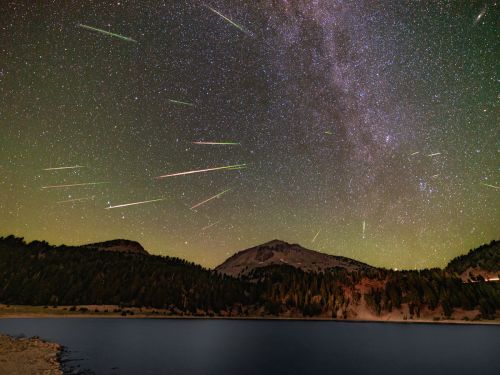
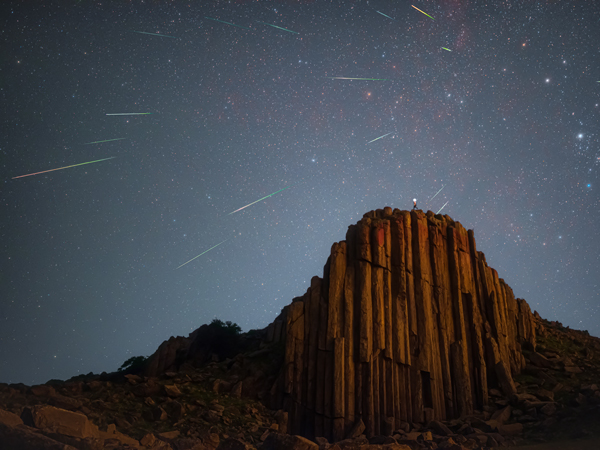
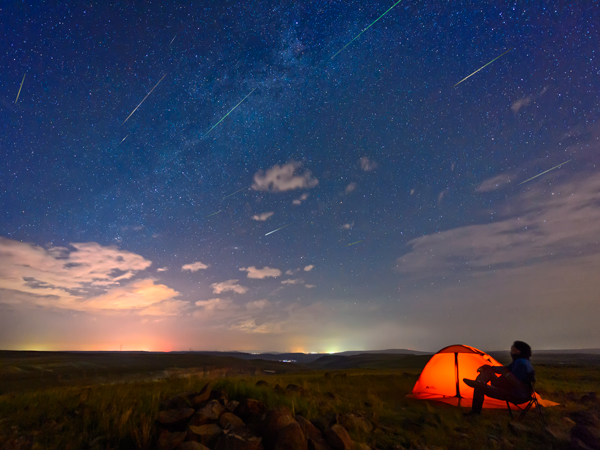
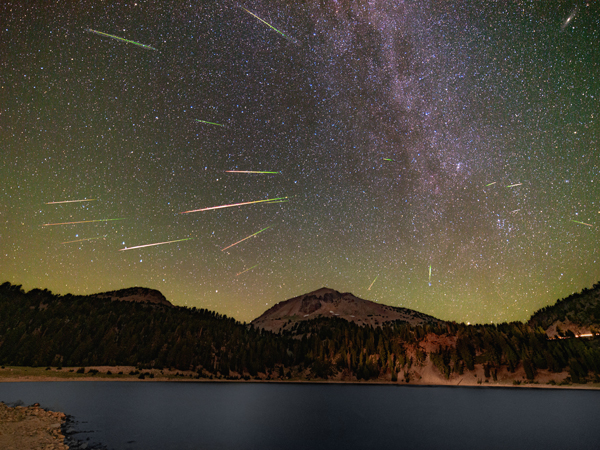
Get ready – the Perseid meteor shower is just around the corner.
The night sky above Australia has been putting on a show this year, with a flurry of interstellar activity on display throughout 2025. But July is really delivering the celestial drama, as the spectacular Perseid meteor shower begins its roughly one-month journey past Earth.
What is the Perseid meteor shower?
The Perseid meteor shower is often dubbed the best of its kind. Characterised by its swift and bright meteors that are visible from both the northern and southern hemispheres, it’s one of the most highly anticipated celestial events around the world.
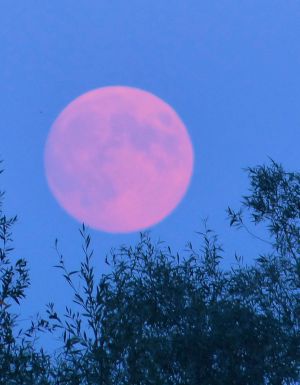
The Perseid meteor shower has been hailed as one of the world’s best. (Image: Getty Images/bjdlzx)
This natural light show has long been a favourite among astronomy enthusiasts, famed for the vibrant trains of light left in its wake and the dazzling fireballs that often accompany it. Not only can us Earth dwellers easily spot it with the naked eye, but we’re also able to make out different colours and sizes.
Compared to other showers like the Lyrids, which usually average 10 to 20 meteors per hour, the likelihood of witnessing the Perseids is extremely high. According to NASA , observers can expect between 50 and 100 meteors an hour – a whopping 400 per cent increase in sighting probability.
When will it be active?
The Perseids originate from comet 109P/Swift-Tuttle, which left a large trail of detritus as it cruised past us back in 1992. When Earth passes through this debris stream during its orbit around the sun, the cometary material collides with our atmosphere. Extreme speeds create air friction, and that, combined with atmospheric compression, causes the objects to heat up, break apart and burn out. That’s what we see during a meteor shower.
The celestial shower is easily visible to the naked eye. (Image: Getty Images/bjdlzx)
Earth enters comet 109P/Swift-Tuttle’s debris trail once a year and takes around a month to fully clear it. This means we’re treated to the Perseids meteor shower every year! While it’ll be visible from as early as 17 July, the best time to witness the celestial show is around mid-August. This year, it’s expected to peak on 12–13 August. This is when Earth passes through the most concentrated part of the debris trail, resulting in the most meteor activity.
Where can I see it?
Australia is home to plenty of prime stargazing spots – from dedicated reserves and observatories to our very own DarkSky-approved stay. But thanks to the Perseids’ spectacular scale, you won’t need to venture far to catch a glimpse. No matter what part of the country you call home, even backyard star-chasers are in for a treat.
Low light pollution is key to the viewing experience. (Image: Getty Images/Jerry Hamblen)
But to get the most out of your experience, a few simple tips and tricks can go a long way. First things first, find a spot with minimal light pollution – the darker, the better. Head outside about 30 minutes before you want to catch the show, giving your eyes enough time to fully adjust to the darkness. The best part? No fancy gear required. You won’t need a telescope or even binoculars – just a cosy blanket, a little patience and an astronomical attitude.
Taylah Darnell is Australian Traveller's Writer & Producer. She has been passionate about writing since she learnt to read, spending many hours either lost in the pages of books or attempting to write her own. This life-long love of words inspired her to study a Bachelor of Communication majoring in Creative Writing at the University of Technology Sydney, where she completed two editorial internships. She began her full-time career in publishing at Ocean Media before scoring her dream job with Australian Traveller. Now as Writer & Producer, Taylah passionately works across both digital platforms and print titles. When she's not wielding a red pen over magazine proofs, you can find Taylah among the aisles of a second-hand bookshop, following a good nature trail or cheering on her EPL team at 3am. While she's keen to visit places like Norway and New Zealand, her favourite place to explore will forever be her homeland.
The charm of Mildura is hidden in plain sight along the Sturt Highway. The capital of Tropical North Victoria is in a league of its own.
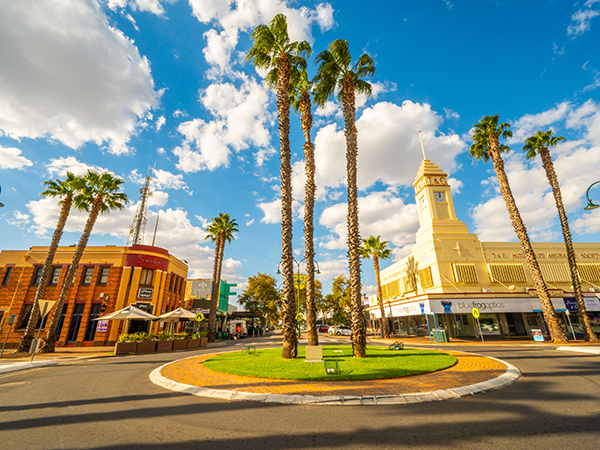
From the moment you arrive in Mildura, the warm air and palm trees invite you to slow down. While most Australians might drive right past it, Mildura is full of surprises. Here you’ll spend one day witnessing over 50,000 years of First Nations history in a UNESCO-listed National Park, and the next dining in a hatted restaurant after wandering through 12,500 fireflies as the outback sunset bursts to life above. From roadside fruit stalls and family-run wineries to houseboats and galleries, it’s time to explore Mildura.
Taste, wander and be surprised in Mildura.
Taste Mildura’s produce
It makes sense to start your trip by addressing the most important question: where to eat. In the beating heart of Australia’s food bowl, sample the local produce directly from the source. And then, of course, experience it through the menu of a hatted chef. Or sandwiched between pillowy slices of Nonna’s ciabatta.
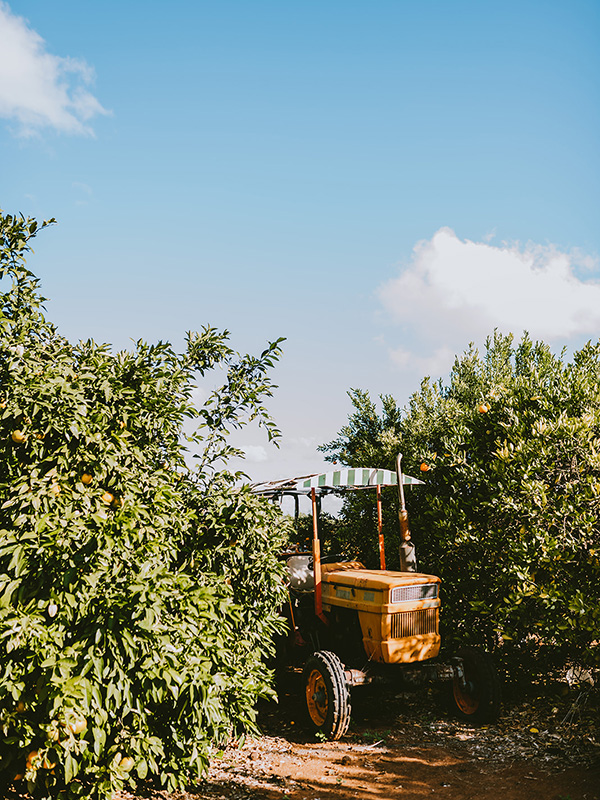
Rows of orchards and olive groves invite you to spend the day traipsing from farm to farm. Taste olives propagated from Calabrian trees brought over in the 40s, oranges picked right from the tree and squeezed into juice and spoons full of honey. Bring the holiday back to your kitchen by stocking your pantry at roadside produce stalls, or calling into the ‘silver shed’ (Sunraysia’s gourmand Mecca).
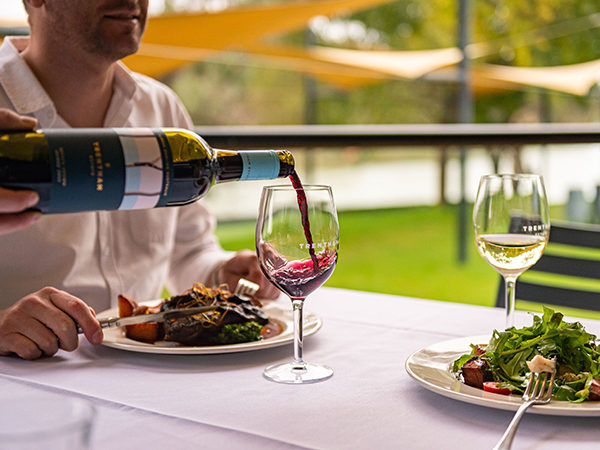
Thanks to the warm, balmy air and fertile soils, the wineries dotted along these hills produce award-winning local wines. Like Chalmers, a family-run, innovative winery dedicated to making their wines as sustainable as possible. And picturesque Trentham Estate offers views of the snaking Murray River as you sample their vintages.
Venture beyond the gnarled shadows of olive groves and fragrant rows of blossoming fruit trees and you’ll find an otherworldly side to Mildura. With Discover Mildura as your guide, visit Murray River Salt’s Mars-like stacks. The naturally pink salt is formed from an ancient inland sea and evaporated entirely by the sun to create one of the region’s most iconic exports.
Start your day with just-squeezed sunshine.
Hatted dining & Italian history
Mildura is home to a proud community of Calabrians and Sicilians. This, paired with the exceptional local produce, means that you can find paninos on par with those in Italy. The Italian is a Paninoteca serving up made-to-order, hefty, authentic Sicilian paninos. Nonna Rosa’s pork meatballs, slowly cooked in tomato ragu and served in a crusty, fluffy roll topped with gratings of Grana Padano cheese and salsa verde, will call you back to Mildura for the rest of your days.
To find hatted dining in Mildura, simply follow the staircase down into the basement of the historic Mildura Grand Hotel to find Stefano’s. Following the muscle memory and instinct of his Italian roots, he delivers on the principle of ‘cucina povera’. That is, the Italian cooking ideology that turns simple, local ingredients into magic.
Bite into Mildura’s Italian heritage.
Discover a thriving culture scene
The city is alive with culture. Whether it’s painted on the town’s walls, told in ancient yarns, or waiting for you in a gallery.
The Mildura Arts Centre was Australia’s first regional art gallery. Behind the walls of Rio Vista Historic House, you’ll find a lineup of ever-changing exhibitions. The gallery’s wall space pays tribute to the art and songlines of local First Nations People, the region’s awe-inspiring landscapes and more. Outside, on the gallery’s lawn, find 12 contemporary sculptures in the Sculpture Park.
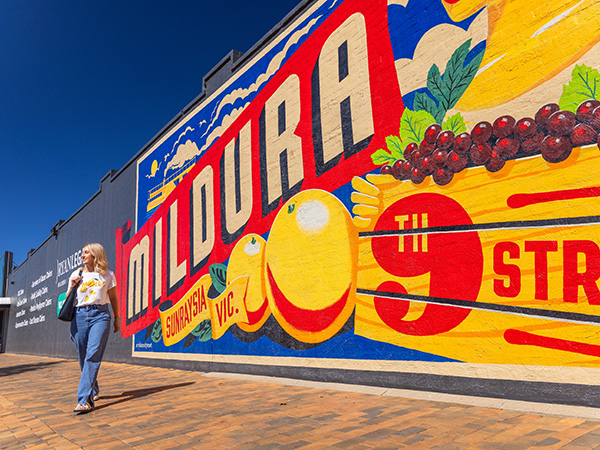
Mildura’s streetscapes are a punch of colour. Swirling strokes of paint blend the winding artery of the Murray River, red dirt and local characters into a story you can see with your own eyes, thanks to the Mildura City Heart’s Mural Art Project. Pick up a copy of the Murals of Mildura guide from the Visitor Information Centre.
Follow the border of NSW and Victoria on a map and you’ll see it hugs the curves of a tiny island on the Murray. That’s Lock Island, where, as the sun and moon trade places, the island comes alive as darkness falls. The island is dotted with 12,500 firefly lights that lead you on a meandering path through the outback sunset. The installation is known as Trail of Lights and was created by the same visionary who dreamt up Field of Light at Uluṟu, Bruce Munro.
Find culture around every corner.
Wonder at ancient landscapes
The landscapes of Mildura feel almost transcendental. The skyline bursts to life with reds, pinks, and deep, sparkly night skies.
The nature will leave you in awe. See hues of pink water changing with the weather at Pink Lakes inside Victoria’s largest national park, Murray Sunset National Oark. Cast a line into Ouyen Lake. Watch the sunset against 70-metre tall red cliffs that reflect the setting sun. Or get the heart racing and sandboard down the Perry Sandhills dunes, formed 40,000 years ago at the end of an ice age.
Just don’t leave without following the twists and turns of the Murray. Stroll or ride along the Shared River Front Path, or jump onboard a boat for a scenic ride.
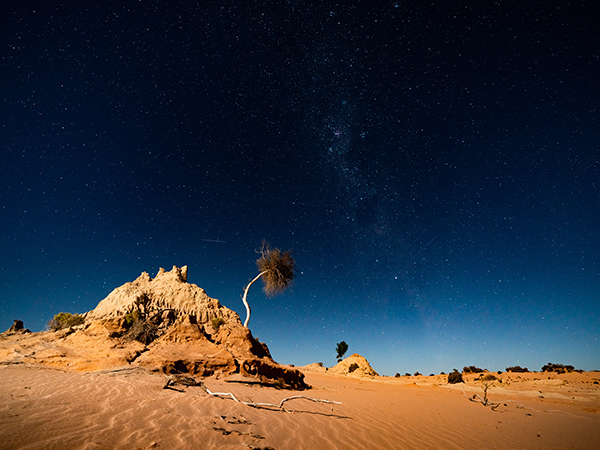
Your itinerary will be incomplete without a visit to UNESCO World Heritage-listed Mungo National Park. Head out with an Indigenous ranger to witness ancient campsites and footprints, before standing in awe of ancient civilisation near the discovery site of Mungo Man—Australia’s oldest human skeleton at 42,000 years old.
Walk in the footsteps of ancient civilisation.
Meet your home away from home
On equal par with planning your meals and adventures, is finding the perfect place to relax at the end of each day.
Sleep inside a Palm Springs postcard at Kar-Rama. A sleek boutique hotel complete with a butterfly shaped, sun-soaked pool. Here you’re staying right in the heart of Mildura but you’ll feel worlds away. Or if you really wish to connect with nature, a night glamping under the stars at Outback Almonds will have you spellbound.
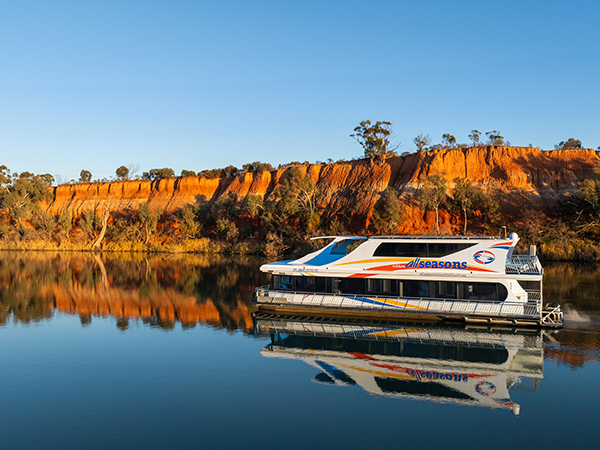
When in Mildura it’s only right to stay on one of the Murray River’s iconic houseboats. Wake up each day to the calm waters of the Murray lapping outside your window. Enjoy days full of river swims, fishing and exploring. All boats are solar-powered and can be self-skippered or moored along the river.
Stay and play on the Murray in a solar houseboat.
Start planning the perfect getaway at mildura.com .