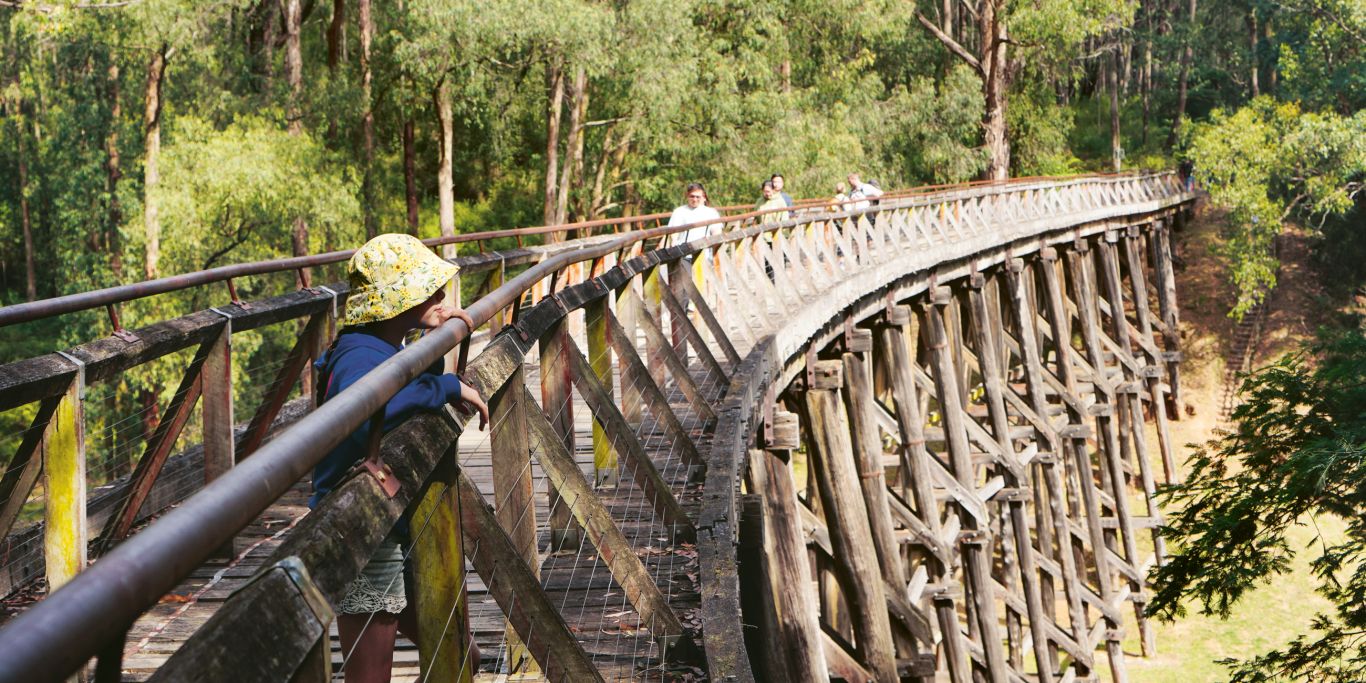

This easy walk leads you to the oldest remaining trestle bridge in Victoria.
An enchanting bridge straight from the pages of Three Billy Goats Gruff (minus the scary troll), the Noojee Trestle Bridge is a bona fide relic from the ‘olden days’. The best part? It’s only a 300-metre walk from the car park, shorter if you don’t complete the entire loop. No whingeing about tired legs here. Follow the rail trail into Noojee, where an old steam train and vintage dress-ups await.
What to expect when you visit
Forget cajoling the kids into walking with the promise of a reward at the end. Here, the attraction can be seen from the car park – a 21-metre-high wooden trestle bridge lording over a valley cocooned by towering mountain ash. The old railway bridge is one of the last remaining timber trestle bridges in Victoria and, despite its rickety appearance, welcomes foot traffic.
Take the steep steps on the right-hand side of the car park to the top of the bridge. Wander along the boards (the bridge is 102 metres long), stopping to take photographs and then loop back down the hill and finish where you started. There is a handrail and wire fencing, so you needn’t worry about little ones slipping through the railings, but be vigilant if you have a climber on your hands.
What is the Noojee Trestle Bridge famous for?
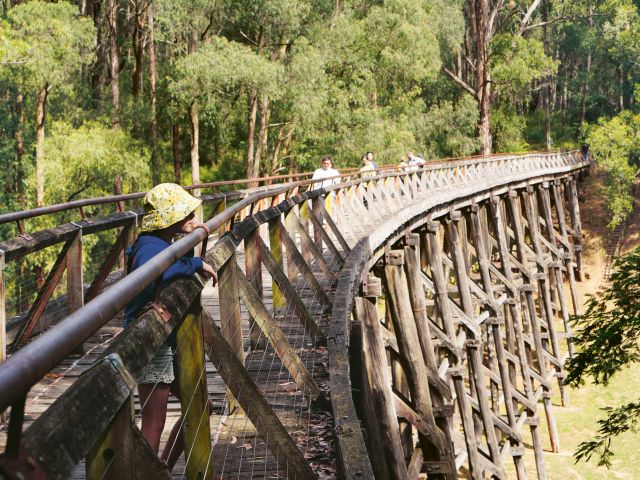
The original bridge was built more than a century ago, completed in 1919 as part of a 42.8-kilometre railway link between the timber town of Noojee and Warragul. Known as Number 7, it was the seventh (and today only remaining) bridge on the Noojee end of the line; affectionately nicknamed ‘Straight Bridge’ because of its comparatively subtle curve.
Twice ravaged by bushfires, the line was integral to Gippsland’s early logging boom, primarily transporting timber, but also livestock, produce and passengers for 35 years. It was decommissioned following a fire in March 1954 – just three weeks after a special train service brought passengers to Warragul for Queen Elizabeth II’s first Australian royal visit. Road haulage had steadily weakened demand, and the line was progressively dismantled, leaving just the Number 7 bridge. It was later bought by the former Buln Buln Shire in 1963 for the princely sum of one pound.
The bridge became a popular tourist attraction until safety concerns forced its closure in 1982. In the 1990s a restoration project was undertaken, replacing rotting timber foundations with concrete and repairing the 19 timber piles. It reopened in 1996 and today attracts about 10,000 visitors a year. Visitation peaked in 2005, when the bridge was lined with tables from end to end to host the ‘World’s Longest Lunch’ as part of the Melbourne Food and Wine Festival. No such feat would be possible today, as it has a maximum capacity of 10 people, so say the signs. But don’t let that put you off – it’s a wonderful family outing.
Need tips, more detail or itinerary ideas tailored to you? Ask AT.
AI Prompt
Is the Noojee Railway Station worth visiting, too?
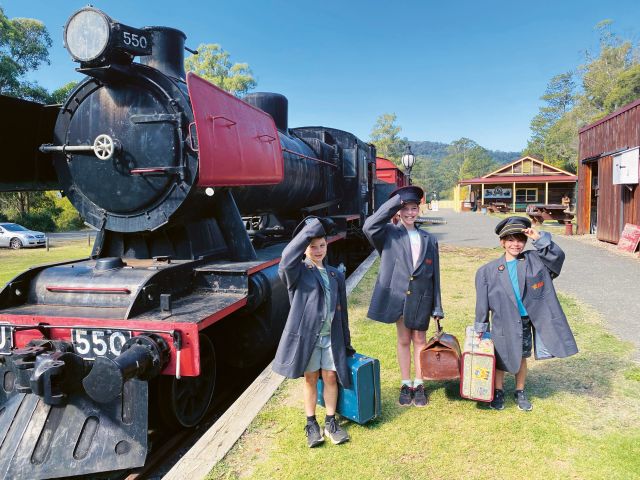
If the kids are feeling particularly energetic, you can extend your walk, taking the old rail trail to Noojee (meaning ‘keeping place’ to the Traditional Owners). It’s a flat and slightly downhill two-kilometre amble (one way), finishing at the replica Noojee Railway Station. If you don’t have the stamina, there’s no shame in driving (we did).
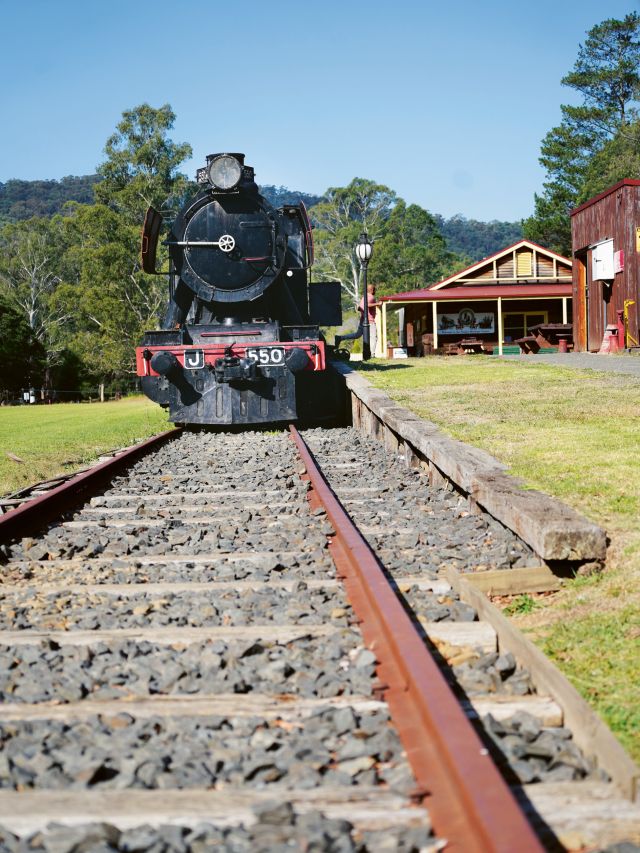
Either way, don’t miss calling in to the Noojee Heritage Centre and Railway Goods Shed to learn more about the timber town, once the beating heart of a 70-kilometre network of wooden tramways ferrying timber from remote sawmills. The highlight is the 1950s J Class steam locomotive. Borrow some stationmaster vintage costumes and luggage from the heritage centre (a donation is appreciated), and let the kids scramble aboard. Admire the chainsaw-carved wooden sculptures on the platform and explore the old machinery. The reserve has a pleasant picnic area with hand-carved timber tables and public toilets.
The details
Where is the Noojee Trestle Bridge?
The Noojee Trestle Bridge is in West Gippsland, about 130km east of Melbourne/Naarm. There’s a car park at the base, five kilometres west of Noojee on the Mount Baw Baw Tourist Rd.
Weekly travel news, experiences
insider tips, offers, and more.
When is the best time to visit?
Warm and sunlit in summer, misty and atmospheric in winter – the bridge is a hit year-round. Check conditions ahead for bushfire risk.
What type of traveller should go?
Everyone, but it is an especially magical family day out.
More information
This is an edited extract from Ultimate Family Holidays Australia by Catherine Best, published by Hardie Grant Explore – out now. For more great ideas, you can order a copy here or at all major book retailers.
Want to see more stories from Australian Traveller in your Google search results?
- Click here to set Australian Traveller as a preferred source.
- Tick the box next to "Australian Traveller". That's it.

Catherine Best
View profile and articles